
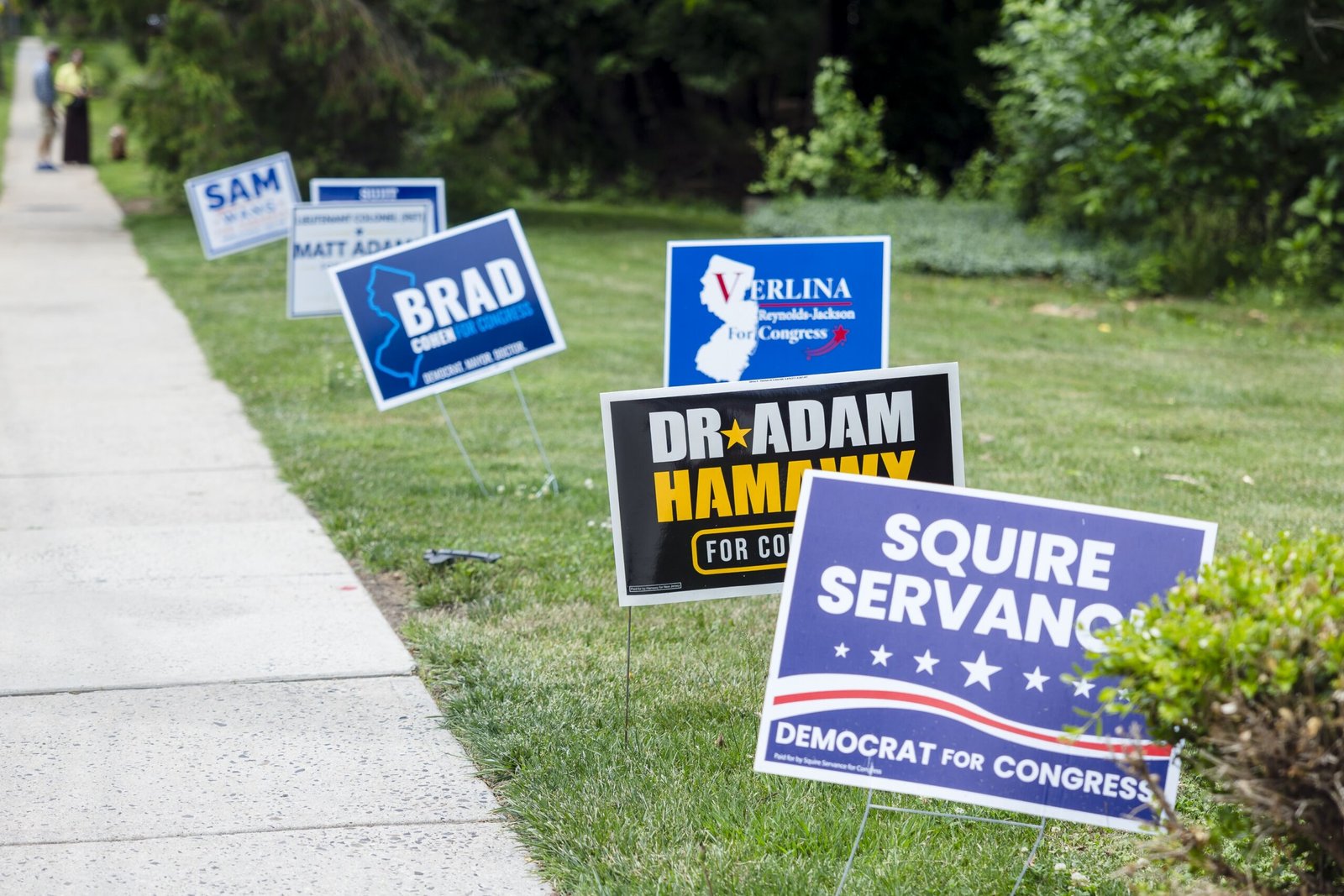
 For the second time this year in New Jersey, a Democratic candidate won a primary election – and likely to come, a full term in Congress – with less than 30% of the vote.
Surgeon Adam Hamawy, a combat veteran, defeated 11 candidates in the 12th District. While he won about 28% of the ballot, close to two-thirds of voters chose a different candidate. The district, represented by Bonnie Watson Coleman, is deeply Democratic making Hamawy heavily favored in the November election.
Hamawy’s primary victory illustrates New Jersey’s evolving politics after the party-line ballot system was snuffed two years ago, a step hailed by democracy activists. At the same time, some advocates say it also is a sign for New Jersey to disrupt the system further.
 Credit: (Hamawy for Congress)
“While it is wonderful that so many people are choosing to run, it is certainly not ideal to have a minority of the voting population selecting who will represent the entire district,” said Julia Sass Rubin, a Rutgers University professor who has done extensive research on the county line’s outsize influence.
Tom Malinowski, a Democrat who represented the 7th District for two terms before redistricting favored Republicans, said New Jersey’s crowded primary field on Tuesday “accentuates the need” for switching to ranked choice, in which voters list candidates by preference.
“I don’t think somebody winning with 25% of the vote in a very crowded field necessarily reflects the true will of the voters,” he said. “Ranked choice would prove it.”
End of the line
In a February special primary for the 11th District, Malinowski finished second of 13 candidates. The victor, Analilia Mejia, bested him by about 1,200 votes and took 29% of the ballot total. She went on to win a special general election and took office on April 20, filling the vacancy created when Mikie Sherrill resigned after winning the November governor’s race.

A court ruling in 2024 led New Jersey to redesign ballots with candidates listed by office sought rather than as a group endorsed by county political leaders and then given top billing. The snuffing of the so-called county line ended an unfair advantage, leading more candidates to run.
“A crowded candidate field is a sign of a healthy democracy,” said Erik Cruz Morales of the League of Women Voters of New Jersey. “When more people believe they have a genuine shot at elected office, more people run and that gives voters real choices based on what actually matters to them. Over the last year, we have seen more candidate engagement, more motivation to compete and more robust public debate.
The result, he said, was “candidates ‘being held accountable to voters, not to a party boss.”
The downside, though, is vote dilution.
“A candidate winning with 30% in a competitive field beats a candidate being handpicked by a political machine in a back room,” Cruz Morales said. “The first scenario reflects a genuinely open contest. The second reflects consolidated power.”
The state must go further, he said. “As multi-candidate races become more common, New Jersey should be looking at structural reforms that make the system more efficient and ensure the winner reflects as much of the electorate as possible.”
‘Money and emotions’
New Jersey is among 36 states whose primary winners are those with the most votes. North Carolina requires runoffs in races whose top performer draws less than 35%, while the bar in South Dakota is 30%.
 Credit: (Sam Wang for New Jersey)
In California and Washington, the top two finishers advance to the general election, and in Alaska, the top four do so.
Sam Wang, a Princeton University neuroscience professor who finished third in the 12th District race, said the best system would be a runoff of the top three or four vote-getters. He favors an all-party primary so that unaffiliated voters could participate.
“A low threshold for winning makes it easier for money and emotions to influence the outcome,” Wang said. “The downpour of outside money in NJ-12 ended up turning the race into a referendum on Middle East policy. I found that voters asked questions on many other topics as well, but those issues got drowned out.”
It’s evident in other states, he said, “that this approach can elect representatives who are more broadly acceptable to voters.”
Hamawy spokesman Vincent Vertuccio said Hamawy, a surgeon, also appealed to voters because of his record of service, including a medical mission to Gaza, and had a broad campaign message that included opposition to tax cuts for billionaires and abolishing ICE and prosecuting its leaders and agents.
Vertuccio said Hamawy supports ranked choice voting.
Order of preference
Nine states require a candidate to meet a threshold – 50% plus one vote — to win. In all but one state, the top two vote-getters compete in a runoff, a system used in several New Jersey cities. Maine alone has primaries involving ranked choice with an instant runoff to determine the winner.
In a ranked-choice system, voters list candidates in order of preference rather than choose one.
A candidate who gets more than 50% of first-choice votes is the winner. If no one gets a majority, the candidate with the fewest first-choice votes is eliminated. Ballots are then counted for voters’ next-ranked choice. The process continues until one candidate has a majority.
The Associated Press created a tool to show how the process works.
Malinowski said ranked choice would solve the problem of the state’s crowded primaries.
“It ensures that votes for candidates with less of a chance to win are not wasted and allows people to vote for their favorite candidate without having to go for their second or third choice for tactical reasons,” he said. “They could vote for someone who likely won’t get more than 3% of the vote because they think they’re really wonderful and then ranks others second, third and fourth, and know that the vote is still going to influence the outcome.”
Ranked choice is used to some degree in 13 states, and most prominently in New York City.
“The most obvious solution is to adopt ranked choice voting, which also would diminish the power of outside money to propel a single candidate to victory,” said Sass Rubin, the Rutgers professor. “At the very least, the legislature could adopt ranked choice voting for congressional races, which have been attracting the largest numbers of candidates.”
Idle legislation
A number of pending legislative bills would compel some ranked choice voting, though none has advanced to a hearing. One, S-1625, was first introduced in 2019.
Malinowski said recent election outcomes may help “change some minds” and lead the Legislature to consider the bills.
Other Democrats privately say the party needs to dissuade unlikely winners from running. That would give the strongest candidates a better chance, they say, and demand less fundraising for races like the 12th, where the Democrats are likely to win in November.
That money could be more strategically spent bolstering Democratic candidates in races like the 7th District, where Republican Rep. Tom Kean Jr. has at least a $2.6 million campaign fund advantage.
“The fall of the county-line ballot system left a vacuum,” said Wang, the failed 12th district candidate. “Losing that system has created a Wild West situation, where anyone can run — and win with less than 30% of primary voters. With a simple plurality voting rule, a determined faction can win.”
Wang pointed to a consequence of the current system.
“The ability to win an election without building a consensus is also how Donald Trump won the presidential nomination in 2016,” Wang said.



