
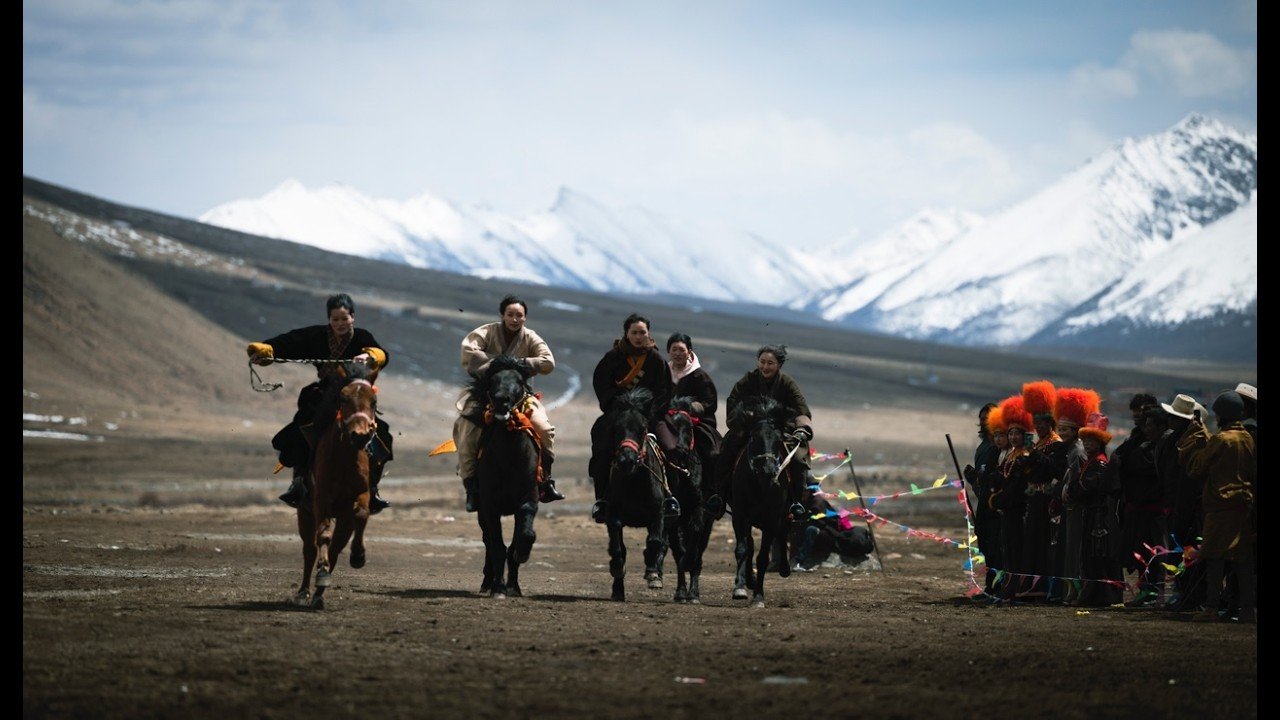
World premiering at the Bishkek International Film Festival, “Released” is a Tibetan drama directed and written by Khabu, who turns a true story from his own hometown into a tale about tradition, freedom, loss and survival. The director first heard about the incident in the area where he grew up and was immediately drawn to the experience of the young woman who inspired the story. He later interviewed her in order to shape the script, while also including her in the movie as one of the six young women appearing on screen. Shot in Litang, an important centre of the Kham region, “Released” also uses its setting to highlight the connection between horses, local identity and life on the Tibetan plateau.
In a small Tibetan village, women have long been excluded from major horse races, particularly those held alongside men. Against this background, Sonam Lhamo, a determined young woman, decides to break with tradition and take part in the competition. Her decision is not simply a matter of personal ambition, since it also places her against customs that have shaped the community for generations. As she fights to participate in the race, she has to confront the doubts of others, the pressure of the village and the weight of expectations surrounding what a woman is supposed to do.
In the same setting, Tsering is a young man who prefers to ride his motorcycle instead of a horse, much to the growing frustration of his father, Dundrop, who is also the leader of the community. Tsering is also in love with Sonam Lhamo, visiting her every day at her home. His father, however, will not even hear about the marriage, considering her a girl who does not uphold tradition. As the two youths try to find space for both themselves and their relationship, tragedy eventually hits.
The focus on realism is quite intense here, with Khabu using villagers and herders for most of the roles. The emphasis is on the presentation of this particular way of life, in which horses play a crucial role, both culturally and practically. In that regard, the horse races throughout the movie, along with a number of scenes in the snow, usually shot from a distance, create a rather appealing amalgam. The sequence with the dead body and the one with the accident also contribute to this approach, which carries the movie for the majority of its duration. Chen Hong’s excellent cinematography plays a crucial role in the aforementioned combination, with his work emerging as one of the best aspects of the feature.
The drama, initially at least, also works particularly well. The two youths who are in love but find themselves facing huge obstacles, the way their relationship is connected with the elders’ refusal to allow women to race, and the role Dundrop plays in the whole affair give the movie a particularly entertaining core. As the story progresses, however, the quality of the narrative deteriorates somewhat. Some forced sentimentality creeps in, while the last part could definitely be briefer. Cui Jian’s editing is an issue in that regard, although the overall pace works well for the most part, mirroring the style of life in the area. Furthermore, the scenes with the horses racing are excellently executed despite their evident difficulty, in the best trait of the technical department. The almost constant music, on the other hand, could have been used less frequently.
Yangchuk Tso, in the role of Sonam Lhamo, definitely stands out in “Released”, both for her acting prowess and for her evident charisma, although the acting in general is on a high level here.
“Released” is a very beautifully shot movie that deals with a significant topic through an approach that connects it nicely with the dramatic core. Some issues here and there prevent it from being truly great, although it definitely emerges as a competent work.



