
As for the tepid run-up to this World Cup? Story after story highlighted the greed of FIFA and the hardening of U.S. borders at the very moment the world was set to arrive. Visas have been denied, or delayed, for a number of staffers, fans, and even players. A referee was denied entry into the U.S. simply, it seemed to him, because he was Somali. One of the host nations is at war with one of the tournament’s participants. The relationship between the U.S., which was set to host seventy-eight games, and Canada and Mexico, which were hosting thirteen each, remained uneasy. Every headline about the World Cup is worse than the last: ticket prices are outrageous, far higher than for any previous World Cup. Cities—and their taxpayers—are on the hook for the lion’s share of expenses. New York and New Jersey are fighting over who goes first on signage. Hotels are reporting unexpected vacancies. There is an unmistakable feeling that a great mass of fans are priced out, or fenced out, while wealthy sponsors and venal bureaucrats get the benefits. It was hard to say who the World Cup was for, or where it was taking place, or what it was even supposed to represent.
And yet, when the World Cup gets going, the story could change. The run-up to Qatar, four years ago, was a humanitarian disaster. By the time the tournament was over, it was considered one of the best World Cups of all time. Perhaps Americans will delight in the sight of thousands of Dutch supporters, clad in orange, marching through Kansas City, or legions of Germans following a young man playing a saxophone, or the Scottish fan who walked three thousand miles from California to Boston, to raise money for mental-health awareness in his home country and attend the Haiti-Scotland match. Only twenty-nine per cent of Americans describe themselves as “interested” or “very interested” in the World Cup, according to a YouGov poll. Fifty-nine per cent say that they don’t plan to watch any games. But the collective attention of Americans is fickle, and prone to sudden excitement. The country is also big enough that even thirty per cent of the population—around a hundred million people—is equivalent to the entirety of many other sizable nations. Spark enough interest, and you’ll have a conflagration.
“We joke on our shows that soccer is America’s sport of the future, as it has been since 1972,” Bennett said. “It’s always perpetually about to be the next big thing.” But this time, this World Cup, would be different, he insisted. “I do believe we’re in that moment where it is about to become the sport of the now, and this World Cup should cement it.”
Perhaps he was right. On Thursday, as the World Cup kicked off in Mexico City, where Mexico defeated South Africa, and then South Korea came back to beat Czechia, I started to hear reports of Scots in kilts roaming the streets of Boston. There was a man wearing a chicken costume and a Brazil jersey, and dancing to music from a boom box, at the Cortlandt Street R station in New York. “Should we all go to France-Norway on 6/26? I think the answer is hell yes,” one of my friends texted our group chat.
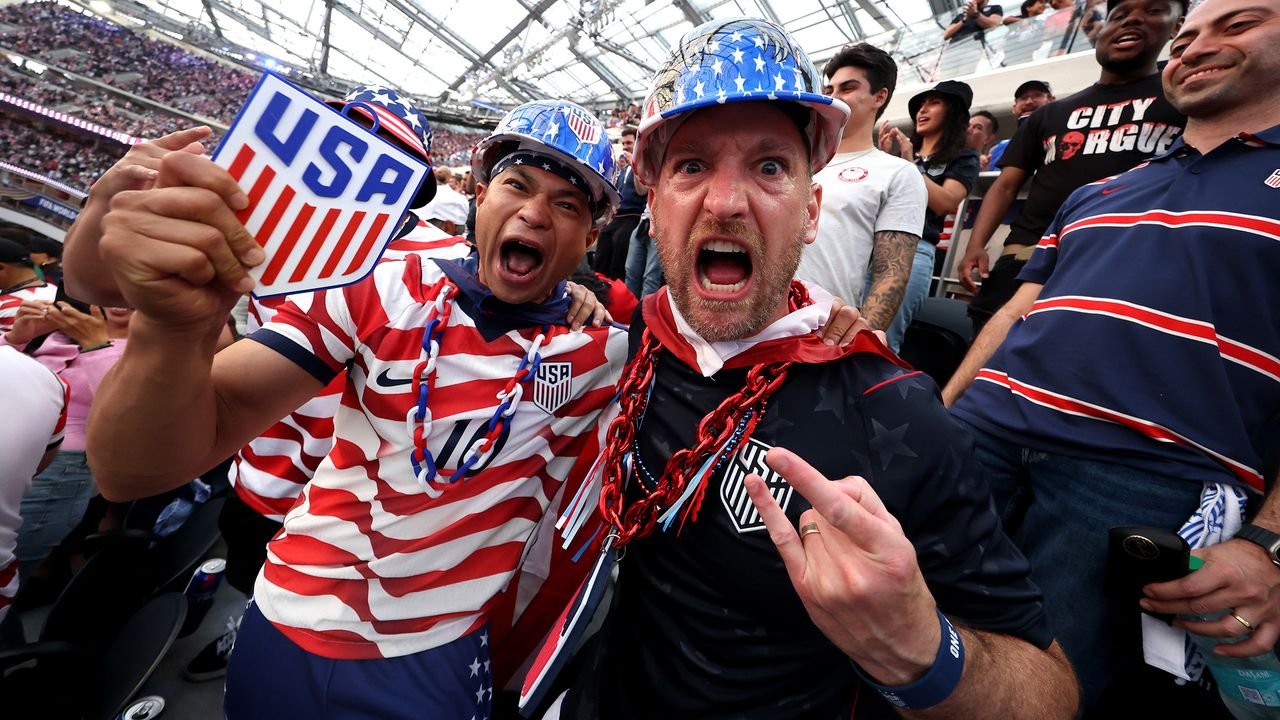
But I wasn’t hearing the same kinds of stories about fans of the U.S. team. The U.S.M.N.T. has a sizable following, led by a fervid group of supporters who call themselves the American Outlaws. But a lack of success in the biggest tournaments has kept it niche. Many American soccer fans root for teams from their ancestral homelands, and so even when the team plays in the U.S., its supporters are often outnumbered. The bet was that those days were over. But it wasn’t obvious to me that Liverpool fans in Brooklyn and Barcelona fans in Atlanta, people who revered Manchester City’s Erling Haaland (who plays for Norway) or Real Madrid’s Jude Bellingham (England), would transfer their allegiances to the U.S.M.N.T. during the World Cup, especially at such a divided moment in this country. “Hardcore soccer fans can recite the starting eleven,” Cantor had told me earlier in the week. But casual fans might only manage a few, he said. It didn’t help that so many of the stories surrounding the team and the tournament reflected division, exclusion, and uncertainty.



