
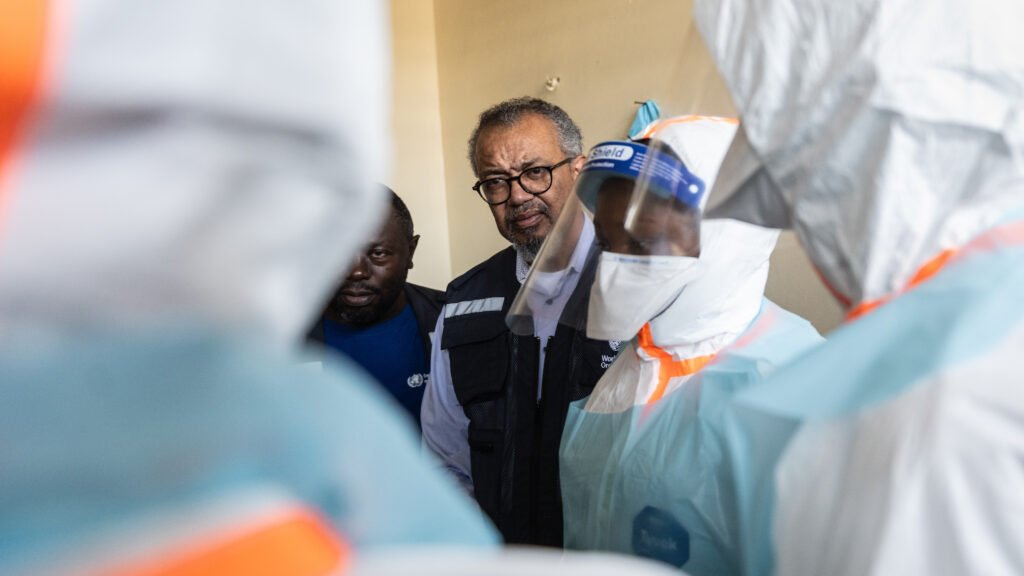
The director-general of the World Health Organization is “really worried” about the Ebola outbreak in the Democratic Republic of the Congo and Uganda, already the third largest on record.
In an exclusive interview with STAT, Tedros Adhanom Ghebreyesus described the conditions he saw after returning from his second visit to the affected area since the outbreak was declared on May 15, and designated a public health emergency of international concern on May 17. Already there have been at least 708 confirmed cases combined in the two countries, 141 of whom have died.
WHO staff in the field in the DRC have faced death threats. Surveillance of contacts of cases remains well off what is needed to contain an outbreak — on June 11, only 28.4% of the contacts of known cases had been followed up. People on the ground told the WHO leader they either don’t believe Ebola exists, or that it isn’t one of their top concerns.
“When the community is not taking it as its priority, it’s very hard,’’ Tedros said in a rare one-on-one interview with STAT.
He recalled a discussion he had with some community leaders who pressed him on why the world only cares about their region when there is an Ebola outbreak underway. With long-standing conflict, hundreds of thousands of displaced people, widespread hunger, and a multitude of diseases that kill more frequently than Ebola does, the conclusion some have reached is that the rest of the world only cares because it’s afraid Ebola will spread beyond the DRC’s borders.
“Ebola is a lesser evil. That’s how they put it,” Tedros said.
Uganda enjoys political stability and has significant experience containing Ebola; the outbreak there at present seems largely under control, with only 19 confirmed cases and two deaths among confirmed cases so far. But in northeastern DRC, the deadly disease is circulating unchecked.
This transcript of the conversation was edited for length and clarity.
What did you hear from people on the ground in the outbreak zone in northeastern DRC?
Why don’t you ask us how many people have died due to other health problems? Or how many people die due to armed conflict? For us, probably Ebola kills less or it’s less of a problem. Malaria probably kills more. Armed conflict kills more.
So what’s the answer, Dr. Tedros?
So the answer is, there is no peace. Their livelihood is affected chronically. And for them, Ebola is not even a priority. They actually wonder why we are serious about Ebola and not the rest of their suffering.
So forget about case reporting, even now collaboration for surveillance. They don’t care. They even think that this Ebola is a conspiracy. It doesn’t exist. It’s a hoax. And even, they say, foreign forces are inventing this to make money for themselves.
There is no surveillance. There is no health system. And people who have been trained [in how to detect and treat Ebola patients safely] some years ago, due to the 2018-2020 Ebola outbreak in the region, are not even in place anymore.
That’s what I was wondering, if there was sort of a carryover of knowledge from the 2018-2020 outbreak.
It doesn’t exist because people are afraid for their lives. Anything can happen to them. They could die because of other things. Ebola is the least killer. That’s what they think.
They were even saying, some of them who know about the 2018 outbreak: You invested a lot of money then. So you contained it. You prevented it from coming to you. But what did we get in return? They said: Nothing.
That’s the problem now.
They see the other health problems they have. Many are dying every single day. And they also see those who are dying because of conflict. So the numbers they see of people dying [from other causes] dwarfs what they see because of Ebola.
I would have thought that because of 2018-2020, there would be some sort of residual memory of Ebola there.
Not much. Because of the chronic nature of conflict there, people really move. And even if there is memory, people are completely demotivated and overwhelmed, because of all the health problems there.
How does the world solve that?
So when I spoke to the leaders, to Félix Tshisekedi [president of the Democratic Republic of the Congo] and Yoweri Museveni [president of Uganda], what the people want is peace. They’re sick and tired of the chronic war, for several decades. They’re poor. They’re displaced. They’re hungry. And they want their livelihood back.
I checked the number of deaths because of the armed conflict since January 2026, the last six months only. And the number of Ebola cases is too small compared to the civilian deaths due to the conflict. Why would they care about Ebola when they’re dying more because of other problems, whether it’s health problems or conflict?
So if we’re going to address this, how do we address the other challenges?
I don’t know how one does that.
I think it’s a political solution.
There should be a political solution, otherwise, if conflict continues to rage in the region, then I don’t think surveillance can improve. And unless other health problems are addressed, it’s very difficult.
By the way, they even said, OK, you invest a lot of money, and you know, even senior people come to us when Ebola comes. But you’re coming to prevent Ebola from coming to you to stop it here.
It’s not because you want to save our lives. It’s not for us, it’s for you.
Help us with Ebola, fine. Help us with our other health service needs. And help us with humanitarian assistance like food. They’re hungry; they need food aid. And then whatever we invest in now should also strengthen the health system.
In this part of DRC, it’s not just one armed gang, there are many. That’s going to be a major challenge, no?
It could be difficult, but talking to them directly, through several means, especially from the community, from the political leaders, they may hold their fire. But I don’t think that’s an easy one because as you said, it’s many of them. And God knows how you can even communicate with some of them. They’re deep in rural areas and there’s not really that much in communication with the rest of the world.
So it sounds like you think this is going to be a very difficult outbreak to contain.
Yeah, I’m really worried.
Our contact tracing rate is now around 50%. It should reach 95%. The virus is ahead of us. Because there is community mistrust, and the community is not collaborating. They actually hide some of the people.
Their displacement is high, and you can’t find the people.
What was your response to the people you spoke to who dismissed the importance of Ebola and the wider world’s interest in containing this outbreak?
I’m not here to dictate. I’m not here to tell you what to do. I’m here to listen to you, because you live here every single day.
You know your problems. You know the solutions. So I’m here to listen to you and support you based on what you say your problems are and what your solutions are.
That brings some understanding.
You were acknowledging their reality.
Exactly. So we need to have a solution for all the problems.



