
“I’m so sorry I’m late,” I said, slipping into the exam room.
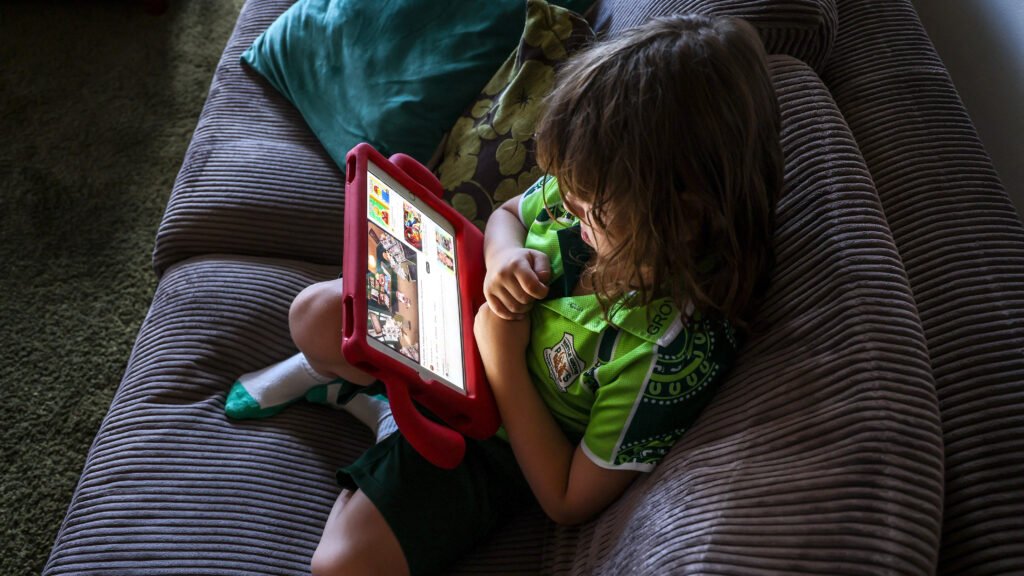
The boy sat perfectly still, watching “Bluey” on an iPad propped against his stroller.
His mother looked exhausted. Coffee untouched. Diaper bag spilling open on the floor.
“It’s fine,” she said. “He didn’t even notice.”
I didn’t judge her. I couldn’t. I’ve handed my own toddler my phone at the dinner table more times than I’d admit to myself or my colleagues.
What I’ve learned, as both a pediatrician and a parent, is this: Many physician recommendations aren’t wrong. They’re just not livable.
We finished the visit. Milestones, nutrition, sleep. And then, the moment that always comes: screen time. She hesitated. “Maybe two hours a day. More on weekends,” she added quickly.
She said it in that quiet way people confess things to doctors.
I hear this confession several times a week. And every time, I’m supposed to respond with the same guidance: limit screens. Avoid them in young children. Prioritize real-world interaction.
The evidence behind that guidance is real. Early passive screen exposure has been linked to language delays, attention problems, and social difficulties. A study in JAMA Pediatrics found that higher screen time in early childhood was associated with poorer developmental screening scores by age 2. I have seen this in my own practice: toddlers who can’t sit through a picture book, elementary schoolers flipping through YouTube Shorts with the glazed focus of a slot machine player.
But if you look closely at the data, a more important pattern emerges. The problem isn’t screens. It’s passivity.
Development in early childhood is built on something deceptively simple: back-and-forth. A child babbles, a parent responds. A toddler points, an adult names the thing. A kid asks “why?” for the eighth time and someone answers, again. Developmental scientists call this “serve and return.” It is the engine of language acquisition, emotional regulation, and social cognition.
When a child sits in front of content that asks nothing of them — no response, no prediction, no interaction — that engine goes quiet.
We counsel parents to co-view for exactly this reason. And it works. Studies consistently show that when a parent watches alongside a child — pausing, narrating, asking “what do you think happens next?” — the developmental outcomes look completely different. The screen becomes a tool, not a drain.
But we also know the truth: Parents cannot do that all the time. Not while making dinner. Not after a 10-hour workday. Not when you’re parenting alone and just trying to survive the hour between daycare pickup and bedtime. For many parents, screen time is a much-needed break and sometimes the only way to make it to the end of the day.
So we are left with a gap between what we recommend and what families can actually do. And for years, I’ve had nothing to offer for that gap. I’d give the guidance, watch the mom nod politely, and move on, knowing nothing would change.
I’m done doing that.
Because I think there is a solution. And it’s not the one anyone expects from a pediatrician.
It’s AI.
Let me explain.
Video streaming and social media companies did not set out to design passive screens for children. They built systems optimized for maximum engagement — recommendation algorithms, autoplay, short-form video — and children adapted to them. Now we are seeing the consequences. But we’ve been here before.
When television entered American homes, the fear sounded remarkably familiar: It would erode attention, replace human connection, harm children in ways we didn’t yet understand. And those fears weren’t entirely wrong. Much of children’s TV was terrible.
But instead of rejecting the medium outright, a group of educators and developmental psychologists asked a different question: What would it look like to use this technology well?
The result was “Sesame Street” — built around specific developmental goals like letter recognition, counting, and emotional vocabulary. Every segment was tested with real children and revised based on whether they actually learned. The show narrowed the school-readiness gap for low-income children in ways that decades of policy had failed to do.
The geniuses behind “Sesame Street” didn’t reject the medium. They disciplined it.
We are standing at that same critical point again. With one key difference: For the first time, the technology itself can respond.
A well-designed AI doesn’t just show content. It can wait for a child to answer. It can ask “what do you think happens next?” and adjust based on the response. It can model emotional language — “it sounds like you’re frustrated” — the way a skilled preschool teacher might, except at 10 p.m. when no parent has the energy left. It can simulate serve-and-return. Not perfectly. Not the way a loving parent does it. But infinitely better than a two-hour autoplay queue, which is what millions of children are getting right now.
Unfortunately, that AI does not yet exist.
Most products on the market today are built to maximize engagement, not development. They are optimized for time on screen, not for language acquisition or attention or emotional growth. The incentive structure is identical to the one that gave us infinite scroll and autoplay. The fact that the user is 3 years old doesn’t change the business model.
That is a design choice. And it can be changed.
Children will use AI. They already do. So physicians, technology companies, and parents must work together to shape these tools before they shape development.
Pediatricians have been clear about screens. The American Academy of Pediatrics has detailed guidance on screen time, co-viewing, and early media exposure. On AI for children, however, there is almost nothing.
Perhaps that’s understandable since the technology is new, sprawling, and changing by the month. But that’s exactly why this is the moment to engage: Pediatricians can shape the technology while it is still taking form. AI is moving quickly into children’s daily lives, and our silence is striking. This is a moment to lead. So far, we haven’t.
AI for children should be built with the same seriousness as any other pediatric intervention. I want an AI designed around the milestones I counsel on at every well-child visit: vocabulary, turn-taking, narrative comprehension, emotional labeling. I want it to adapt not just to age, but to each child’s individual pace. I want it built with pediatricians and developmental scientists in the room from the beginning — not consulted after launch as a PR exercise. And I want it tested with the same rigor we apply to anything that claims to help children: randomized controlled trials measuring real developmental outcomes, not engagement metrics.
We do not let pharmaceutical companies release drugs for children without pediatric trials. We should not let technology companies release AI for children without equivalent evidence.
To the companies building these tools: Build this with us. Optimize for growth, not engagement.
To my fellow pediatricians: We need to stop counseling avoidance of a technology we cannot realistically remove and start demanding something better.
Because parents are not failing. They are adapting. The mother in that exam room did not turn to a screen out of neglect. She turned to it because it worked. Because it made an impossible moment manageable.
I don’t want to tell her to turn it off.
I want to tell her what to turn on.
The future should be pediatrician-prescribed AI.
Dua Hassan is a physician at Boston Children’s Hospital. She researches AI applications in pediatric cardiology, advises on child-centered AI, and writes about medicine for general audiences.
Source: www.statnews.com



