
Last fall, Rep. LaMonica McIver raced back to Washington, D.C., when House leaders announced a vote on a bill to reopen the federal government following a prolonged shutdown, a vote that came just hours after McIver underwent her fourth surgery for uterine fibroids.
Millions of New Jerseyans struggle with uterine fibroids, benign but painful and potentially debilitating tumors that impact at least two-thirds of all women by the time they are in their 50s and 80%-plus of Black women. Some live with the pain and heavy bleeding but are never diagnosed. Many women never receive treatment; for those who do, it most likely involves surgery.
McIver, a Newark Democrat, said she counts herself lucky to have been diagnosed early.
“It’s like, hey, I have a disease, but no one can give me a real answer of why it’s happening, especially in Black and brown women, who are dealing with this at high numbers and just cannot get answers,” McIver told the New Jersey Monitor.
McIver said women need to feel comfortable talking about these issues and healthcare providers need to do more to educate patients on their options, particularly younger women who may not fully understand the impact fibroids can have on their lives.
It’s a topic some doctors in New Jersey are also focused on, hoping to raise awareness around uterine fibroids so more women can be diagnosed and more options are made available to those who seek treatment. Two Democrats in the state Legislature are also looking to boost research and treatment options with state funding.
“The most important thing is for a patient to be their own advocate,” said Dr. Eric Liberman, an OB/GYN who leads a specialized fibroid center that opened in February at Holy Name Hospital in Teaneck. “Education is key. Education is power.”
Liberman tells patients that monthly bleeding that lasts more than a week, includes blood clots, seeps through clothing, or involves back pain or excessive cramps could be a sign of fibroids, even if it’s normal for them or common among female relatives. Women experiencing these symptoms should talk to their doctor, he said.
Dr. Pratik Shukla, an associate professor of radiology at Rutgers New Jersey Medical School, said some women are bed-bound during their monthly period.
“It could get very extreme, where about half our patients that present at our clinic are victims of anemia,” Shukla told the New Jersey Monitor, adding that some say they are short of breath.
“The very extreme is many of these women actually require blood transfusions,” he said.
Liberman, an expert in minimally invasive surgery, said in some cases doctors could help by asking better questions and by better understanding the symptoms and effects of fibroids. He credits Holy Name for recognizing the need for a dedicated center.
“A lot is done in silos” within healthcare, Liberman said.
Expanding the science around uterine fibroids is a mission of Assemblyman Kenyatta Stewart (D-Passaic), who is also eager to raise public awareness around the condition. He introduced a bill in May that calls for the state Department of Health to develop a $5 million grant program to fuel fibroids research and to fund a statewide public awareness campaign.
Women are strong, Stewart said, but he urged them not to ignore the warnings.
“Trying to thug it out and get through it, you may be putting yourself in more danger,” he told the New Jersey Monitor. “Listen to your body. It’s OK to say something is not right.”

Stewart said he was motivated to introduce the bill by stories he’d heard from family and the community. In addition to advancing diagnosis and treatment, he hopes the measure will help reduce the stigma around a highly personal condition.
“People in the Black community, we are a prideful people,” Stewart said. “We need to give people a safe place to open up.”
Stewart said he envisions a government-funded grant program that would support not just clinical research, but also nonprofits and community groups working on the ground to raise awareness about fibroids and connect people with care.
“There’s often an invisible wall between government and community,” he said.
His district mate, Sen. Benjie Wimberly (D-Passaic), sponsored the same measure in the Senate. Neither has been heard by the Legislature’s health committees.
McIver agreed that more needs to be done to expand the science around fibroids.
“There’s not enough research, and there’s not enough dollars being put into it. There’s not enough care around preventing this, or even finding out why it’s happening,” she said.
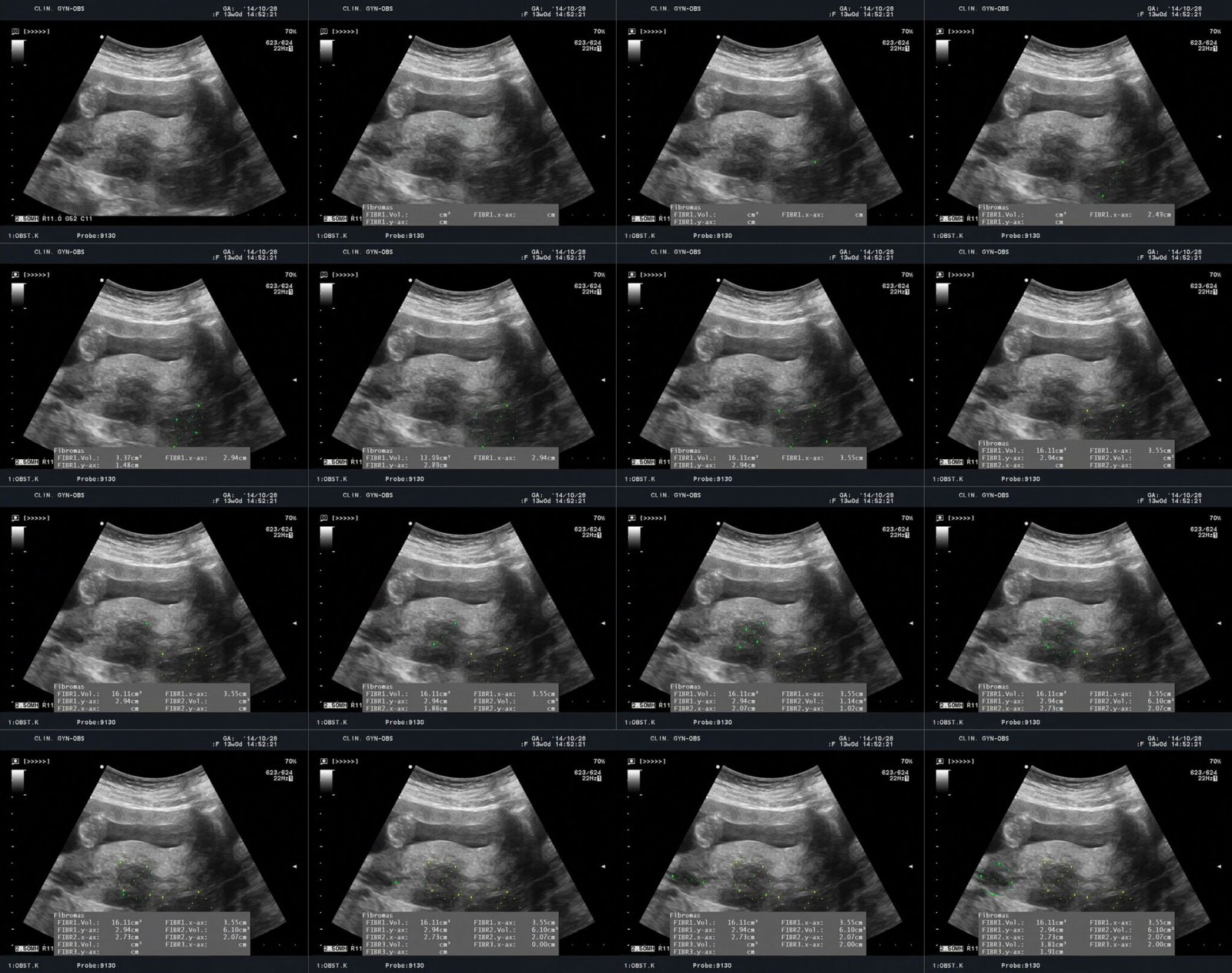
When women are suffering from symptoms that could be fibroids, doctors said the first step is to fully understand the scope of the problem. A diagnosis requires imaging, which reveals the size, number, and placement of the growth.
Many women have multiple tumors, but roughly 1 in 4 patients is driven to seek treatment, Liberman said.
“It’s very important for every woman to have a thorough evaluation to figure out what’s going on with them,” he said.
The treatment for fibroids depends on multiple factors, doctors said, including family history, the size and location of the tumors, and whether the patient wants to have a baby in the future, a choice that excludes several options, including a hysterectomy or removal of the womb. Hysterectomies can be done in several ways, and they remain the most common treatment for fibroids.
“I think the biggest fibroids we’ve treated are the size of a small watermelon,” said Shukla.
Shukla performs uterine fibroid embolization, a minimally invasive treatment, at University Hospital in Newark. He launched a fibroid embolization work group at the Radiology Health Equity Coalition, a program of the American College of Radiology, to help spread the word about the procedure, an outpatient operation that he said typically involves a few days of recovery time.
Through the work group, Shukla said he has partnered with medical schools in urban communities in six states — including Rutgers New Jersey Medical School in Newark — to train students to educate members of the community about fibroids and treatment options, as part of the volunteer responsibilities.
“What we really need in these communities is a boots-on-the-ground effort,” Shukla told the New Jersey Monitor.
Treatment options also include hormone therapy, as estrogen and progesterone impact the growth of fibroids. Women who want to have children can opt for a myomectomy, in which doctors scrape out the tumors and leave the womb in place.
Patients may have more choices for care, but a study published by the National Institutes of Health in April showed social determinants of health — things like ethnicity, economic status, and education level — may also impact the care women receive for fibroids.
The study, by Mayo Clinic researchers, said patients are more likely to get invasive fibroid treatments if they are Black, poor, have limited education, or live in rural areas, when compared to other patients. The study involved data from more than 133,000 people aged 15 to 55 who sought treatment between 2010 and 2023.
McIver, who has undergone four myomectomies, some more invasive than others, said these racial disparities are connected to the gaps in maternal mortality in New Jersey, where Black women are nearly seven times more likely to die — and Hispanic women 3.5 times more likely — than white women during pregnancy, birth, or the postpartum period. Some of this reflects a lack of cultural understanding among healthcare providers, she said, but it illustrates the way some doctors dismiss Black women’s concerns.
“Doctors have to focus on educating women about the possibilities of what could be happening to their bodies and making sure that they’re getting all of the care that they deserve, to make sure that everything has been ruled out,” she said.
GET THE MORNING HEADLINES.



