
Peter Shane, a constitutional-law scholar at New York University, told me, “I wondered if Trump understood that he wouldn’t be the center of attention. The Chief Justice wouldn’t be staring him in the eye, there’d be no television cameras on him. That is not usually his cup of tea.” In the end, there were no disruptions, not even when Trump walked out after the government’s lawyer made his presentation and before the opposing lawyer, from the A.C.L.U., had got very far into hers. The Justices seemed to avoid even glancing at the President.
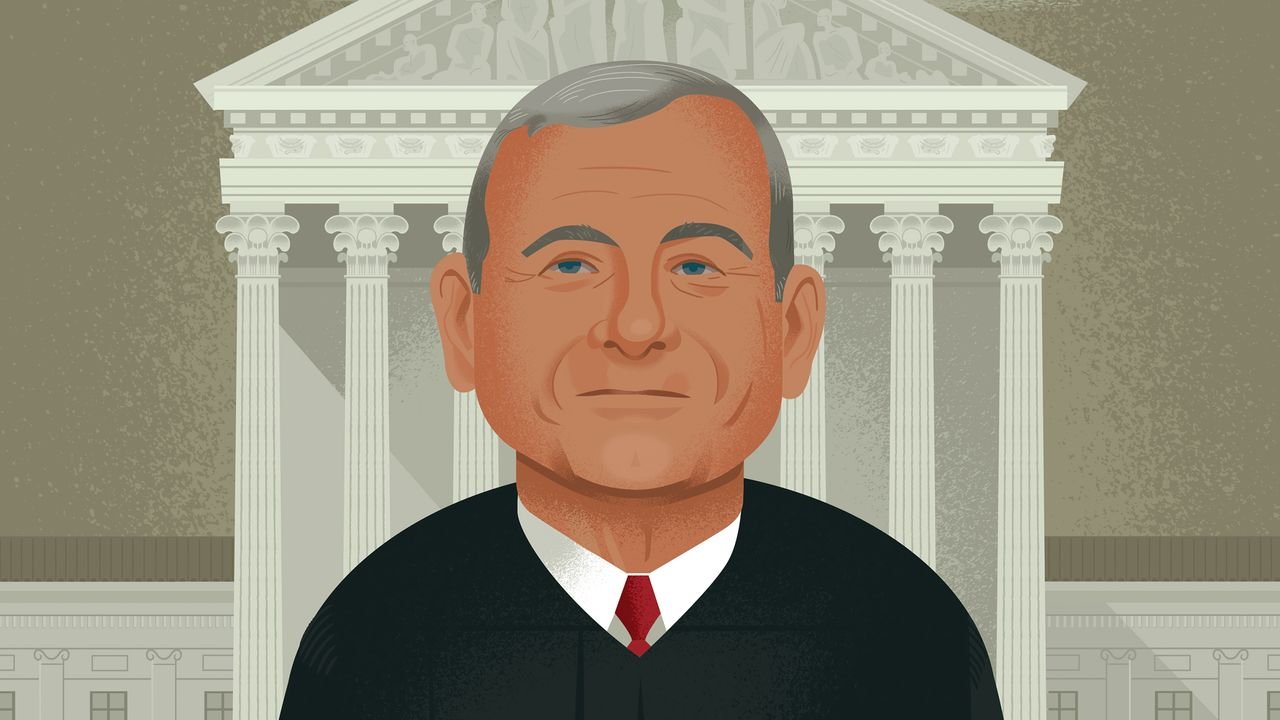
Still, it was another profoundly strange moment in a profoundly strange time for the Court—especially for the seventy-one-year-old Chief Justice, John Roberts. Twenty-one years into his tenure, he keeps waking up, “Groundhog Day” style, to the same ironic scenario: he’s a proponent of maximal Presidential authority who is compelled to deal with a President especially likely to abuse it. (Roberts, a George W. Bush appointee who is reflexively polite, with a self-deprecating sense of humor, probably wouldn’t even enjoy a round of golf with Trump.) Roberts has leveraged his mild persona to defend the Court’s political neutrality at a time when Americans increasingly see it as partisan; according to a recent poll by the Pew Research Center, more than half hold an unfavorable view of it—a near-historic low. Whereas Roberts likes to stress that the Court is fundamentally nonpartisan and frequently unanimous—the Justices agree around forty per cent of the time, though typically on minor issues—many Americans believe that he has presided over a rightward march in the Court’s jurisprudence, on such issues as affirmative action, immigration and asylum, abortion, voting law, gun rights, and the separation of church and state. And, with a few high-profile exceptions, such as the tariffs case, his Supreme Court has overruled lower courts to permit much of Trump’s second-term agenda to proceed. This has often happened without explanation, because the decisions have been issued on the emergency, or “shadow,” docket—that is, decided without a full briefing, oral arguments, or detailed opinions. Of the thirty-five requests for emergency action made by the second Trump Administration—on everything from defunding scientific research to allowing people to be deported to “third countries” where they have no affiliations—the Court has ruled in the Administration’s favor, in part or in full, twenty-five times, generally with the three liberal Justices, Sonia Sotomayor, Elena Kagan, and Ketanji Brown Jackson, in dissent. Among the fifty-six cases fully briefed and argued before the Court this past term, there were 6–3 splits between the Republican and Democratic appointees in thirteen rulings, compared with six last term.
To some observers, the fact that the Court ruled against the Trump Administration in a few major opinions—including, it turned out, the birthright- citizenship case—was a reassuring affirmation of Roberts’s view that it operates outside the realm of politics. Trump’s theatrics fuelled this impression: his clumsy attempts to tip the balance obviously failed. William Baude, a law professor at the University of Chicago, argued in the Times that the Roberts Court was “one of the most independent” he could “imagine at this stage of the second Trump administration.” Yet the term was overwhelmingly favorable to the President, and, though the final rulings certainly matter, of equal importance is the Court’s choice of which cases to take up in the first place. Steve Vladeck, a law professor at Georgetown, pointed to the Court’s handling of Louisiana v. Callais, in which the conservative majority gutted portions of the Voting Rights Act. Vladeck noted that the Court could have treated the case—involving Louisiana’s creation of a majority-Black voting district—as a smaller dispute, but instead it ordered the parties involved to re-argue the case as a broad test of the constitutionality of weighing race when redistricting. Vladeck said, “A big theme of this term is all these times when the Court could have looked like it was above politics but chose to lean in. This is the one institution left in the country that had a chance to say, ‘We have long-term principles’—and instead it got swept up in the political moment.”
Roberts has offered the occasional courteous rebuke to the President’s public trashing of the judicial branch. In 2018, after Trump dismissed a district-court judge who’d rejected one of his asylum policies as an “Obama judge,” Roberts declared, “We do not have Obama judges or Trump judges, Bush judges or Clinton judges. What we have is an extraordinary group of dedicated judges doing their level best to do equal right to those appearing before them.” Even those lofty, carefully considered remarks rankled Trump. At the Easter lunch that year, he said, “ ‘There is no Republican judge and there is no Democrat judge,’ a certain person says. And I say you’ve lost all credibility when you say that.”



