
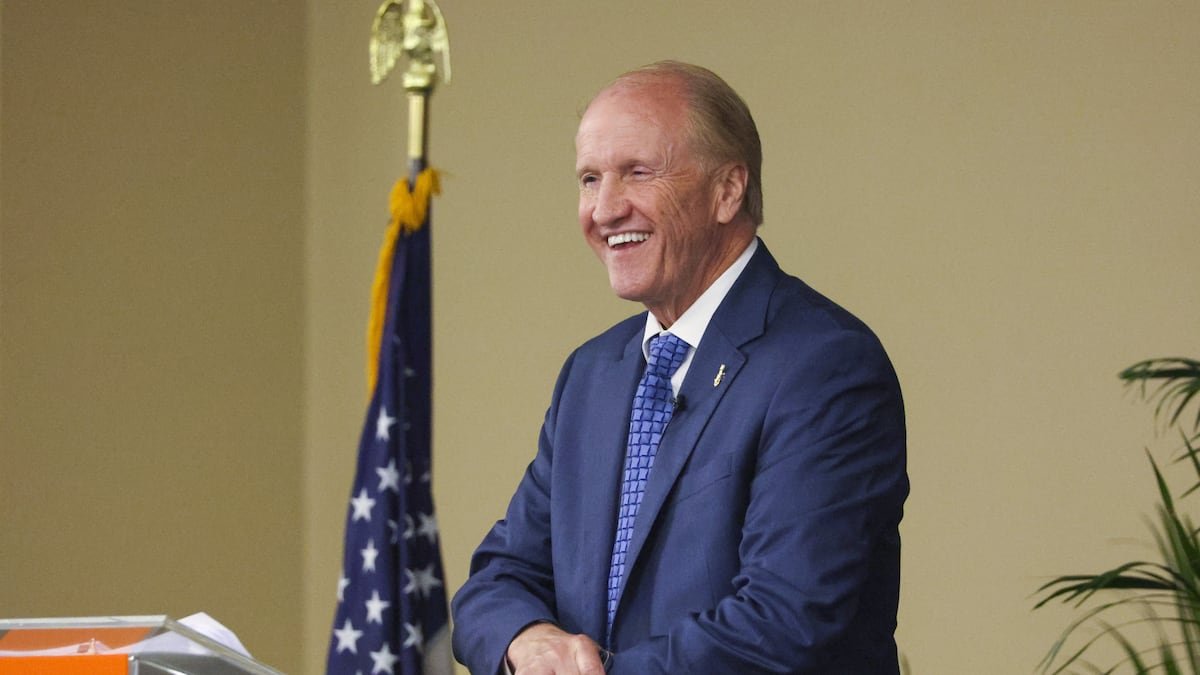
Amid a brewing conflict between school and state leaders, the University of Florida’s board of trustees voted unanimously on Monday to name Stuart Bell interim president.
The board selected Bell as the school’s permanent president earlier this month. But last week, the chairperson of Florida’s Board of Governors, which must approve the pick, postponed his confirmation vote.
In a letter last week to State University System Chancellor Ray Rodrigues, chairperson Alan Levine voiced concerns about UF chairperson Mori Hosseini’s scope of authority.
He wrote that he will not approve discussing any agenda item for a university while that university’s board is out of compliance with state regulations.
Levine wrote that past presidential contracts had granted Hosseini “sweeping authority” to approve hiring of university personnel, including the provost, deans and other administrative leaders. A Board of Governors regulation states that a chairperson can’t make personnel decisions within a president’s purview, Levine wrote.
Hosseini and other board members spoke for over an hour before the vote, mounting a defense against Levine’s accusations of improper leadership. Some also lamented the school’s urgent need to have a permanent leader.
Shortly after the meeting, Levine said in a statement that he wants to schedule a special meeting to consider Bell’s confirmation as permanent president and the university’s other agenda items.
“I look forward to positive results from our mutual work,” he wrote.
In his first public remarks on the issue, Hosseini said the university is too big to depend on one president or one chairperson.
He said UF implemented post-tenure review, protected Jewish students by blocking pro-Palestinian encampments and created the Hamilton School for Classical and Civic Education.
“I am so proud of everyone,” he said. “The reason we are here is because of you people, all of you.”
Before the vote, Provost Joe Glover presented a draft slideshow of public university metrics that he said the Board of Governors sends to provosts around the system.
Glover cited UF’s metrics in post-graduate employment and wages, student retention rates, student debt, research spending and annual philanthropy. UF performs at the very highest levels, he said.
Rahul Patel, the vice chairperson of the UF board, cited an opinion from Attorney General James Uthmeier stating that UF leadership standards related to hiring and compensation do not violate the law. The law firm GrayRobinson, hired by UF trustees in response to Levine’s allegations, provided the same opinion, Patel said.
Levine, in his letter, wrote that he has asked the Board of Governors’ inspector general to investigate any “credible allegation” involving real estate and financial transactions at UF that could help the board monitor governance.
Patel said GrayRobinson’s research found that no Board of Governors member can direct an inspector general to open an investigation.
The Board of Governors will discuss changing and specifying its rule on university governance at its meeting on Wednesday at Florida Atlantic University.
The proposed change would add that a university trustee may not become president of that university for two years after they leave their position.
The new language would also require university boards to maintain neutrality on political and social issues and require course syllabi to include faculty and student disclosure on the use of artificial intelligence.
If the amended regulation is approved, it will be available for public comment for two weeks and up for final approval at the Board of Governors’ next meeting in September.
Levine will facilitate a discussion about university leadership and authority at Wednesday’s meeting and go over the results of a governance review conducted by Board of Governors staff.
Hosseini proposed that UF should choose, and the Board of Governors would need to approve, an independent third-party expert in university governance to review practices at all public universities. Levine, in his Monday evening statement, said he agrees.
Bell, who will start his interim role on July 1, has remained focused on the future of the university, Patel said.
Hosseini said he hopes leaders can put their personal agendas aside and get back to normal.
“Mori Hosseini has not done anything wrong,” he said. “Nothing. Zero.”
The Tampa Bay Times Education Hub reports on Florida’s schools and universities and the students they serve. You can contribute to the hub through our journalism fund by clicking here.



