
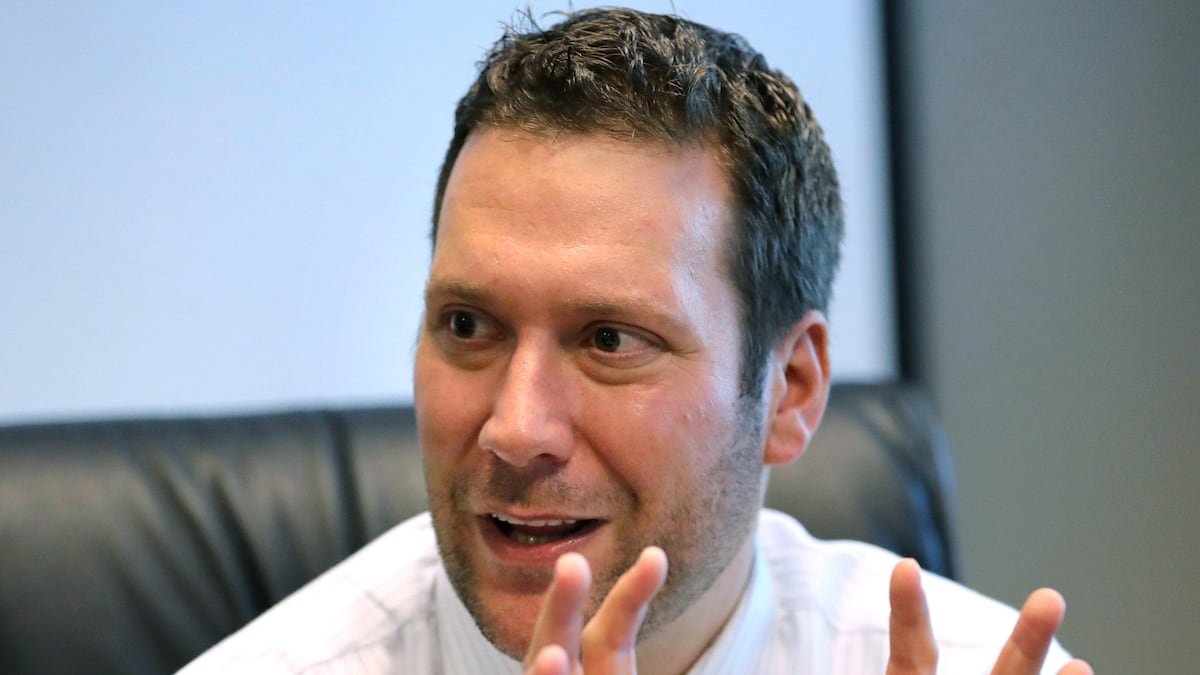
Last week, the Orlando Sentinel carried a story that said Joel Greenberg, Seminole County’s most infamous political criminal, wants Donald Trump to shorten and commute his prison sentence.
I was at the North Carolina coast when the story broke, but you still might’ve heard me laughing from 500 miles away.
The idea of Joel Greenberg — who pleaded guilty to a toxic mix of crimes, including sex trafficking of a child, wire fraud and stalking — feeling entitled to a break is pretty bonkers.
Yet it’s also within the realm of possibility, considering that Trump has turned presidential pardons into a transactional turnstile of political patronage.
Trump has lessened or wiped away the consequences for all manner of convicted criminals. Political scoundrels. White-collar felons. And, of course, the rioters who stormed the nation’s Capitol and assaulted police officers.
Few, if any, of these people were unjustly convicted. Many were, however, loyal to Trump and the MAGA movement.
And Jailhouse Joel wants to make sure Trump knows he was, too.
“I did everything to help Trump get elected in the first term,” the former tax collector said in a statement to the Sentinel, “and I served the MAGA movement with everything I had.”
Greenberg seems to be pretty clear about how “justice” is doled out by the current administration.
Greenberg may think he deserves a break. But do you know who didn’t catch a break? His victims, including the taxpayers he defrauded and the innocent schoolteacher he stalked and defamed.
You might not remember that the investigation into Greenberg began, in part, when it was revealed that Greenberg had targeted a political rival — teacher Brian Beute, who filed to run against him — by sending anonymous letters to his school, bogusly accusing Beute of sexual misconduct with a student.
The former Trinity Prep teacher was ultimately vindicated with investigators concluding the accusations against him were completely manufactured. But he and his family still paid a price.
“My reputation was attacked. My career was ruined. My family was displaced,” Beute said this week. “Joel can ask a president to make his sentence disappear. No one gives us those years back.”
It’s also worth remembering that the sentence Greenberg received — 11 years at a low-security prison in Miami — was already a massive break, compared to what he was facing.
Greenberg was originally charged with 33 crimes, which could’ve netted him multiple lifetimes behind bars had he been convicted of all of them.
The feds, though, offered him a deal, allowing him to plead guilty to only six charges in exchange for helping secure the conviction of others. Still, the half-dozen charges to which Greenberg admitted guilt were ugly and carried maximum penalties of more than half a century behind bars.
Yet Greenberg was allowed to serve only 11 years, which he now thinks is too much.
In some ways, Greenberg is similar to another Central Floridian who received a pardon from Trump — billionaire Joe Lewis.
The Tavistock owner had already received a light sentence of probation and restitution after he pleaded guilty to securities fraud on charges that could’ve meant decades in prison.
But Trump decided even that was too much, granting Lewis a “full and unconditional pardon” last fall. That prompted Lewis to say he could now “enjoy retirement and watch as my family and extended family continue to build our businesses.” How nice for him.
Trump certainly isn’t the first to hand out pardons in unseemly ways, rewarding friends, powerbrokers and political patrons. Bill Clinton made eyes roll with his controversial pardons of friends convicted in the 1990s Whitewater scandal.
But Trump has made unseemly history with his blitz of pardons, commutations and clemency grants in such sweeping and nakedly political fashion. Political allies like Roger Stone and Michael Flynn have received favors. So have elected criminals like George Santos and Rod Blagojevich. And there was, of course, the blanket pardon of the January 6 attackers, some of whom were convicted of assaulting law enforcement officers.
While Greenberg said he was requesting a “pardon,” the records on Justice Department’s website say he’s requesting a “commutation of sentence,” suggesting he’s asking for a shortened prison sentence rather than completely overturning his conviction. Earlier reporting said Greenberg had previously asked his buddy Matt Gaetz, the former congressman and failed nominee for attorney general, to help him get a pardon.
Basically, Greenberg has been looking for political friends to help him avoid accountability for his crimes from the moment he knew he needed it.
Meanwhile, Beute said he can’t even get the full details from the feds about who else was involved with Greenberg’s attacks on him, saying he’s still fighting to unmask an unindicted co-conspirator in the case.
So Greenberg wants freedom while one of his victims can’t even get answers.
That doesn’t make a whole lot of sense to the former teacher who said of Greenberg’s victims: “We don’t get a reduced sentence. We don’t get a pardon. Joel has an endpoint. His victims have consequences without one.”
©2026 Orlando Sentinel



