
Trial oversight
Trial NI006-101 was carried out at six sites across Germany, France, Spain and the Netherlands, in compliance with the Good Clinical Practice guidelines of the International Council for Harmonization and the ethical principles outlined in the Declaration of Helsinki (EudraCT number 2019-001932-80, NCT04360434). The protocol received approval from all pertinent national regulatory authorities (Paul-Ehrlich Institut, Germany; Agence nationale de sécurité du médicament et des produits de santé, France; Agencia Española de Medicamentos y Productos Sanitarios, Spain; and Centrale Commissie Mensgebonden Onderzoek, the Netherlands) and local ethics committees (Ethikkommission der Medizinischen Fakultät Heidelberg, Germany; Comité de protection des personnes Ile de France VII, France; Comité Etico de Investigación Científica – H. Puerta Hierro, Spain; and Medisch Ethische Toetsingscommissie UMCG, the Netherlands). Written informed consent was obtained from all participants. The trial was designed by the authors, who also contributed to the data collection and analysis. The sponsor, Neurimmune, provided cliramitug and placebo and supervised the execution of the trial and statistical analysis.
Trial design
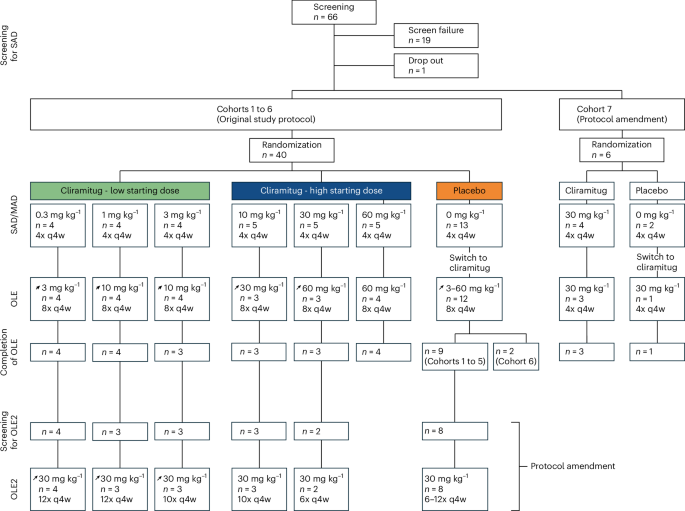
The first-in-human and proof-of-concept trial NI006-101 was designed to investigate the safety and tolerability of intravenous cliramitug at doses up to 60 mg kg−1 q4w in patients with confirmed ATTR-CM. An additional focus was on exploring the efficacy of cliramitug. Key eligibility criteria included a left ventricular wall thickness of ≥14 mm, NT-proBNP ≥600 ng liter−1 and the ability to walk ≥150 m in the 6-MWT (see Extended Data Table 2 for a full list of eligibility criteria for the SAD). Due to delays in recruitment, largely caused by the COVID-19 pandemic, trial participants enrolled early and at low dose levels could not be up-titrated to the expected efficacious doses as planned24. To generate data on the safety and efficacy of cliramitug at a dose level of 30 mg kg−1, the protocol was amended to extend the original 8-month OLE for participants enrolled in cohorts 1 to 5 (0.3 mg kg−1, 1 mg kg−1, 3 mg kg−1, 10 mg kg−1 and 30 mg kg−1, respectively; see Extended Data Table 3 for a full list of eligibility criteria for the OLE2). These adaptations, summarized as OLE2 for the purpose of this paper, allowed for 6 to 12 additional administrations of cliramitug depending on the starting dose level, increasing the maximal number of infusions in the entire trial to 24. The full trial protocol is available in the Supplementary Information.
Out of the three participants who did not undergo OLE2 screening, one died during follow-up of the original OLE (previously described (case 1)14) and two declined due to the complexity of the trial (eg, monthly visits, advanced age or long travel distance to the site.
Trial intervention
All OLE2 participants received cliramitug in an outpatient setting during the OLE2. Study drug was administered as an intravenous infusion using an infusion bag over approximately 50 to 60 min. In participants with previous exposure to a dose of 30 mg kg−1 during the OLE of the original protocol, cliramitug dosing was continued at a level of 30 mg kg−1. In participants with previous exposure below 30 mg kg−1, the first OLE2 dose was 10 mg kg−1, and all subsequent doses were 30 mg kg−1.
Assessment of safety and tolerability
In agreement with the initial trial goals, the primary objective of OLE2 was to further evaluate the safety and tolerability of cliramitug beyond month 12 as determined by the occurrence of treatment-emergent adverse events, changes in laboratory parameters, vital signs and echocardiography parameters. Assessments of all local laboratory results and electrocardiograms were performed by the investigators, and adverse events were recorded. Screening for anti-drug antibodies was performed periodically using a specialized assay.
Assessments of cardiac amyloid burden, structure and function
To characterize the effect of cliramitug on cardiac amyloid burden, all participants underwent either cardiac MRI or planar scintigraphy with DPD (3,3-diphosphono-1,2-propanodicarboxylic acid) or HMDP (hydroxymethylene diphosphonate), depending on local regulations and Investigator decision, to assess changes in the ECV or cardiac tracer uptake (heart over whole-body retention ratio, HR/WBR), respectively. HR/WBR was calculated as the proportion of tracer uptake within the reader-defined cardiac region of interest relative to the total body tracer signal, after exclusion of anatomical areas with confounding high tracer retention (for example, bladder, kidneys or injection site)25. Image acquisition was performed using harmonized protocols and image analysis was conducted by two independent readers for each modality at a core laboratory (Biotrial, France). In case of reader disagreement beyond a predefined cut-off, a consensus reading was performed. Changes in cardiac structure and function were assessed using transthoracic echocardiography in all trial participants. Images were acquired by trained sonographers according to a harmonized protocol across all sites. Image analysis was performed centrally by a single reader with documented low intra-reader variability on key echocardiographic parameters (Biotrial). To reduce bias in the assessment of imaging data in this open-label trial, all central readers were blinded to the initial treatment allocation during the placebo-controlled phase of the trial, to the participant ID, and the timepoint of the assessment.
In addition, serum concentrations of disease-relevant cardiac biomarkers NT-proBNP, an indicator of myocardial stretch, and troponin T, an indicator of myocardial damage, were assessed at selected timepoints throughout the trial at a central laboratory (SGS, Germany).
Quality of life and exercise capacity
Changes in quality of life were assessed using the Kansas City Cardiomyopathy Questionnaire. In addition, the 6-MWT was utilized to assess changes in exercise capacity. Both tests complement the objective measures of cardiac status by imaging and blood biomarkers with clinically relevant subjective information, and have been validated as modifiable disease markers in ATTR-CM19.
Statistical analysis
The results presented here were generated after all participants had completed the full trial and include data from all participants who received at least one dose of study drug. Data were pooled from all sites. Participants assigned to cliramitug were grouped based on starting dose level into high-dose cliramitug (10, 30 or 60 mg kg−1) and low-dose cliramitug cohorts (0.3, 1 or 3 mg kg−1). Participants randomly assigned to receive placebo were pooled from all cohorts. No formal statistical hypotheses were tested, and no imputation of missing data was performed.
As prespecified in the SAP (provided in the Supplementary Information), descriptive statistics are presented for absolute and relative change from baseline to the end of the OLE2 for all participants enrolled (Extended Data Figs. 1 and 2). For participants randomized to placebo, the last assessment prior to OLE is considered as baseline. To describe the continuation of changes among participants included in the initial publication14, changes are presented for predefined dose groups: low starting dose, high starting dose and placebo (Fig. 2). In an additional post hoc analysis that accounts for missing data, the dose-response relationship between cliramitug and selected exploratory efficacy parameters across all participants in the trial (including patients who did not participate in the OLE2), absolute change from baseline to the last available assessment for each participant was correlated with cumulative cliramitug exposure (area under the curve, AUC, in mg/ml*d) for each individual’s last assessment timepoint (Fig. 3). In addition, to explore longitudinal changes in selected exploratory efficacy parameters at the highest dose levels of 30 or 60 mg kg−1, a dose range currently being investigated in the DepleTTR-CM phase 3 trial (NCT06183931), an additional baseline (landmark) was defined as the most recent assessment prior to the first received dose of 30 or 60 mg kg−1, and absolute change from that landmark was analyzed (Fig. 4). SAS version 9.4 (SAS Institute) and R version 4.4.2 (R Foundation for Statistical Computing) were used for data handling, descriptive statistics and data visualization. Numerical values were formatted for clarity, with decimal precision adjusted based on value magnitude. Linear and LOESS (locally estimated scatterplot smoothing) regression analyses were performed for the correlations of treatment effects with AUC and time, respectively.
Reporting summary
Further information on research design is available in the Nature Portfolio Reporting Summary linked to this article.



