
Topline
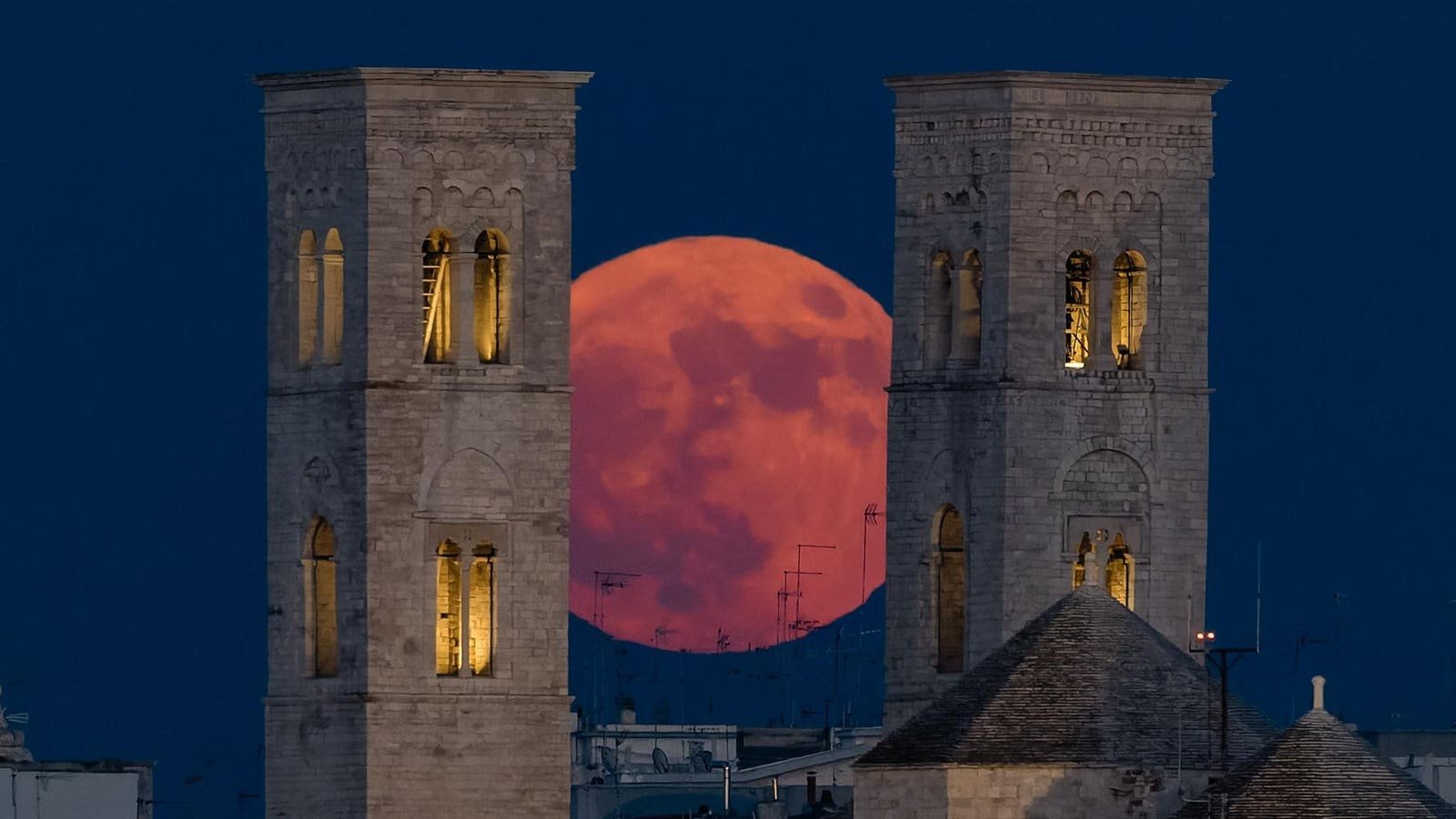
The Strawberry Moon rose across the world on Monday, June 29, marking the first full moon of summer in the Northern Hemisphere. Despite being the second-smallest of 2026, its perfect timing — rising just after sunset as seen from Europe and North America — created jaw-dropping moonscapes across the world. It came amid a forecast for Northern Lights in northern U.S. states. Here are the best photos of June’s full moon, one of the celestial highlights of summer.
The Strawberry Moon is seen behind the towers of the Cathedral in Molfetta, Italy, on June 29, 2026. (Photo by Davide Pischettola/NurPhoto via Getty Images)
NurPhoto via Getty Images
Key Facts
The full Strawberry Moon became 100%-lit at 7:56 p.m. EDT on June 29, according to Timeanddate.com.
It was the seventh full moon of 2026 and the first full moon of astronomical summer in the Northern Hemisphere, and of astronomical winter in the Southern Hemisphere.
This Strawberry Moon occurred just 36 hours after the moon’s farthest point from Earth — its apogee — giving it the status of a smaller-than-usual “micromoon,” though that’s not an official astronomical term.
The most dramatic scenes came at moonrise during dusk, when the moon appeared low on the southeastern horizon and glowed orange through Earth’s atmosphere.
June’s full moon, nicknamed the strawberry moon, lights up the night sky on June 29, 2026 in Qingzhou, Shandong Province of China. (Photo by VCG/VCG via Getty Images)
VCG via Getty Images
Why Was It Called The Strawberry Moon?
The origin of the name Strawberry Moon has nothing to do with the color of June’s full moon, according to Almanac. Instead, it takes its name from the short harvesting period for ripe strawberries in North America. Other cultural names include Blooming Moon (Anishinaabe), Green Corn Moon (Cherokee) and Hoer Moon (Western Abenaki).
The full Strawberry Moon rises behind the skyline of midtown Manhattan and the Empire State Building in New York City on June 29, 2026, as seen from Weehawken, New Jersey. (Photo by Gary Hershorn/Getty Images)
Getty Images
Why This Full Moon Looked Small
June’s Strawberry Moon was a micromoon, which occurs when a full moon coincides with the moon’s apogee — the most distant point in its elliptical orbit around Earth. This full moon was 252,442 miles (406,267 kilometers) from Earth, slightly farther than average, so it appeared slightly smaller and dimmer than average.
The full moon rises behind a large soccer ball atop a gas station in honor of the World Cup soccer tournament in Arlington, Texas, near Dallas, Monday, June 29, 2026. (AP Photo/Julio Cortez)
Copyright 2026 The Associated Press. All rights reserved.
A Low-Hanging Summer Moon
As the first full moon of summer, the Strawberry Moon followed a shallow arc across the sky in the Northern Hemisphere. Full moons always sit opposite the sun, and with the sun riding high near the June solstice, the moon remained lower than usual. As a result, the Strawberry Moon rose far to the southeast, stayed low across the southern sky and set far to the southwest before dawn. In the Southern Hemisphere, it was the year’s highest full moon.
The full moon rises beyond pylons at the Kansas City Convention Center Monday, June 29, 2026, in Kansas City, Mo. (AP Photo/Charlie Riedel)
Copyright 2026 The Associated Press. All rights reserved
What Comes Next In The Night Sky
The next full moon will be the full Buck Moon on July 29, which will be followed by a dramatic run of late-summer solar and lunar events. The main attraction will be a total solar eclipse on Aug. 12 in eastern Greenland, western Iceland and northern Spain, which will be seen as a deep partial solar eclipse across Europe and as a small partial solar eclipse in northeastern U.S. states and Canada. It will be followed by a very deep partial lunar eclipse on Aug. 27-28.
Further Reading
source: https://www.forbes.com/sites/jamiecartereurope/2026/06/30/in-photos-strawberry-moon-lights-up-night-sky-around-the-world/



