
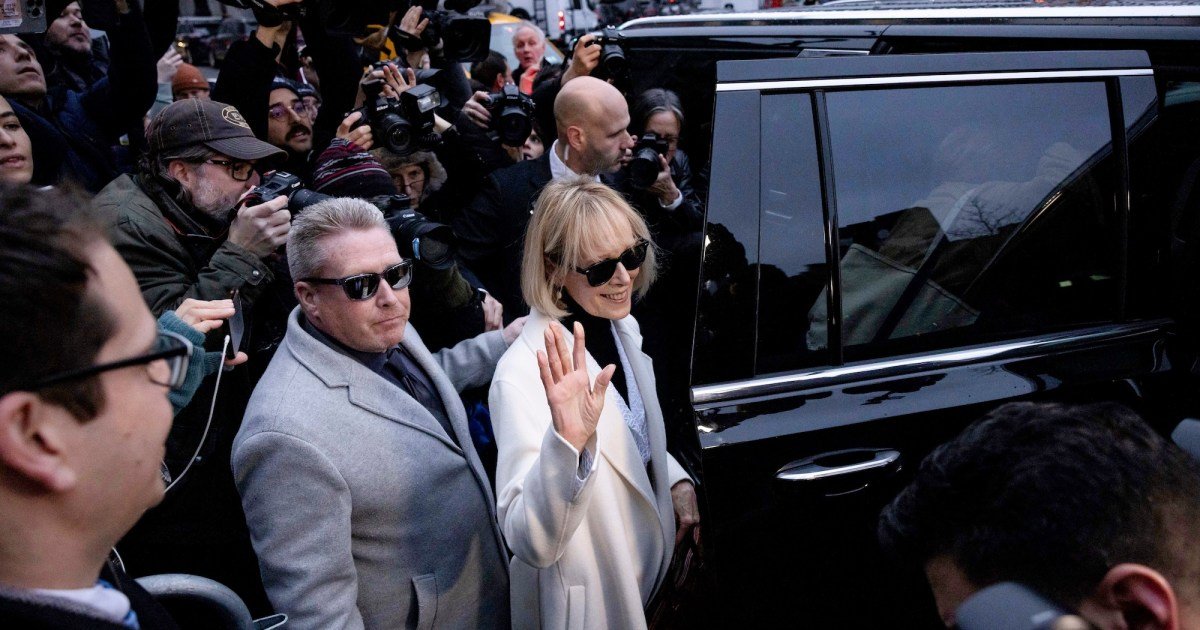
Yuki Iwamura/AP
The Supreme Court has issued a raft of recent decisions benefiting Donald Trump. But on Monday, the justices rejected his latest effort to avoid paying E. Jean Carroll millions of dollars a jury awarded her after finding Trump liable for sexual abuse and defamation. Carroll had accused Trump of sexually assaulting her in a department store dressing room in the 1990s. Carroll successfully sued him in 2023, after he not only denied the allegation—calling it a “hoax” and a “conjob”—but mocked Carroll as “not my type.”
A federal jury found Trump liable for $5 million in damages in May of 2023, after which Trump immediately denied the assault and once again mocked Carroll, leading to a second similar lawsuit, in which a jury quickly found that Trump owed an additional $83.3 million.
Trump appealed both jury decisions, but a federal appellate court ruled against him in 2024. He took the initial case to the Supreme Court last summer. On Monday, the court declined to hear the case, leaving the initial judgment in place.
Theoretically, the much larger second judgment could still be taken up by the Supreme Court. But today’s decision suggests the president is running out of legal avenues to avoid paying Carroll the money the juries said he owes.
Trump posted an angry message on Truth Social following the Court’s decision. He insisted he would keep fighting the case—he didn’t explain how—and tried to reframe Carroll’s lawsuit against him as an attack on America.
“This Case is really against the United States of America, and all it stands for, and should never be allowed to happen to another President, or Candidate to be!” Trump wrote.
Trump specifically cited the fact that Carroll had sued him under New York State’s Adult Survivors Act, a 2022 law that temporarily suspended the statute of limitations on civil lawsuits in which victims allege they were sexually assaulted. Previously, the statute of limitations had been only three years.
In his post on Truth Social, Trump claimed the law had been written specifically to target him, which is not true. The law was modeled on a similar law that temporarily allowed lawsuits by victims of child sexual abuse, who otherwise would have been prevented from suing because of the statute of limitations. Nor was he the only defendant sued under the law—besides Carroll’s lawsuit, the law also enabled lawsuits against Bill Cosby and Sean Combs.
During the 2023 trial, Carroll testified, in sometimes graphic detail, about the incident, her confusion over how to handle it, and her eventual decision to write a book that included the allegation.
Asked on the stand if she regretted going public with her accusation, she said, “I regretted it about 100 times, but in the end”—she paused as she broke down into tears—“being able to get my day in court…I’m crying, but I got to tell my story in court.”



