
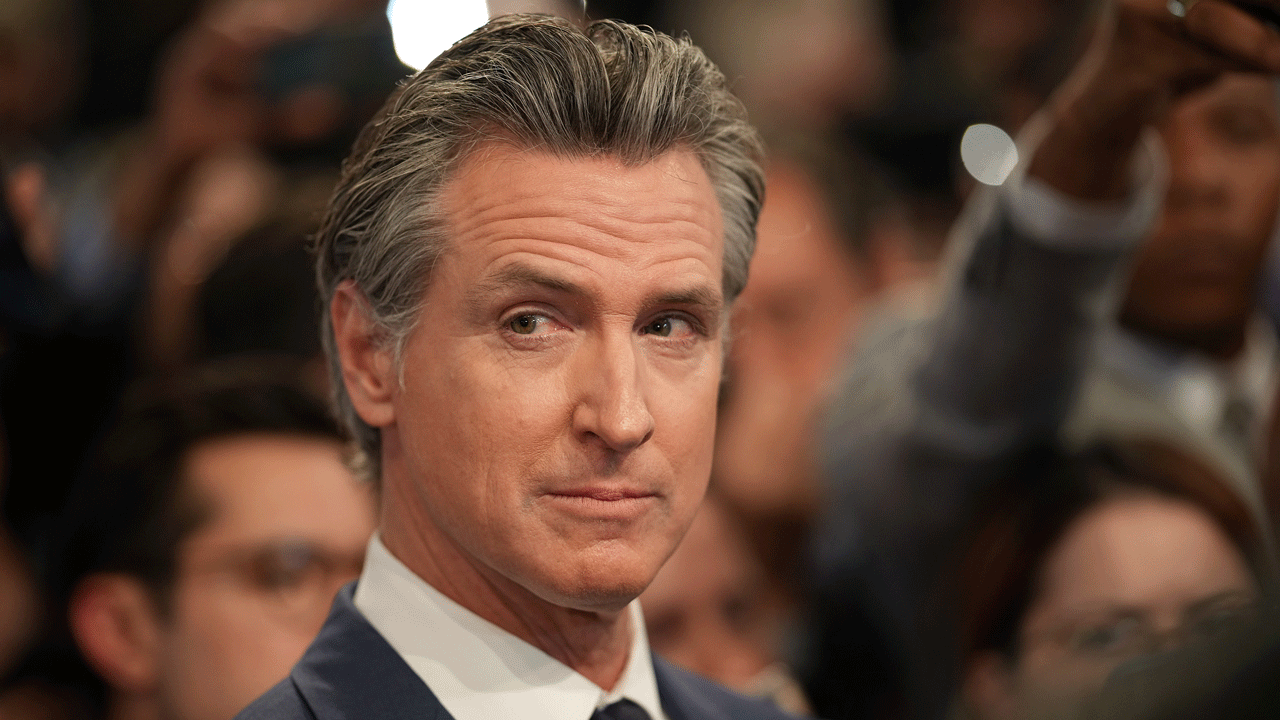
California’s budget has grown roughly 40% since Gov. Gavin Newsom took office in 2019, but a former state senator who helped oversee the budget says the governor squandered a once-in-a-generation opportunity to put the state’s finances on stronger footing.
In some of Newsom’s final acts as governor, he passed a $351 billion spending budget for 2026-27, a whopping 40% increase since he was elected to serve Californians in January 2019.
When Gov. Gavin Newsom first took office, California entered the budget cycle with a projected $21.4 billion surplus, thanks to the work of previous Gov. Jerry Brown. Since then, California has experienced years of record spending and recurring multibillion-dollar budget deficits.
Many Californians might wonder what Newsom has to show for it.
The newly approved spending plan continues Newsom’s focus on expanding Medi-Cal, funding homelessness and housing programs, and investing in public education, wildfire prevention, and climate initiatives.
It also adds more funding for special education and child care, while relying on several revenue-generating measures, including extending taxes that help fund Medi-Cal and limiting certain business tax breaks.
Many have criticized this budget, including Assemblyman David Tangipa, who pointed out that the fund for illegal immigrant services is over $10 billion, while veteran services has only about $500 million.
In an interview with the Daily Signal, John Moorlach, senior fellow and director at the Center for Public Accountability at the California Policy Center, shared his concerns about Newsom’s budgets. He also expressed worries for the future, saying Newsom didn’t focus enough funds on paying down existing debts.
Moorlach is all too familiar with the governor’s financial mismanagement; he served as a California state senator from 2015 to 2020 and served on the Budget and Fiscal Review Committee.
“Spending went up, and reducing debts was not focused on as strongly as it should have been,” Moorlach said. “The state didn’t attack its unfunded liabilities for retiree medical, nor did it make aggressive increased payments to the pension plan.
“So, it’s one of these massive, missed opportunities because paying down debt—even though it’s a good, smart thing to do in a household—is not sexy and it’s not fun.”
Since 2012, Moorlach has been ranking each state by how much unfunded pension debt there is for each resident.
When the previous governor handed things off to Newsom, California was in 41st place in Moorlach’s rankings. However, after almost eight years, California dropped to 44th.
Moorlach gained access to the state’s 2024 Annual Comprehensive Financial Report and saw a suspicious number that caused California to improve.
Since 2012, Moorlach, a CPA by profession, has been monitoring the United States’ unrestricted net positions. In 2024, Moorlach noticed a huge positive improvement: states had improved their unrestricted net positions by $100 billion.
But when Moorlach went to investigate how that was done, he saw that around half of that money—$46.2 billion—was tied to California. When he looked deeper, that money was all due to “error correction.”
“Now, thanks to a really radical error correction, [California] is moving up to 43rd. But he left it in a lot worse shape than Jerry Brown handed it off to him,” he said.
“You would think we should be much higher because of who we are—we’ve got Silicon Valley, and we’ve got six of the top corporations on the stock market. But instead of benefiting from the unique good fortune and being diligent about managing the resources properly for future generations, Gavin Newsom’s just had a fun time just spending it all. So, if we do go into a recession, it will get really ugly.”
What Moorlach referenced was the unfunded liabilities still hanging over Californians’ heads. When those debts aren’t paid down by the governor, they don’t go away—they become the responsibility of Californians.
If the state goes into a recession, residents will still have to worry about those payments, except they will be making substantially less money to cover them.
Moorlach finished by saying Californians shouldn’t be surprised: “It’s not unreasonable to think about, because [Newsom] is a leftist, liberal politician who did what one would expect of someone who is not focused on being fiscally conservative.”



