
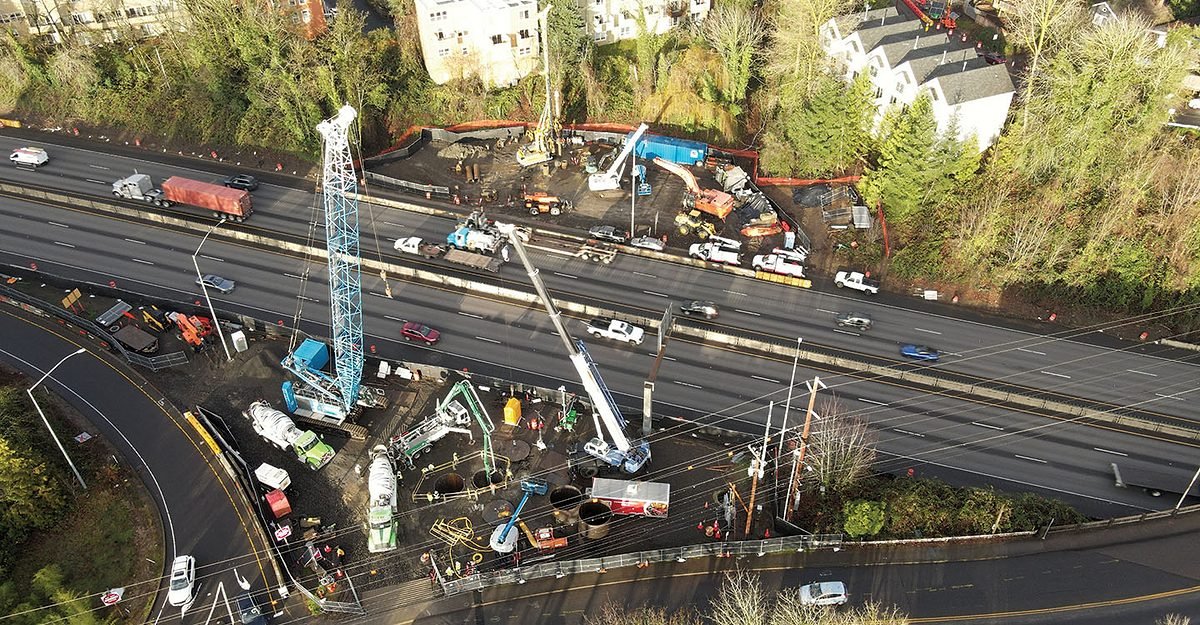
Steep slopes, narrow streets, a busy interstate highway—and two abandoned trestles—are some of the challenges that makes the Carolina Trunk Rehabilitation project “one of the most complex ‘small’ projects that I’ve been on,” says Chris Bottoms, division manager with James W. Fowler Co. The construction manager-general contractor project is $79.3 million, but the challenges of replacing a nearly century-old sewer main in Portland, Ore., are outsized—while the available working areas are just the opposite.
“We have very confined working areas. The sites are all difficult to access, and in many cases interface closely with the public,” says Ryan Carney, engineering supervisor and owner’s representative with the City of Portland Bureau of Environmental Services (BES). BES and its advisor, Kennedy Jenks, spearhead the project. He adds the project has been a challenge “since design is developing the construction sites so that we can make sure we have adequate working space while keeping the community safe.”
The project will replace the old sewer trunk line built almost 90 years ago. Should the aging structure fail, it could cause problems on Interstate 5, note project officials.
The trunk line also runs underneath private properties, making it nearly impossible to repair without temporarily displacing residents. The new alignment, just a ¼-mile long with a 107-ft change in elevation, will move the trunk under existing right of way and permanent easements and provide access points to make it easier to maintain in the future.
“This is is a key infrastructure project for us in the South Portland area,” says Ainsworth Marshall, BES senior project manager. “We have a failing trunk sewer here that we did some conditional assessment on, and it had some structural issues…. is was a critical piece of infrastructure that really needed our attention.”
Initially, BES thought it would have to rehabilitate the original trunk line. “Before we had this team together, the city was wrestling with what we do with this,” says Amy Dunning, BES engineering supervisor. “We thought we were kind of stuck with rehabilitating the existing trunk, but once we got the contractor and the CMGC method on board, we were really looking at could we actually install new pipes.”
The original concept was to microtunnel deep in the bedrock beneath I-5 as the preferred trenchless approach. Subsequent geotechnical exploration revealed deep artesian groundwater pressures approximately 75 ft deep, fundamentally altering risk assumptions for microtunneling, according to WSP.
“We were progressing toward 30% design, and we needed one additional boring that happened to be in the location of a wetland on the west side of I-5,” recalls Sarah Lingley, a WSP vice president. “So we weren’t able to bore into that wetland until it dried out in the late spring or early summer.”
Looking for quick answers on construction and engineering topics?
Try Ask ENR, our new smart AI search tool.
Ask ENR →
GET STARTED
Lingley recalls the team submitting the 30% design in 2023 to the city on the same day that it received the results of the bore. “The boring showed that there are actually artisanal pressures deep underground. That changed the risk profile for going with a microtunnel.”
Through the CMGC delivery process, the team reevaluated the trenchless strategy and pivoted to a shallower auger bore with drop structure approach. “This was a custom design and required us to leverage computational fluid dynamics, or CFD modeling, to confirm the hydraulics,” says Lingley.
The contractor suggested two 10-ft-dia oscillated casings instead of a 30-ft-dia secant pile shaft to reduce risk and cost and improve safety conditions for workers. The WSP team pivoted to designing the vortex drop to be able to fit within the 10-ft-dia casing, with a custom-designed concrete chamber at the bottom.
“We went as shallow as possible under I-5 because there is groundwater in the area,” notes Lingley. “We are doing a drop shaft just on the east side of I-5, and then we come down the hill from Shaft 3 to Shaft 4.” The first set of vortex drop structures are located on the east side of I-5 at Shaft 3. The base of the vortex drop and custom de-aeration chamber is located 60 ft below grade within the 10-ft diameter casings. The pipes were installed by auger bore from Shaft 4 to Shaft 3 at a 7.5% slope. A second set of vortex drops are located at Shaft 4.
A Trunk Line’s 90-Year History
The Carolina Trunk was built in a gulch of the same name; the gulch and two bridges crossing it eventually got buried in landfill. A neighborhood was built atop that. Now crews are contending with the history of the area in order to build for the future.

The Carolina Trunk was built in a gulch almost 100 years ago, before the rise of neighborhoods and the Interstate highway.
The replacement trunk line must snake through residential streets, hillsides, and under the highway with minimal disruptions to traffic.
Crews must avoid contact with two timber trestles that were abandoned and buried in fill.
The old Carolina trunk line is severely corroded; a failure could cause a sinkhole on I-5 or raw sewage to spill into streets.
Photos Courtesy Portland BES
“We actually had some mixed phase conditions in the geology,” she adds. “Tere was a significant amount of coordination between what Fowler’s team told us they needed for constructability on an auger bore, and what slopes they needed versus slopes the design team needed in terms of hydraulics. This whole situation was very closely coordinated between design, engineering and also maintenance considerations, because BES staff is going to have to get in there. Ultimately we were able to come up with the preferred alignment.”
Fowler began preconstruction services in late 2022. The guaranteed maximum price construction contract was executed last May, with WSP’s sub Kelly McNutt Consulting playing a key role; McDonald Excavating started preparatory site work that summer as a sub to Fowler. The expected completion date is 2028.
The project is part of an overall large-diameter sewer program. “We have many of these lines throughout the city, anywhere from 80 to 100-plus years old, and there will be more projects in the future to address deFciencies,” says Carney.
Over the past decade, BES assessed sewer infrastructure throughout the city, identifying priority projects. “A sinkhole on I-5 was the big concern,” says Dunning. Bottoms adds that during the dry season, flows through the trunkline average between 50 and 100 gallons per minute, while “during a rainstorm event we might see over 100,000 to 130,000 gallons per minute flowing through.” The new trunk line is designed for that volume.
One of the major concerns for BES was “how we manage installing the new sewer,” says Marshall. “We couldn’t use the same alignment. Our goal was to put the new sewer in the public right of way.”
But to do so, the team has to temporarily impact private property. Slavin Road, at the north and west end, has only one lane in each direction and is lined with residences. It’s also a dead-end road.
“So we had traffic considerations, [housing] utilities,” says Marshall. “We also have environmental zones along that alignment.”
Gulch State
The Carolina trunk line is named after the gulch in which it was built. “As far back as the 1930s [the city] began trunk construction in several of these gulches on the south side of Portland,” says Bottoms. “The hillsides actually go down to an old creek bed, and the existing trunk is a cast-in-place concrete horseshoe at the base of that gulch.”
The vortext drop structure had to be engineered to fit within a 10-ft-dia casing.
Diagram Top Courtesy WSP, Diagram Bottom Courtesy JW Fowler
In the subsequent decades, the gulch was filled in, and eventually a developer built the existing neighborhood on top of it. “That’s how you end up with a 42-inch-diameter trunk sewer 90 feet below a neighborhood,” says Bottoms.
John Horne, WSP design manager, notes the existence of two 400-ft-long bridges over the gulch, also buried in fill over time as the city began transitioning from rail to road transportation, with one for rail and the other a roadway.
“A lot of the CMGC efforts also evolved into trying to plot potential historic trestle impacts and what could happen to the operation if we were to encounter those,” says Bottoms. “We’re trying to put the vortex drop right in between the two historic trestles.”
That is one of the four shaft locations. “Shaft 1 is uniquely challenging because it’s nestled between three structures and a contractor-engineered soil nail wall,” says Bottoms. “Shaft 2 is challenging because we’re right next to I-5. Southbound Shaft 3 is challenging because it’s nestled between two historic trestles, and Shaft 4 is challenging because we’re in the parking lot of two businesses.”
The construction site area for Shaft 3, dubbed Corbett Island for the I-5 northbound off-ramp it sits near, is only 180 ft x 80 ft. “It’s a small, tight access site where the first two of four drop structures are located,” says Bottoms. The shaft there is approximately 65 ft deep.
The team must keep the off-ramp open while using the small patch of land for construction staging, notes Lingley. “The team does get to do night shutdowns of a lane periodically to move equipment in and out. Essentially they’re using the shoulder adjacent to Shaft 2 as access, and this has all been coordinated very closely with ODOT.”
The team also replaced one vegetated stormwater treatment swale owned by the Oregon Dept. of Transportation with a precast concrete stormwater filter box for polluted discharge and stormwater runoff at Shaft 3.
Good Neighbors
ODOT is just one of the many stakeholders. The team works with State Historic Preservation Office and the city, a regional housing authority, and property and business owners. Aaron Abrams, the city’s public involvement manager, notes that the outreach team, with the help of JLA Public Involvement, tried to contact every property within 50 ft of work for noise and settlement monitoring. The team conducted bilingual outreach events well before work began.
Ting Lu, the city’s utilities director, credits CMGC with informing the outreach: “Having early technical expertise allows us to provide clearer, more transparent communication to the community, supporting a core strategic priority for BES and the City.”
The homes on Slavin Road, near Shaft 1, are also located on a steep hillside. “Looking through the evaluation of risk [regarding] slope stability of the homes above us, that was a big one for the CMGC team,” says Bottoms. “The team’s dealing with slopes that are already moving before construction began.”
Access Limited built the temporary soil nail walls at the foot of the slopes “in order to widen the alignment enough for people to go down the road on a single alternating lane closure for basically 18 months,” says Bottoms.
Crews perform auger boring at depths as much as 40 ft, working at four shaft locations.
Photos Courtesy J Portland BES/ JW Fowler
Crews have inches to work with. “We really need to maintain an 11-foot travel lane there, and that road is so narrow to begin with,” says Lingley. “So we were looking at how do we get two parallel pipes in here, maintain traffic control, make sure the contractors’ equipment will fit. We looked at the exact excavator they’re going to use, the swing radius. We were looking at inches, making sure we had enough to maintain that lane and that the pipe location was appropriate, so that they could excavate above it.”
At Shaft 4 on Macadam Avenue, the project team took over an office coworking space. “Originally we didn’t think we were going to occupy this space,” says Marshall. “But as we continued the discussions about staging and how the project would fit in, we quickly realized that it would be extremely difficult for that business to function here while we were doing the work. So we worked with the business owner to rent this space during construction” as a colocating space.
The project team took over the workspace last summer. “That’s when we started construction in the field,” says Bottoms. “Ultimately we’re trying to build these two drop structures.
“When you get into these type of sewer projects, there’s usually at least one or two spots where grade and sewer is important with gravity, and this just happens to be where the new grade and the existing grade cross,” he adds. “So we always have to figure out a way to make that work during construction.”
Stiver Engineering designed a temporary gravity bypass flume. This summer, “we will do the switchover and continue our excavation out here now that we’ve finished the two auger drives up above,” says Bottoms. “Then we’ll excavate down, expose the [old line], install the temporary bypass on the left side and then demo out and abandon the existing trunk in that section.”
Augers and Oscillators
Gonzales Boring completed four of the seven auger bore crossings as of late June and has started the second one under I-5.
At Shaft 4, where geologic conditions are variable, there are contractor-designed tiebacks for intermediate support in the shoring, and Northwest Infrastructure designed a permanent retaining wall structure. Limited auger bore access at Shaft 4 spurred the team to engineer a unique thrust restraint system. Boring thrust is transferred into headwall tiebacks via large-diameter coil rods, eliminating need for a conventional thrust block.
A cast-in-place manhole structure ties into the existing trunk line in the neighborhood. “One other benefit of the alignment chosen is not only did that allow for safe installation and stability, but also allowed for a sanitary storm separation for future storms,” says Bottoms. “Right now, this trunk entirely feeds to the water treatment plant. In the future, they’ll be able to split this up and take sanitary only flows to the plant, and then a significant amount of the stormwater straight to the river.”
Last fall, crews installed beam-and-plate driven shafts. “We don’t have a lot of tolerance to have moving ground and settlement based on the proximity to the structures nearby,” says Bottoms. “So we have drilled beams, then we vibrate plates in.” Crews with Pacific Foundations installed beams at all shaft sites, and the tiebacks at Shaft 4.
Crews and heavy machinery work right next to businesses and residences.
Photos Courtesy of Portland BES/ JW Fowler
Temporary soil nail walls were installed along with the drilled beam and plate shafts in close proximity to homes, with constant monitoring for settlement.
“Once the beams are in place, we use variable moment hammers to install the sheeting, and that’s super important to be able to change the amplitude and frequency of the vibration based on how close we are to those homes,” notes Bottoms.
“So then we essentially vibrate the plates down as deep as we can get them before we hit refusal. Once we get down, we can only excavate in one-to-two-foot lifts, and then weld the final couple feet of plate instead of lagging on once we’re in the denser [soil].”
Malcom Drilling utilized an oscillator dubbed Oscar to install the 10-ft-dia steel casings. “We sunk the two casings at the beginning of the operation, and then built the shaft around that. Then as we excavate down we cut off the steel casing, leave that at handrail height, dig down another five feet, cut off the casing and work our way down inside the shaft,” says Bottoms.
Delve Underground designed a unique telescoped shaft shoring system at Shaft 3 using 10-ft-dia oscillated steel casings driven to roughly 70 ft. The telescoping geometry was critical because it let the casing string fit within the tight envelope between the trestles above and the rock valley below.
The larger upper cell accommodated the cast-in-place vortex approach structures, while the water-tight 10-ft-dia oscillated casing at depth was sized both to receive the auger bore steering heads and to incorporate the de-aeration requirements of the drop structure.
“You’re trying to thread the lower part of the shaft between the trestles and the rock, and then catch your trenchless excavations in the small-diameter shafts at the depth,” says Bottoms.
The team received permits to remove an artificial wetland for construction, says Lingley. “So that area is now not currently a wetland, but after the project is completed, they will remove the added fil, and the wetland will be restored.”
She adds: “We’re really having to thread the needle,” on the overall project. “We’re looking at inches [to spare] while we’re moving the pipe in different directions, to make sure that we’re maximizing the hydraulic capacity of the infrastructure.”
Noting that Portland was a pioneer in using CMGC principles in the public agency space, Bottoms adds: “CMGC is still alive and well in Portland.”
Source: www.enr.com



