
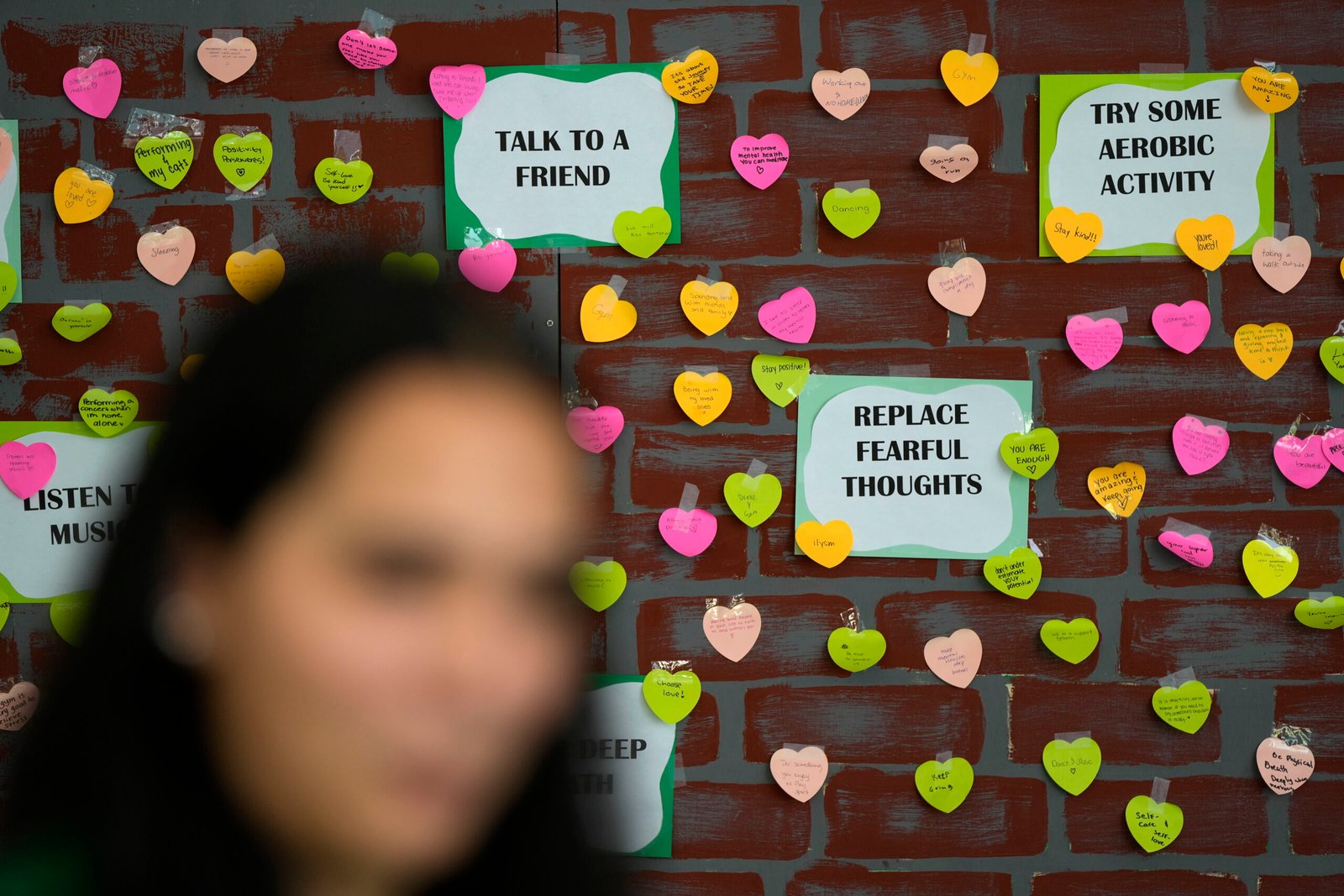
Mental health services, particularly for children, made significant funding gains in New Jersey’s biggest-ever annual budget. Money for crisis centers, though, remains tied to a pending bill, leaving hospital emergency rooms to handle cases that advocates say demand a more specialized approach.
Gov. Mikie Sherrill on Tuesday signed a $60.7 billion spending plan that boosts services to address depression, addiction, homelessness and other issues. In a win for children, public schools will continue to assess and treat psychiatric issues via a system called NJ4S. That hub-and-spoke service model operates 15 units that provide crisis prevention and intervention for students, school staff, parents and caregivers. The budget allotted $40 million to that program, which began in September 2023.

“This protects the most vulnerable students,” said Debbie Wentz, president and CEO of the New Jersey Association of Mental Health and Addiction Agencies, who joined other advocates in pressing lawmakers and the administration to continue funding. “We’re looking forward to building on it.”
Another priority was support for people who are unhoused. The 2026 annual statewide Point-In-Time survey logged 13,748 people experiencing homelessness — the most since 2014. The state budget for the fiscal year that starts July 1 allocated $25 million for rapid re-housing and $4 million for the New Jersey Coalition to End Homelessness, a Princeton-based nonprofit.
“We’re really gratified to see that,” Wentz said of the overall support for homeless individuals.
Sherrill came to office in January with a mental-health agenda, particularly for youth. About 1.4 million New Jersey adults experience mental illness each year, according to the National Alliance on Mental Illness. Among New Jersey children ages 3-17, about 11% struggle with anxiety and depression, according to Kids Count data.
988 lifeline
The state’s 988 Suicide & Crisis Hotline — which offers immediate support via text, call or chat — will continue to be supported with roughly $28 million. Missing from the fiscal 2027 budget, though, was a dedicated annual funding stream that advocates had sought. No money was allotted for crisis stabilization centers for people to seek help rather than report to hospital emergency rooms.
Advocates, policy makers and some lawmakers have stressed the need for steady revenue, all while caregivers and families cope with a numbing increase in suicides. Many of those deaths are young people: Suicide is the second-leading cause of death among those age 10-14 and the third-leading cause among those age 15-24.
In 2025, New Jersey counted 723 suicides, a 6% increase from the year before, according to the Office of the Medical Examiner. From January-May, the office recorded 261 such fatalities — just over three times the number of homicides in the same period. In all, 14% of those deaths were people under age 24.
Dedicated funding for the 988 crisis hotline and accompanying services would have come from a new 40-cent monthly charge on phone lines. That would generate more than $67 million annually, according to the nonpartisan Office of Legislative Services.
The revenue, supporters argued, likely would be enough to fund the broader services, particularly crisis centers, to accompany the crisis hotline.
Crisis centers
Now those crisis centers will delay opening or possibly never begin operations, according to Matthew Camarda, advocacy and public policy director for the New Jersey chapter of the National Alliance on Mental Illness.
“We’re incredibly disappointed to see that there was zero funding,” Camarda said. “We’ve got to keep pushing for it in the coming months.”
The centers were a crucial third part of emergency response, he said. The state funds the crisis hotline and mobile emergency response teams, though it lacks places for additional support, Camarda explained. A crisis center can be as simple as a safe spot for a person to visit, meet a caregiver or get some basic treatment.
“But if somebody really needs to physically go somewhere to get that care, we don’t have that,” he said. “Too many people end up in the emergency room.”
In 2024, New Jersey hospital emergency departments logged 142,907 patients who sought help for mental or behavioral disorders. While that’s a steep drop from 2019, when 166,299 such patients were seen, advocates say the figure is far too high.
A bill that lawmakers considered in June would require the state Department of Children and Families to supervise and implement policies to strengthen psychiatry and behavioral health services for children and their families. Passed by the Assembly, it has yet to receive a Senate vote.
The department would be required to expand the New Jersey Pediatric Psychiatry Collaborative, offering help to its member pediatricians. The department would be tasked with working with other state departments to review and modify “payment structures and reimbursement rates for pediatric primary care physicians providing pediatric psychiatry and behavioral care health services.”
The bill would require a public awareness campaign on the program’s services, and compel psychiatric caregivers and providers to report “standardized data on hospitalization visits and admissions, discharge and placement information concerning children seeking pediatric psychiatry or behavioral health care services.”
Kids on social media
Amid growing evidence that social media have negative effects on children and younger adults – and fears that the tech companies are targeting youth – legislators and policy makers have taken steps to curb such use. In Janary, then-Gov. Phil Murphy signed a law strictly limiting cell phone use in schools, following an example set by several local school districts.
Lawmakers now support a bill to create a research center at a college or university to conduct “collaborative and interdisciplinary research, analysis, and outreach activities to help New Jersey navigate the usage of social media, particularly among children and adolescents.”
To pay for it, lawmakers said the money would come from “an annual appropriation by the Legislature, and by any grants, gifts, donations, or other additional funds received by the center from public or private sources for research related to social media.”
The budget signed by Sherrill does include $500,000 for a social media research center, though it’s likely to need more funding should the underlying measure to create it becomes law. Non-partisan fiscal analysts for the Legislature noted that the New Jersey Gun Violence Research Center, at Rutgers University School of Public Health, has had an annual appropriation of $500,000-$3 million.
If you or someone you know is struggling with suicidal thoughts or another mental health crisis, contact the 988 National & Suicide Crisis Lifeline by calling or texting 988.



