
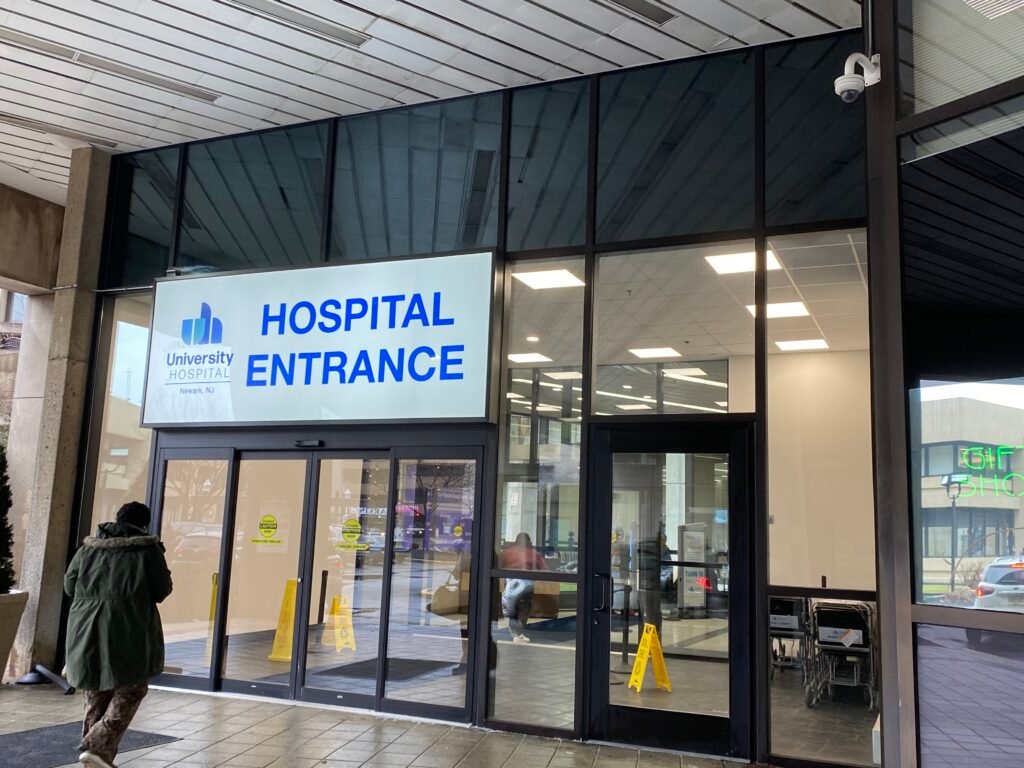
University Hospital in Newark operates one of at least six prehospital blood programs in New Jersey and is the only one in the nation to have received accreditation from an international blood-bank safety group. (Photo by New Jersey Monitor)
Hours after the New Jersey State Police’s Southstar rescue helicopter in Atlantic County was first equipped with capacity to do blood transfusions in the field, it was dispatched to a nearby motorcycle crash where a rider was losing blood fast.
The team arrived in less than nine minutes, according to state officials, and was able to quickly administer blood to the injured rider on scene, long before they could get him to the emergency room. Doctors involved said that fast response probably saved his life.
“We’ve known for a while in medicine that what someone who is having severe trauma, who is bleeding to death — what they really need is blood,” said Dr. Timothy Satty, director of emergency services at Newark’s University Hospital.
NJ lawmakers approve new protections for transgender and reproductive healthcare
The hospital last year launched a prehospital blood program for ambulances it operates in Newark, Orange, and East Orange, and through its partnership with the State Police’s two air rescue units, Southstar and Northstar.
The program, one of at least a half dozen in New Jersey, has treated close to 50 patients with prehospital transfusions so far, Satty told the New Jersey Monitor. While data is still being analyzed, it’s clear to him that the practice is helping people who have suffered motor vehicle injuries, knife wounds, gunshots, and other trauma.
“We have definitely seen those cases where people are very, very ill, their vital signs are very bad, and then they’re a lot better when they arrive to the trauma center,” said Satty, an assistant professor at Rutgers New Jersey Medical School.
The program at University Hospital, the state’s only public hospital, announced in June that it is the first field transfusion program in the nation to be accredited by the Association for the Advancement of Blood and Biotherapies, an international organization that develops blood-bank standards. The designation means the transfusions people get in the field are the same high quality they would receive in a hospital, according to the organization.
Dr. Scott Pasichow, part of University Hospital’s emergency services team, said the accreditation also reflects the program’s careful use of blood, a critical healthcare resource that costs hundreds of dollars per bag. University’s prehospital program ensures blood not quickly administered on ambulances or helicopters is returned to the central blood bank for use in the hospital before it expires, the doctors said.
Pasichow said initial data suggests that, over the past year, at least 100 other trauma patients would have benefitted from prehospital blood transfusions. He hopes to narrow that gap in the years to come, while protecting the hospital’s supply of this precious and limited resource.
“We want to be mindful of using it when it’s critical, when it’s going to save a life, but also not giving somebody blood that doesn’t necessarily need blood,” Pasichow, also a professor at Rutgers New Jersey Medical School, told the New Jersey Monitor.
Prehospital blood transfusions date back to World War II and continued during military actions in Iraq and Afghanistan, according to John Holcomb, an international trauma expert with the University of Alabama. Sometimes these involved “walking blood banks,” in which a medic used his own blood to resupply a wounded soldier.
As more studies documented the benefits of prehospital blood transfusions, the practice became more accepted in civilian life, Holcomb said in a 2023 presentation for the Prehospital Blood Transfusion Coalition, a national advocacy group. Data from 2017 shows prephospital blood use reduced mortality by nearly three-quarters in the first 24 hours and over 50% after a month, he said.
“I can think of no other initiative prehospital — tourniquets, hemostatic dressing, anything else – that will have a bigger impact than prehospital whole blood,” Holcomb said at the conference.
Today, at least 400 prehospital blood transfusion programs are operating nationwide, according to the coalition. In addition to the University Hospital program, services in New Jersey include programs by Hackensack Meridian Health in Bergen County, RWJ Barnabas in Middlesex, New Jersey EMS in Monmouth, Atlantic Care in Atlantic, and Virtua in Camden, the coalition says.
Despite the clear advantages, building University Hospital’s prehospital program took time, money, and regulatory changes to ensure ambulance teams had licensing that allowed them to provide transfusions, and that blood banks could work with mobile responders, Satty said. Dozens of first responders also needed additional training, he said.
Rescue vehicles had to be stocked with specialized coolers and monitoring equipment to ensure the lifesaving product is kept very cold and stable, a separate machine to reheat the blood to human body temperature, and a third device to push the blood into the patient quickly to counteract blood loss, doctors said.
University Hospital is now essentially covering these costs, but the doctors hope state lawmakers will pass a bipartisan bill that would further formalize prehospital blood initiatives, provide state funding for new programs, and require insurance companies to pay healthcare systems the same amount for an ambulance-based transfusion than they would pay for one in the hospital. Currently, ambulance services are reimbursed at set rates that don’t allow for any itemization, the doctors said.
“It’s got to be paid for through the health insurance that pays for all the other parts of care,” Pasichow said.



