
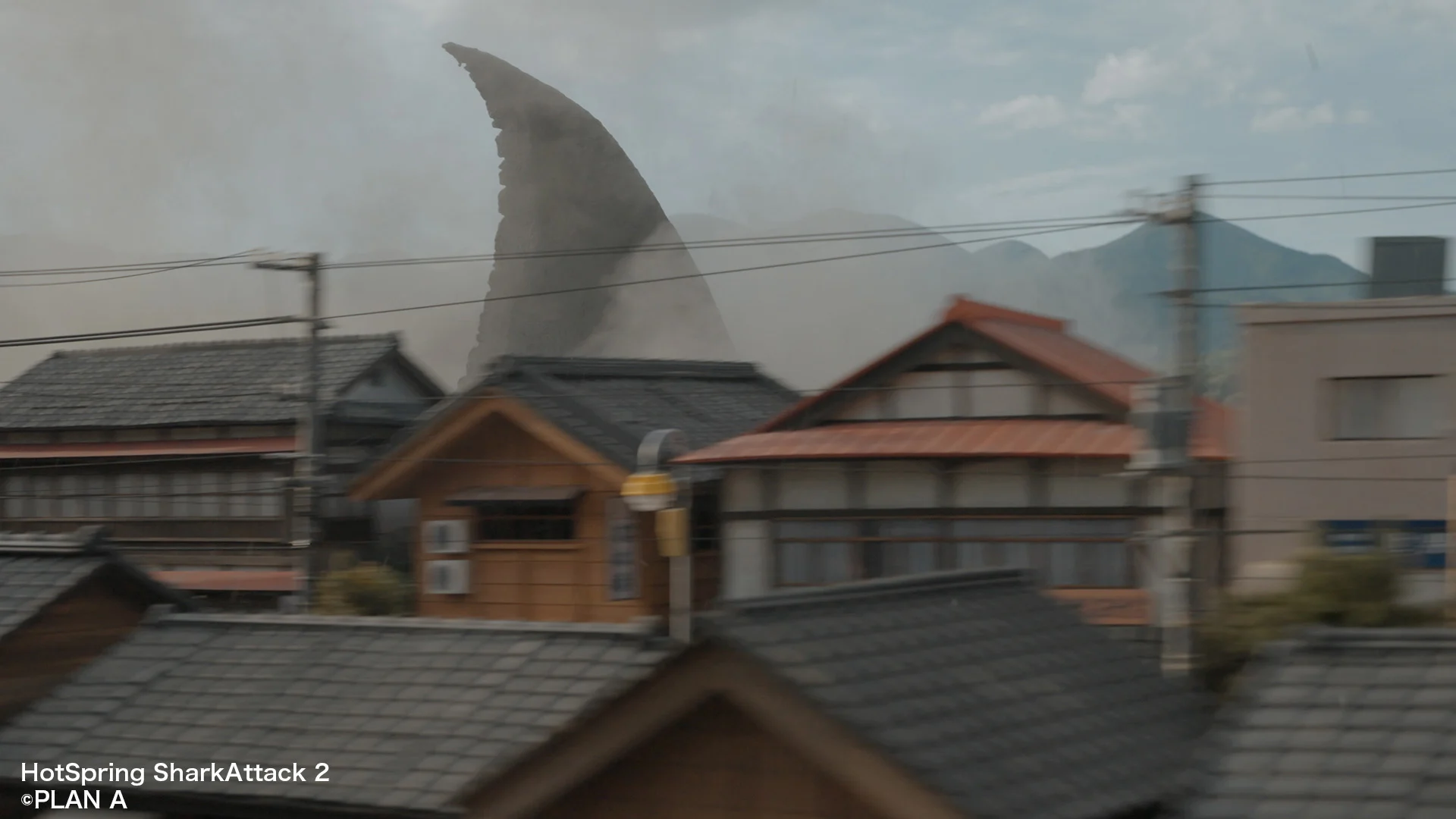
Ever since “Hot Spring Shark Attack” became a festival and audience favourite, director Morito Inoue and his crew have been working on its sequel. Rather than simply repeating the formula of its predecessor, however, Inoue explained that he wanted “Hot Spring Shark Attack 2” to be more ambitious and larger in scale, featuring more effects and, naturally, more sharks. In fact, he promised “three times as many sharks” as in the original.
The result is a production that embraces the silliness of its premise even more wholeheartedly, making Inoue’s work a superior “Sharknado” in many respects while also touching upon themes such as the exploitation of nature and local culture through tourism. As promised by its director, “Hot Spring Shark Attack 2” is an even bigger spectacle than its predecessor, making it essential festival viewing, especially since experiencing it with an audience greatly enhances its entertainment value.
Years after the threat of the infamous onsen sharks has supposedly been eliminated, tourism has still not recovered in many hot-spring regions. The island of Kyushu is one such place, whose local history is intertwined with the legend of a famous warrior who once fought the mighty sharks. High-school student Tenma (Shibata Ruka), however, has little interest in local folklore or the oblivious tourists and cannot wait to leave her hometown after graduation. At the same time, she feels an inexplicable connection to the local legend and the statue of the shark-slaying warrior standing in the town square.
As she investigates the myth, Kyushu is struck by a series of mysterious disappearances and deaths. While local authorities seek a quick solution that will not scare away visitors, Tenma becomes convinced that the onsen sharks have returned. With the help of a group of scientists experienced in fighting the creatures, former police officer Denbei (Kaneko Kiyobumi), once the police chief of Atsumi, joins Tenma in her battle against the sharks. However, as the creatures multiply rapidly, Tenma must uncover the truth behind her mysterious connection to them if she hopes to save Kyushu and its people.
In short, “Hot Spring Shark Attack 2” delivers an even bigger experience than its predecessor. While Inoue’s fondness for kaiju, Ultraman, anime and many other elements of Japanese pop culture was already evident in the first installment, he incorporates even more references and tongue-in-cheek commentary here. Yet these moments are far more than mere audiovisual gimmicks. They are woven into the narrative itself, expanding the universe while adding depth to both new and returning characters.
Putting the absurdity aside for a moment, “Hot Spring Shark Attack 2” actually takes its world-building surprisingly seriously, grounding even its most outrageous ideas within the logic of its story rather than treating them as throwaway jokes. Kyushu, for example, proves to be an inspired setting thanks to its rich onsen culture and distinctive geological features, most notably its volcanic landscape. As with Atsumi in the first installment, Inoue highlights the close relationship between Japanese traditions, geography and local identity, making this sequel considerably more layered than its outrageous premise might initially suggest.
At the same time, “Hot Spring Shark Attack 2” is yet another reminder of the creativity and inventiveness of Japanese genre cinema. Although its intentionally mismatched effects, goofy CGI, miniature work and delightfully awkward puppets may create an impression of deliberate “trashiness”, nothing could be further from the truth. Instead, Inoue once again demonstrates his talent for orchestrating an entertaining spectacle that remains unmistakably Japanese—an identity that, at times, seems to be lacking in other contemporary genre productions from his home country. Beneath the laughter, he also delivers some surprisingly sharp, albeit satirical, observations about tourism and the ways it transforms or exploits local communities. Likewise, he pokes fun at capitalism and corruption, suggesting that the sharks themselves are more than monsters: they become an obvious metaphor for the destructive forces threatening both people and their environment.
“Hot Spring Shark Attack 2” is another gloriously silly and hugely entertaining spectacle that is best experienced with an enthusiastic audience. Morito Inoue more than delivers on his promise of making the sequel larger in every conceivable way while remaining firmly rooted in the traditions of Japanese popular culture. It is exactly the kind of joyful, self-aware genre entertainment that reminds viewers why festival screenings can be so much fun.



