
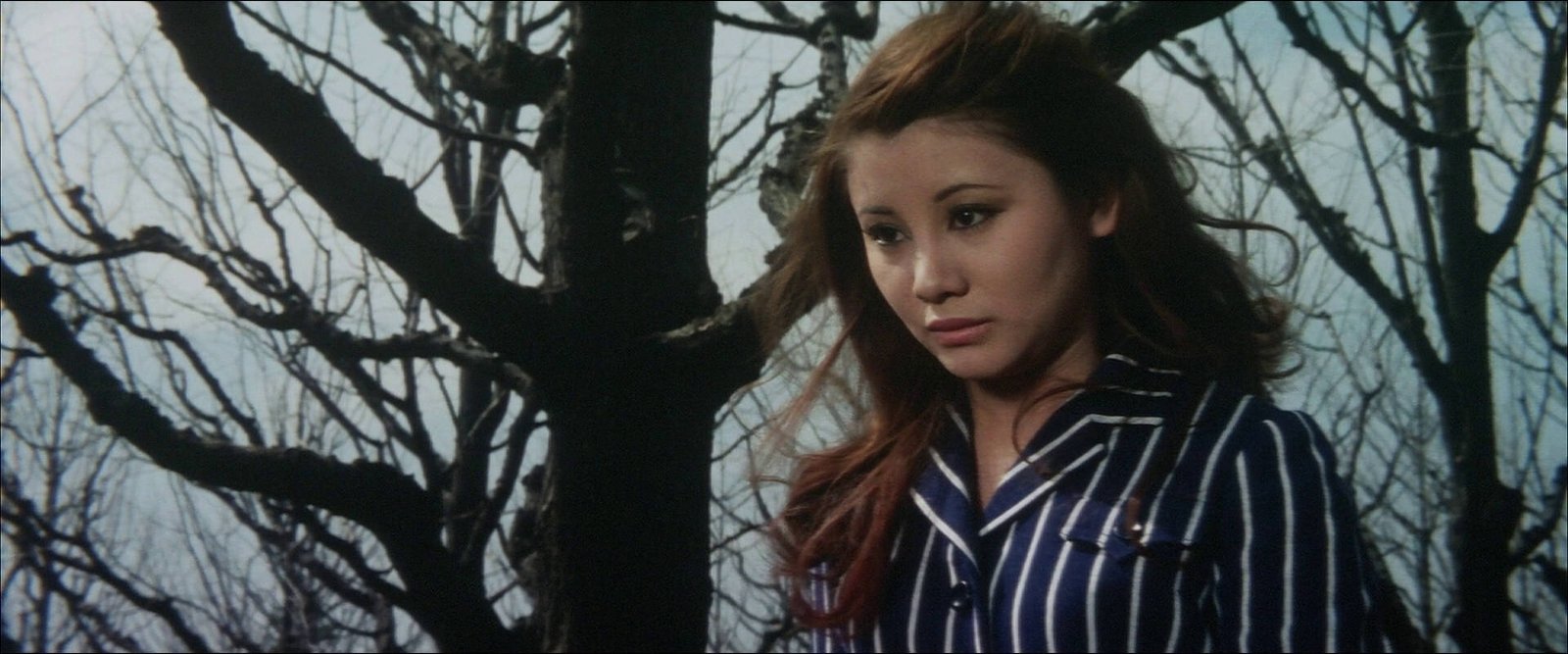
By the end of the 1960s, it was time to see whether the revolutionary spirit of the decade had really brought about the change it had promised. While the victories over conventions and traditions were undeniable, especially in the arts and other sectors, perhaps the most revealing question was whether the change that had taken place was genuine or simply proof that the system had adapted to altered conditions and audiences. Interestingly, not many directors dared to question this particular development, with Yasuzo Masumura being a notable exception, as his works looked closely at politics, the economy and society and how they had adapted to the times, or whether genuine change had actually taken place.
Features such as “Giants and Toys”, “Red Angel” and “Blind Beast” are just some examples within a filmography that dared to take a closer look, with his 1970 effort “Play It Cool” dealing with the emancipation movements of the 1960s and their results. As the main heroine navigates her way through the seedy underworld of Tokyo, trying to make life easier for herself and her family, the question of whether she is an emancipated woman or one who has simply adapted to her environment is posed repeatedly.
Buy This Title
From Terracotta by Clicking on the Image Below
After her mother is arrested for murder, nineteen-year-old Yumi (Mari Atsumi) has to survive on her own. As she needs to earn money fast, she eventually quits dressmaking school to become one of the many hostesses at a nightclub. Her youth quickly attracts the attention of the male customers as well as the ire of her female colleagues, who want her gone sooner rather than later. However, Yumi herself struggles with this kind of work, and as she learns to use her looks to her advantage, she starts negotiating with the male clients, sometimes openly and at other times over a game of poker.
Nozawa (Yusuke Kawazu), a former business lawyer who now runs one of the most exclusive nightclubs in the Ginza district, becomes interested in Yumi. He gets her a job at his club, frequently protects her and supports her as she demands higher sums if she engages with the male customers or sleeps with one of them. He even introduces her to Kada (Ko Nishimura), the owner of the nightclub and many other establishments, who also takes a liking to Yumi, eventually taking her as his mistress. However, it is still not enough for Yumi, who is attracted to Nozawa but also to the money she makes, which she aims to increase even further
When approaching “Play It Cool”, it is worth mentioning how Masumura’s feature can be regarded as both a social commentary and a portrayal of its time. Yumi is a product of a period defined by emancipation movements, which is further emphasized by her deep dislike of men, especially those who exploit others. Playing by the rules, investing in an education and engaging in a relationship will lead nowhere in a world ruled by exploiters, which is a lesson Yumi quickly learns and adapts to her own path in life. Mari Atsumi’s character is both naive and childish considering her age, but she is also eager to learn about this new world and its opportunities, especially since they prove to be far more successful in many ways: she makes a lot more money and seems much more content than her mother, who has been abused time and again by men. However, Masumura provocatively asks whether we would call her emancipated or simply quick to adapt to a capitalist system that rewards the opportunistic and exploitative elements of society.
On the other hand, “Play It Cool” shows us the rotten core of the aforementioned system and how it corrupts people. This is especially fascinating when considering the relationship between Nozawa and Yumi, as both have learned to “play it cool” and stick to the rules of their environment, resulting in financially lucrative positions. By adding the possibility of a romance between the two, Masumura adds another dynamic, as Nozawa in particular seemingly sees Yumi as a mirror image of his own experience and corruption. Ironically, his many attempts to support her ambitions and protect her from others eventually become the engine driving her (and him) into wanting more and more. Considering he was once a lawyer, Nozawa has become the polar opposite of what he once stood for: a man supporting capital and exploitation rather than moral values.
Consequently, Masumura portrays the allure of the capitalist system. While also adding a few references to the counterculture of the 1960s, “Play It Cool” highlights the attractiveness of the world Yumi is introduced to. Ruled by power, prestige and money, she becomes a gambler herself, with many of Yumi’s conversations feeling very similar to business negotiations or like an extension of the poker games she is so fond of. The restaurants, discos and expensive apartments are defining settings and reflections of a world run by capital – and one that is only affordable to those who have mastered the art of playing it “cool”.
“Play It Cool” is a drama about how a society ruled by capital and prestige corrupts the individual. Yasuzo Masumura provocatively asks whether the struggles of the 1960s really brought about meaningful social and political change, or whether people simply learned to adapt to a world still defined by monetary values.



