
Published July 8, 2026 09:57AM
Alanis Siffert saw the number on her bike computer and decided she did not want to know.
She was on the bike at Challenge Roth, riding herself into the front of the women’s race, and the power was higher than expected. High enough that another athlete might have eased off.
Siffert’s solution was delightfully simple.
“Once I saw it on my Garmin, I was like, Oh, that’s really high,” she says. “So, then I didn’t really want to see it. I switched to the navigation page.”
It’s a small detail, but maybe the most revealing one from her win at Roth. Siffert did not ride by data. She caught Lucy Charles-Barclay earlier than expected, felt strong, saw the number, and chose to trust the feeling.
“In my head, if I had started to think about it, I would have thought that I wouldn’t be able to hold it or I’m going to blow up,” she explains. “But it felt right. So, I just went for it.”
There is a kind of innocence to that, though innocence is probably the wrong word. Siffert is not rash. She knew exactly what could happen. She had suffered late on the bike at Roth the year before. She knew Charles-Barclay and Kat Matthews were behind her. She knew the second lap was windy and busy with amateur athletes. But she did not seem afraid of finding out where the limit was.
“I’m trying to improve and reach the top level, so I have to try my best,” she says. “And if I blow up, then the next time I’m going to blow up a bit later.”
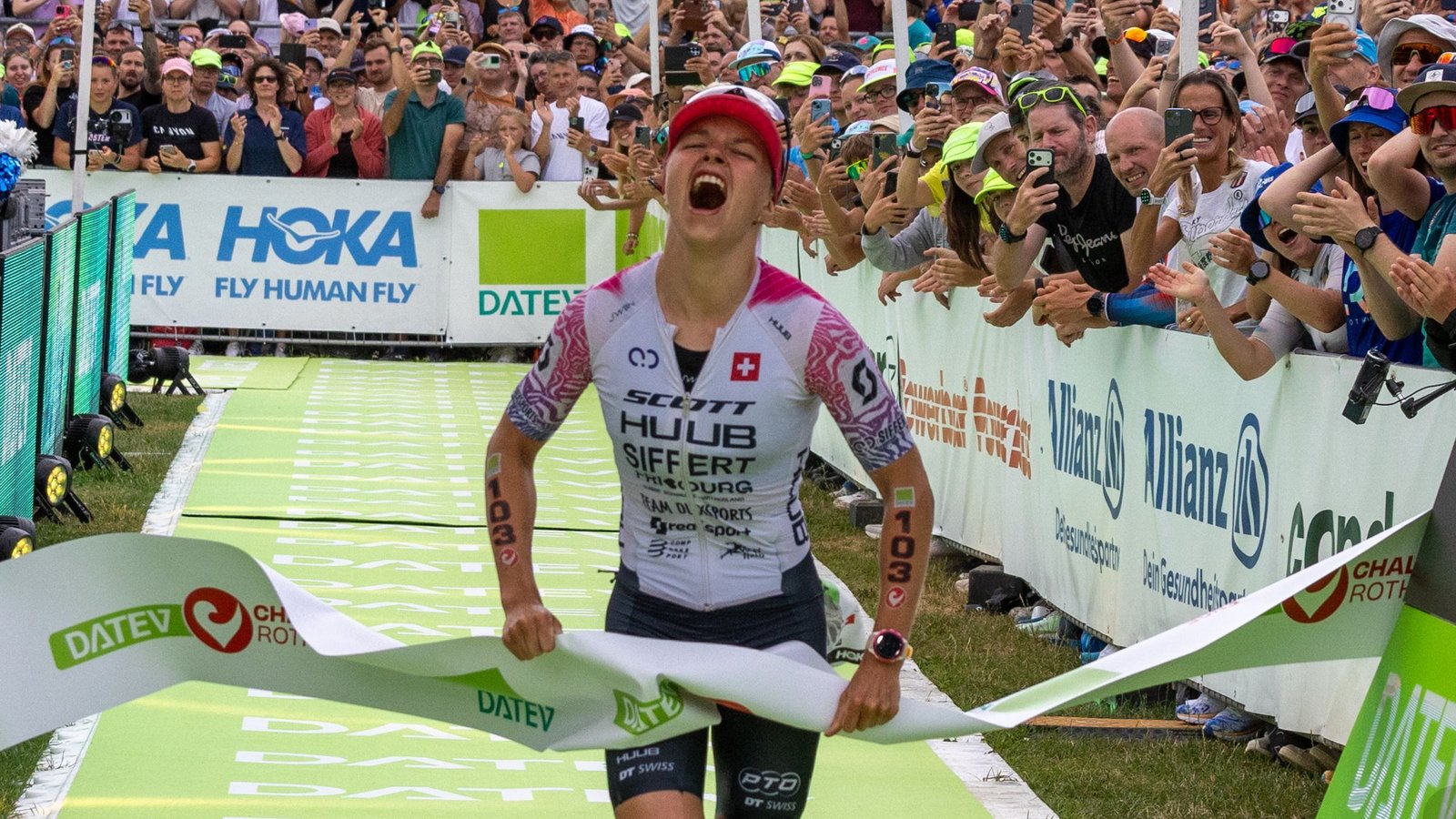
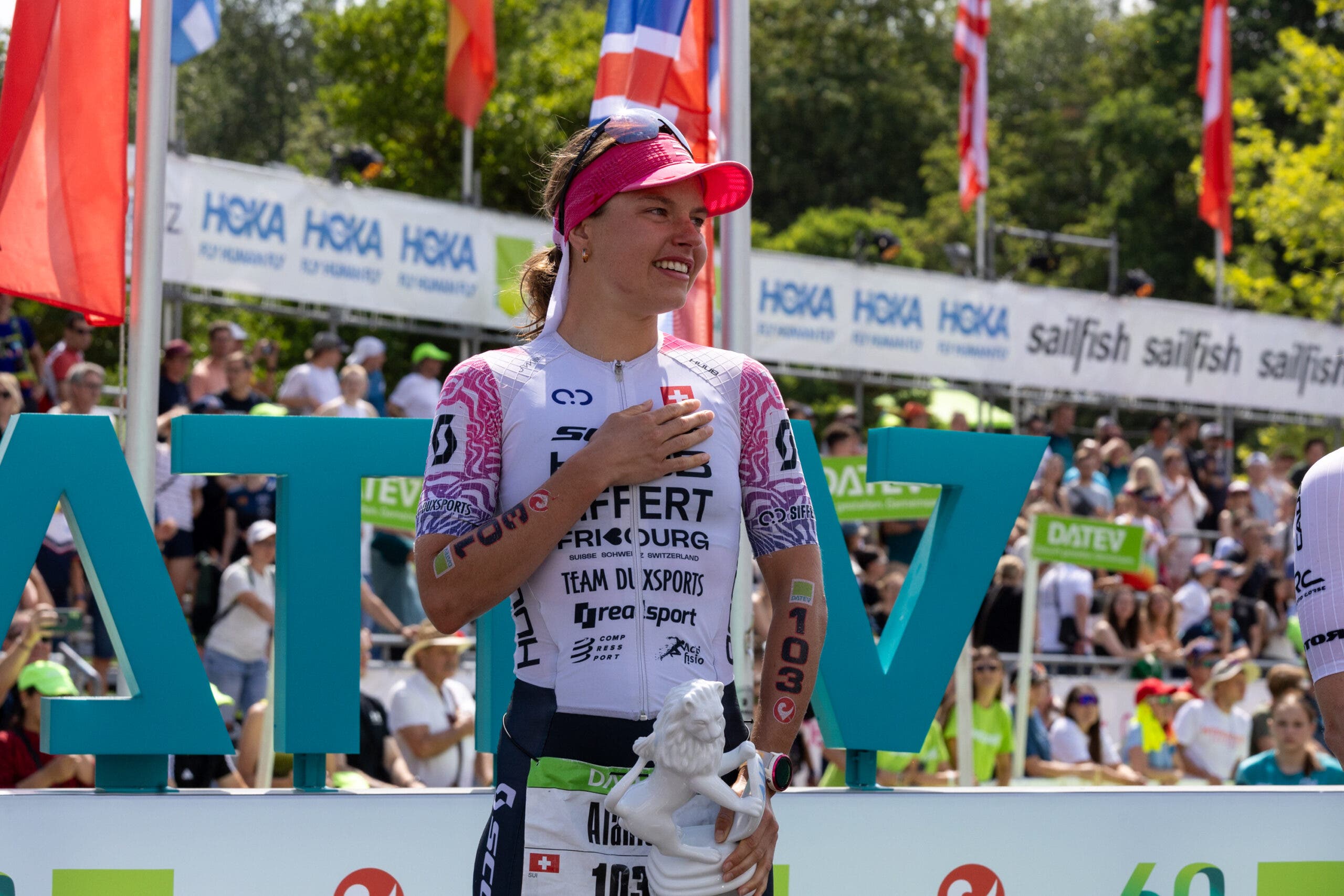
She did not blow up. Instead, the 24-year-old Swiss athlete produced one of the most complete races of her young career. She finished in 8:09:09, with a 52:03 swim, a race-best 4:29:19 bike split and a 2:45:00 marathon – a run more than 19 minutes faster than the 3:04:30 she posted at Roth the year before. Charles-Barclay, the 2019 Roth champion and one of the pre-race favorites, finished second, 7:32 back. Daisy Davies rounded out the podium in third, and Matthews was fourth, more than 22 minutes behind.
For most of the triathlon world, it looked like an upset. The pre-race conversation had centered largely on Charles-Barclay and Matthews. Siffert, despite finishing third at Roth last year, sat outside the main storyline.
“I could feel that everyone thought it was going to be a head-to-head between them,” she says. “But it didn’t bother me. I thought, let’s play my cards when I can. If I can enter the game and they’re going to be a bit surprised, maybe they’re not counting on me. I would say that’s an advantage.”
By the end of the day, everyone had to count on her. But Siffert didn’t win because she threw caution to the wind. She won because she was willing to race before letting caution talk her out of it.
The athlete before the triathlete
Siffert grew up in Fribourg, Switzerland, in what she describes as a “very sporting family.” Her first sport was swimming as her mother “wanted me at first to just know how to swim,” she recalls. There were other sports too: gymnastics, soccer, skiing. But even as a young child, Siffert figured out that she didn’t want to divide herself between multiple commitments.
“It was always you have the soccer game, the ski competition, or the swimming competition all on the same day,” she says. “I didn’t want to do one third of each. If I’m going to do it, I’ll do it right, and I chose swimming.”
That decision built the foundation. Siffert attended a Swiss “Olympic” high school in Bern to focus on swimming. She still lived at home, which meant early mornings, long days and plenty of logistics. Her parents drove her to the pool at 5 a.m. and picked her up from the train station at night. At the time, it was just her life. Looking back, she understands what the experience gave her.
“It was like life school,” she smiles. “I learned so much. I learned discipline. You had to make sacrifices already at a young age. You learn so many things that you can take away. And then, of course, now it’s nice that I can still use the swimming, so all the hours are not wasted.”
Pools closed, and the triathlon door opened
Siffert’s pivot towards triathlon came during the pandemic. In 2020, her daily structure disappeared when COVID shut everything down.
“I was in super shape for swimming,” she remembers. “We came back from training camp, and all the pools were shut down. I was like, what am I going to do?”
She went outside. She started mountain biking with her brother and running with her parents. It wasn’t a career move at first; it was simply exercise and fresh air. “I really enjoyed myself,” she says smiling, “and when I came back to swimming, I found it a bit boring.” Her progress in swimming had also stalled: “I’m really disciplined… but I’m not really improving my times, and it’s not satisfying anymore.”
Triathlon seemed obvious. She could swim. She liked riding. She liked running. Why not give triathlon a try? That led her to a summer camp with a local coach that was part of Brett Sutton’s coaching network. The camp – a mixed group of age-groupers and younger athletes – was a low-pressure way to discover triathlon.
But at the same time, Sutton was also in St. Moritz with his own squad. He had seen her in the pool and had heard about her interest in triathlon.
“He came up to me and said, ‘I see something in you. If you want to give it a go, you can join my squad,’” Siffert recalls. “To be honest, I didn’t even know who he was. I was new to the sport.”
What Sutton saw was far from a complete triathlete. Siffert could swim, but she didn’t even have a road bike and could not really run. “He said, it’s the head,” laughs Siffert. “You have the mentality.”
However, Sutton made it clear that if she joined the squad, “it’s to become a champion, not just play triathlon. So, you have to make a decision.”
She made it. She put her university studies on hiatus and went all-in.
Long distance without the fear
Sutton knew she had a swimming background and a body unprepared for heavy run training. So, they built her up through the bike and long-distance racing.
“I did very little running,” Siffert explains about her first year of training with Sutton. “I started to do long-distance races because he said that’s going to make you stronger. It’s much more sustainable than doing these short races, which will break you or injure you.”
What began as development became Siffert’s preference. “I really enjoy long-distance racing, the mental side you have to have in these races,” she says. “I think it’s more where I see myself, and what I enjoy most and what I’m best at.” She prefers non-drafting because there is no hiding and no waiting for someone else to determine the shape of the race: “you just put the power down and go for yourself.”
At Roth, that was exactly what she did. She had finished third the previous year, but she did not arrive in Roth this year expecting a win or even a podium from herself. The field was strong, and her goal was to be ready, aggressive, and present enough to take the opportunity if it came.
The key word here is “aggressive.”
Siffert trains largely by feel. Sutton gives intensity cues rather than strict numbers: easy, moderate, medium, mad. “Medium” is “comfortably uncomfortable.” Mad is exactly what it sounds like: all-in for the requisite duration. She has a power meter, but only recently. She has pace on her watch when running. She uses the pace clock in the pool. She does not use heart rate data at all. Regardless, the data takes a backseat to how she feels. It’s useful feedback, but it doesn’t drive how she trains or races.
At Roth, her feeling said “go.”
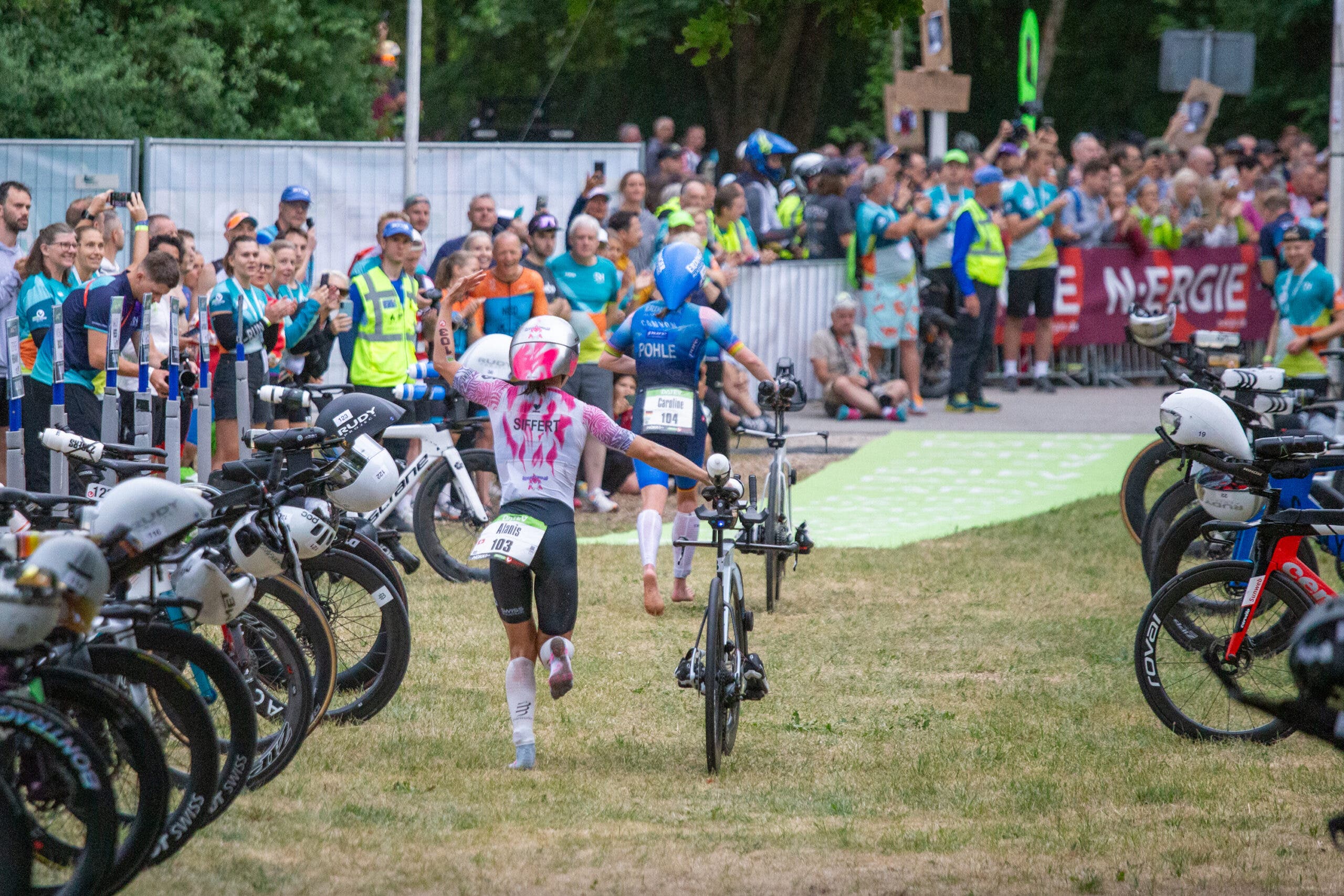
Siffert exited the water about 90 seconds behind Charles-Barclay, then started to reduce the gap faster than expected. “I caught her really early,” she says, still sounding a little surprised by it. I was not expecting that.”
From there, she kept pressing. The power was high. She hid it. The effort was hard, but it felt right. That’s the simplest explanation for the day: Siffert trusted what felt right before she trusted what looked sensible.
The duck runs 2:45:00
When Siffert began triathlon, the run was the glaring weakness. Sutton, naturally, had a nickname for her.
“When I started running, he called me the duck,” Siffert laughs. “Because I couldn’t run.”
One leg goes a little to the side. But over the last few years, the work has started to sink in. First, she was hanging on to the slowest group in the Sutton squad. Then she moved up. Earlier this year in China, she noticed she was no longer surviving the front group. At times, she was leading it.
“We didn’t change the sessions,” she explains. “It was the same again, again, again, again. You just improve. Consistency is key.”
Still, no one knew what would happen when she got off the bike at Roth. She had ridden hard. Maybe too hard. Last year, she remembered feeling awful off the bike. This time, she felt differently.
“I started to run, and it felt great,” she says. “I was just in the flow.”
She looked at her watch and saw 4:00 minutes per kilometer. At one point she saw 3:55 per kilometer. She knew that was fast. Maybe too fast. “I thought, Don’t look at it, because you feel good,” she shrugs. “So just run.”
Behind her were women capable of running her down. Charles-Barclay and Matthews are proven athletes with bigger resumes. Siffert knew that, but at the first U-turn, she could see the gap was not shrinking. Indeed, it was growing.
At around 20km, when she knew the gap was roughly three minutes, she finally let herself consider the possibility that she could win Challenge Roth. Then she pushed it away. “If I want to win, I just have to keep doing what I do,” she says. “It was still a long way to go.”
Her parents were on course, focused mostly on handing her nutrition. Normally, they would have given splits, but this time, they stayed quiet. Afterwards, Siffert asked why.
“They said, you looked so composed,” she recalls. “You looked controlled. Your body language – they saw I was in a good place. They said, you didn’t need to know the split.”
That is telling. From the outside, her run pacing looked risky. From inside the race, Siffert was in control.
The long (Kona?) view for Alanis Siffert
Siffert’s performance surprised even Sutton. After the race, he told her that he had expected improvement, but not this.
“He said, I normally know what you’re capable of,” she says. “He said, I did the math, and it’s already a big ask to think you’re going to improve 10 minutes on your marathon. [Siffert’s prior best was 2:57:48 at Challenge Almere in 2024]. That’s already huge. He said he was really stressed. And then he said, you really impressed me.”
Siffert is careful about what the win means. “I don’t say that I beat Lucy one time and now I’m at that level,” she says. “But I did have that capability on the day.”
She knows the media will see her differently now. She knows she will not be overlooked in quite the same way. But she does not want to start racing as a contender. She hopes to keep racing from the same place that won Roth. “I don’t feel the pressure,” she confesses. “It’s more that I feel I have the capability to be at this level, so it gives me confidence and motivation.”
The temptation after a big win might be to seek the next big target. So, what is next? She is qualified for the Ironman 70.3 World Championship in Nice. She also wants to return to the French races in the Alps – Embrunman, Alpe d’Huez, Gérardmer XL – that Sutton has used as part of her development. Kona is also part of the vision, but she’s willing to be patient.
“For sure, Kona is the goal,” she smiles. “But if I go to Kona, I also want to be in the fight, be in the race, and not just say I was starting in Kona.”
That patience matters. Siffert sees room to improve everywhere, especially in the run. She has only been running for four years. She believes there is far more to come if she can stack consistent work not just for months, but for years.
“I feel like now I’ve just started to get it together,” Siffert admits. “If I can consistently do these training sessions, not only for three or four months, but a year, three years, where can I go?”
After such a decisive win at Challenge Roth, that question feels less hypothetical.
Whatever comes next, Siffert is patient enough to know she does not need to rush to Kona. But inside a race, when the feeling is right, her patience dissipates. She is not willing to wait around for the numbers to give her permission.



