
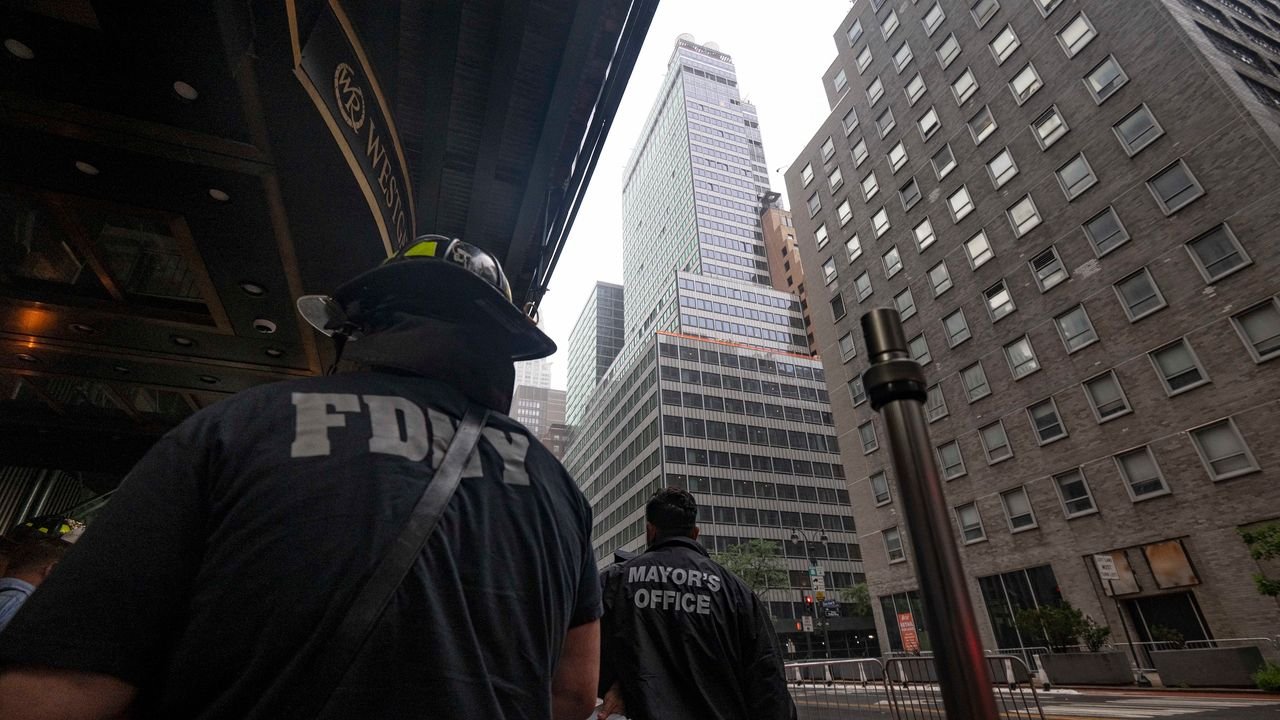
If so, Berman, who had previously been celebrated for bringing conversions to the city that were, if not cheap, at least not pornographically expensive, was suddenly a potential J. Bruce Ismay. Buildings don’t just typically fall over; someone, in all probability, made a mistake in building them. The Pfizer conversion used almost no organized labor, which did not make the unions happy; the only union workers on the site were the steamfitters, who immediately claimed that Berman skimped on steel. (He has called the charge “total nonsense.”) Scabby, the inflatable rat, quickly made an appearance at the site. The carpenters’ union deployed a truck to the area with an electronic readout sign: “Crime Scene,” one message read. “1,600 residential units at risk due to cutting corners.” Another readout asserted “Shame on Metroloft.” (Berman told me he would not comment on the Pfizer situation.)
In the world of New York City real estate, Berman is prominent but neither famous nor infamous. Mike Vatter, of the Laborers’ Union, told me that Berman was just “one of many.” And, although the current mayoral administration wants new units in old buildings, Berman’s projects don’t exactly fit neatly within the Zohran Mamdani mold. In 2024, as we toured his Wall Street conversions, he pointed out amenities such as swimming pools and well-stocked gyms—luxe additions that had been planned for the Pfizer building as well. Creating housing for first-year associates at Goldman Sachs—which is how Berman told me he conceptualizes his work—qualifies you as a do-gooder only within the extraordinary economic microenvironment of Manhattan.
But, anyway, renown wasn’t what Berman sought, as he made clear when I wrote about him. For him, the puzzle of how to make money was what mattered—he likened converting an office building into a residence to solving a Rubik’s Cube. If the math didn’t work, he hollowed out cores and used the leftovers to add floors on top until it did. Berman’s passion for shoving as many units into as small a space as possible and then going big on plush facilities led one of his own architects to describe the developments to me as “slums for the rich.” He was unapologetic: “If the price per pound is right, I say, ‘Let’s go.’ ” Berman was born in the Soviet Union, in 1959, and another of his business principles, he explained, was to try to avoid any deal that involved government, i.e., he would not get involved in a project that required a change in zoning regulations. “Life is short,” he said.
Up until July 7th, none of this was a problem. But now, faced with a potential debacle on East Forty-second Street, Berman could have used a few friends—city officials, union leaders, the kind you make when you put your name on an art museum. (Before turning to real estate, Berman worked at his father-in-law’s art gallery.) It didn’t help that when Berman stepped up to explain the problem, he made the mistake of free-associating in front of a reporter. “This incident is nothing more than a typical construction mishap,” he told the Times, on Tuesday evening. “It happens, unfortunately, far too often on construction sites: falling cranes, people—God forbid—falling off buildings, windows falling.”
Though attention immediately focussed on Berman, he wasn’t the only possible malefactor by any means. A conversion of this size isn’t a solo project. Berman isn’t the only owner of the structure—he shares that title with David Werner, known informally around the city as the King of Flips, whose sense of civic obligation makes Berman start to sound like a member of Mamdani’s Democratic Socialists of America. And where was Gensler, the global design and planning firm that would have submitted the architectural drawings? Or the structural engineer, the well-known firm Goldstein Associates Consulting Engineers? And the layers of inspection oversight that a renovation like this gets from the private inspectors that it hires, and ultimately from the city? According to the Times, which combed through “millions of rows of city violation records,” the inspection firm hired for the project had a history of errors and violations on previous jobs, for which the city assessed fines, not all of which the company appeared to have paid. Previous problems with the Pfizer-building renovation also came to light in the press—a fall off a ladder and objects that plummeted to the street below. Money, as George Bernard Shaw once wrote, “is not made in the light.” New York City real estate sometimes resembles a basement crawl space.



