
After attracting international attention with “MONDAYS: See You ‘This’ Week!” and subsequently returning to documentary with “A Big Home”, Ryo Takebayashi once again grounds an unusual concept in recognisable everyday anxieties. “The Invisibles” received its world premiere in the Fanta-scape section of the 30th Bucheon International Fantastic Film Festival, where it won the Children’s Fantastic Choice Award. It will be released theatrically in Japan on August 28, 2026.
Gaku (Katsuya Maiguma) lives quietly on an island with his three daughters following the death of his wife. His oldest daughter, Fuko (Hana Kondo), dreams of becoming a filmmaker, while Nene is interested in fashion and acting. The youngest, Hikari, was born invisible. Terrified that the outside world will discover her existence, Gaku has confined the girls to an isolated life, rejecting their ambitions under the guise of keeping them safe.
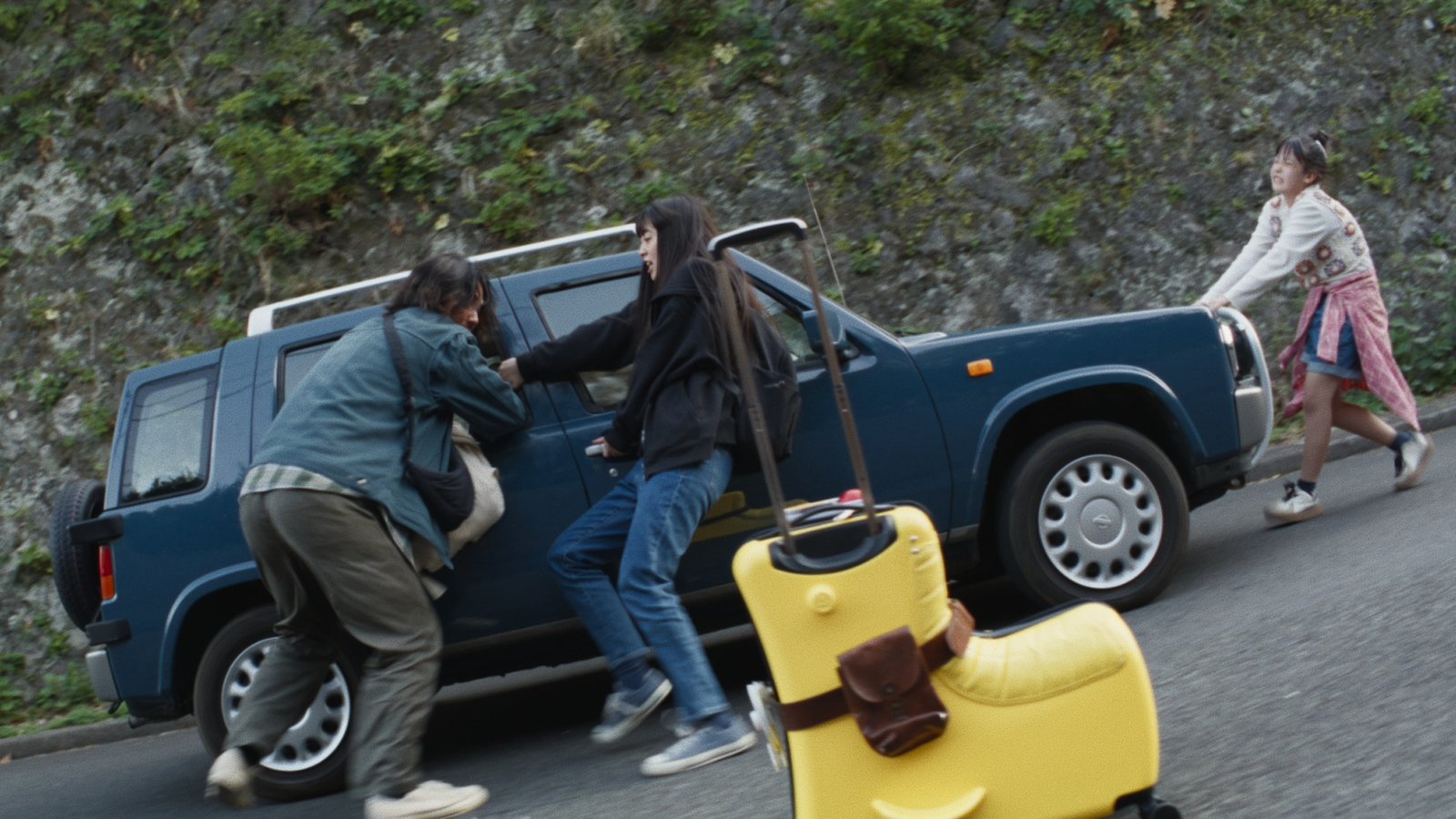
When they learn that the girls’ estranged grandmother, a famous actress living in Tokyo, has been hospitalised, the daughters pressure their father into making the journey to see her. Gaku reluctantly agrees, although travelling with an invisible child proves considerably more difficult than remaining hidden at home. Carrying Hikari’s conspicuous yellow suitcase, the family embarks on a road trip filled with accidents, unexpected encounters and increasingly unavoidable confrontations with the fears that have shaped their lives.
The most intriguing aspect of Takebayashi’s approach is the way he presents a father who essentially torments his children in an attempt to protect them. Gaku restricts their movements, dismisses Fuko’s filmmaking ambitions and treats contact with the outside world as a constant threat. Nevertheless, Takebayashi does not turn him into a simple villain. His behaviour emerges from grief, trauma and an overwhelming fear that Hikari will be rejected or exploited if her condition becomes known. His love for his daughters is genuine, but it has gradually transformed into a suffocating form of control.
The daughters’ resistance is therefore crucial. Rather than openly rebelling against Gaku, they repeatedly push, manipulate and gently corner him into allowing them to experience what they want. Their eventual ability to make him participate in their plans results in one of the most adorable aspects in the movie. It also encapsulates the production’s emotional philosophy: the father does not need to stop caring, but he must understand that protection cannot mean preventing his children from living.
This kawaii sensibility permeates much of the road trip. Many of the individual episodes are light, warm and playfully constructed, while Hikari’s invisibility becomes a source of comedy without reducing her to a gimmick. Although she cannot be seen, her personality is felt more vividly as the journey continues. Her comments, pranks and interactions gradually allow the audience to imagine her expressions and movements, fulfilling the director’s ambition of making an unseen character emotionally visible.
At the same time, Hikari’s condition functions as a metaphor for people with disabilities or special needs whose families sometimes respond to social prejudice by hiding or excessively shielding them. Gaku assumes that the world is incapable of accepting his daughter, but he rarely allows Hikari to discover that for herself. The excellent episode involving the blind man makes this point particularly effectively. Unable to see any of the family, he encounters Hikari without treating her invisibility as something frightening or abnormal. Their interaction becomes the most moving section of the narrative, suggesting that understanding another person depends far less on physical appearance than on openness and empathy.
Trauma and regret also remain palpable throughout. Gaku has never fully processed his wife’s death, while his daughters have inherited the consequences of his fear. The trip gradually becomes an opportunity for each family member to confront what has been lost and what might still be recovered. The final section involving the grandmother, however, is somewhat far-fetched and disconnected from the more convincing emotional progression that precedes it. Her role is important to the premise, but the resolution surrounding her feels closer to a narrative mechanism than an organic culmination of the journey.
The episodic structure is similarly uneven. The repeated pattern of a new problem appearing, the family panicking and a solution eventually being found becomes noticeable, particularly during the middle stretch. Some encounters contribute directly to the central themes, while others primarily serve to extend the road-movie format. Nevertheless, the episodes work more often than not, largely because of the warmth of the characters and the chemistry among the three sisters.
Maiguma is convincing as the anxious father, communicating both Gaku’s oppressive behaviour and the vulnerability underneath it. His tendency to expect disaster gives the comedy much of its energy, but he never loses sight of the grief driving the character. Kondo is equally appealing as Fuko, whose desire to become a filmmaker represents the future Gaku is most determined to control. Hana Yayama brings an energetic, mischievous presence to Nene, while Rinko Suzuki ensures that Hikari develops a distinctive personality despite remaining visually absent.
The three young performers play off each other particularly well, creating the impression of sisters who have spent years entertaining, annoying and protecting one another. Their natural chemistry prevents the sentimental passages from becoming excessively calculated. Susumu Terajima is also a welcome presence as the taxi driver who becomes involved in their journey, adding his familiar mixture of gruffness and understated humour. Kimiko Yo completes the central family dynamic as the grandmother.
Visually, the yellow suitcase is an inspired choice. Since Hikari herself cannot occupy the frame conventionally, the brightly coloured object becomes a moving indicator of her presence. It simultaneously attracts attention and illustrates the absurdity of Gaku’s efforts to keep her hidden. The imagery surrounding it is among the most memorable in the production, turning an ordinary piece of luggage into a symbol of both Hikari’s confinement and her refusal to disappear completely.
“The Invisibles” occasionally suffers from repetition, and its final dramatic turn does not connect smoothly with the rest of the journey. Nevertheless, Takebayashi succeeds in transforming the traditional invisible-person concept into a warm family road movie about grief, disability, parental anxiety and the dangers of confusing love with control. Anchored by Maiguma’s layered performance and the charming chemistry among the three sisters, the result is funny, moving and frequently adorable. Most importantly, it understands that truly protecting someone does not mean hiding them from the world, but helping the world learn how to see them.



