
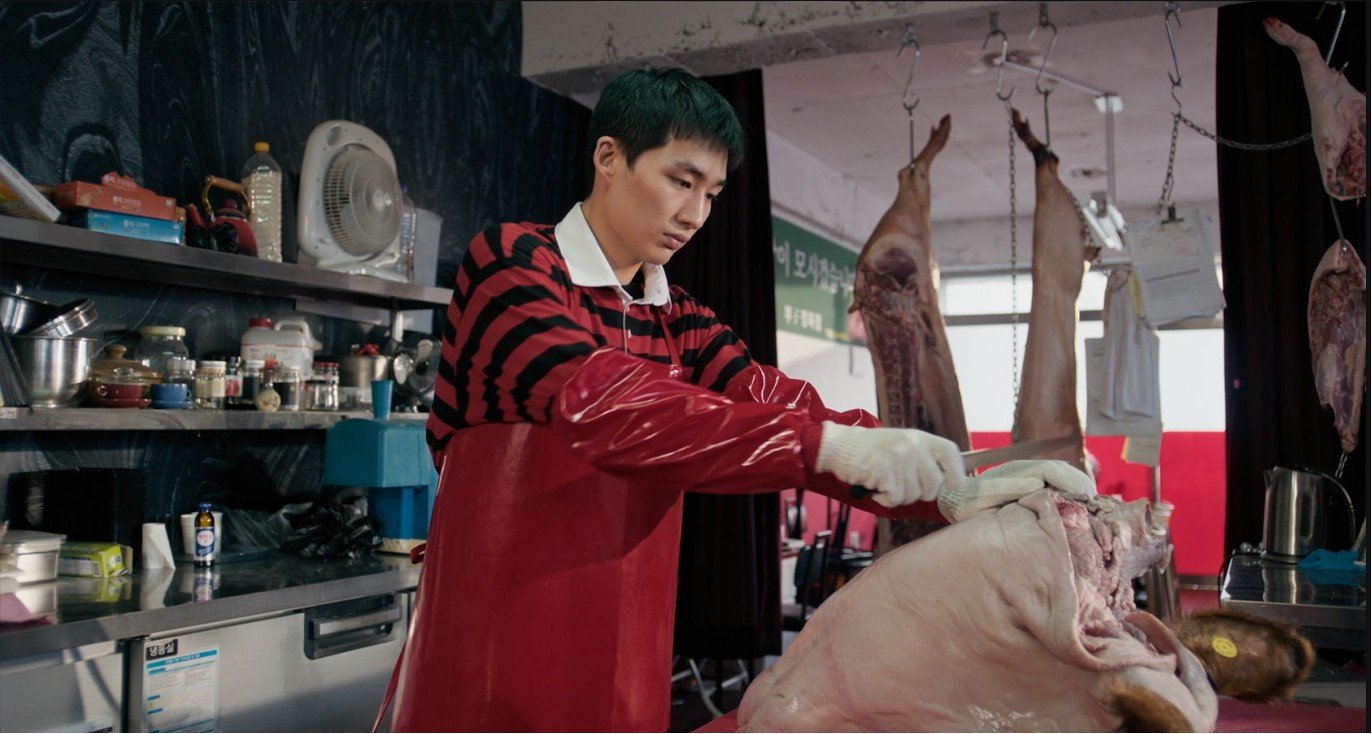
Produced through the Korea National University of Arts, “The Only Child in the Butchery” is the feature debut of Yoo Hyoung-joon, who studied character animation at the California Institute of the Arts before pursuing directing at the Korea National University of Arts. His previous work includes the animated shorts “Kincet Side” and “Dream Merchant,” as well as the live-action shorts “As Seen” and “A Record to Be Remembered.”
Presented in the Bucheon Choice Korean: Features section of the 30th Bucheon International Fantastic Film Festival, the 81-minute production earned Yoo the Best Director Choice award, while Jeong Hyeong-seok received a Special Mention for his performance.
Orphaned at a young age, Tae-seop (Kwon Ji-woo) was raised by his aunt’s husband, whom he has always called father. In exchange for being given a home, he has spent most of his life working without pay in the man’s butcher shop. Now an adult and preparing to marry the woman he loves, Tae-seop finally asks for the money he believes he has earned. His request is coldly rejected, with his supposed father once again presenting food, shelter and upbringing as debts that Tae-seop can never finish repaying.
The discovery that the older man is willing to spend freely to conceal an extramarital affair changes something in Tae-seop. Realising that the lack of money is not the issue, he begins anonymously blackmailing him, hoping to secure enough cash to leave the butcher shop and establish an independent home. The plan initially seems straightforward, but the entrance of a suspicious husband, a blackmailer, the police and an unexpected disappearance gradually transforms the scheme into a convoluted web of lies.
At the centre of the narrative is the manner in which choices can alter a person’s entire existence. Tae-seop’s decision to resort to blackmail is unquestionably wrong, yet Yoo carefully establishes the years of exploitation that push him towards it. His guardian may have taken him in as a child, but that act of benevolence has become a permanent instrument of control. Tae-seop is repeatedly reminded that he owes everything to the family, making any desire for wages, marriage or independence seem like an act of ingratitude.
This pressure of benevolence is among the strongest elements in the movie. Tae-seop is technically free to leave, but emotionally and financially he remains trapped behind the butcher-shop counter. His guardian has convinced him that being raised within the household means surrendering the right to define his own future. The shop thus becomes both his workplace and his prison, while butchery is less a chosen profession than an identity imposed upon him.
The story also reflects the difficulties of sustaining relationships in contemporary Korean society when housing, marriage and financial security are closely connected. Tae-seop does not initially dream of wealth or revenge. He merely wants the money required to begin a life with his partner. However, economic dependence prevents him from moving forward, and the frustration produced by this situation gradually turns a relatively ordinary young man into an amateur criminal.
In this sense, “The Only Child in the Butchery” also functions as an unusual coming-of-age story. Tae-seop’s awakening does not arrive through education, romance or a moral lesson, but through his discovery that the family structure he trusted has always been fundamentally unequal. Growing up means recognising his exploitation, although the methods he chooses to escape it bring consequences he cannot anticipate. Each attempt to take control only draws him further into a reality shaped by deceit, jealousy and dangerous impulses.
Despite its brief duration, the narrative is impressively layered. Yoo moves between styles several times, beginning with an understated family drama before introducing adultery, surveillance and blackmail. The presence of the police and the mysterious blackmailer adds both suspense and humour, with the director maintaining a delicate balance between the two. The situation becomes increasingly absurd, but never to the point that the characters’ desperation loses its emotional weight.
The twists are also handled as a kind of guessing game. Information is rarely revealed immediately, and much of the tension comes from what the characters are hiding from one another. Apparent victims become potential perpetrators, while people who seem to understand what has happened are frequently operating with only part of the truth. Some developments border on excessive convenience, but the constant shifts keep the story engaging and ensure that its short running time feels particularly dense. At the same time, the violent moments are well embedded in the narrative, actually progressing the story, although the last one is somewhat abrupt one could say.
Kwon Ji-woo gives a very good central performance as Tae-seop. He captures the protagonist’s passivity without making him seem empty, gradually revealing the resentment hidden beneath his obedient exterior. His nervous reactions after the scheme begins to collapse are equally effective, particularly as Tae-seop tries to behave normally while becoming increasingly aware that almost everyone around him may know more than they admit.
Jeong Hyeong-seok is also excellent as the man Tae-seop has been conditioned to regard as his father. His performance avoids turning the character into a straightforward monster. Instead, his casual entitlement is what makes him so disturbing. He genuinely appears to believe that taking in an orphan gave him the right to control that person indefinitely. Ahn Min-young is similarly impressive, particularly in the way her character reacts as the affair, the extortion attempt and the disappearance begin colliding. Her behaviour introduces another layer of unpredictability to an already unstable situation.
The editing complements the narrative’s accumulation of misunderstandings, allowing each new revelation to revise the audience’s interpretation of what came before. The changes in tone are frequent, but the transitions between mystery and humour work for the most part. Rather than interrupting the suspense, the comedy emerges from the characters’ increasingly desperate attempts to conceal their behaviour.
The recurring image of the cow’s head is another particularly effective concept. Closely associated with Tae-seop’s unwanted existence as a butcher, it conveys the grotesque atmosphere surrounding the shop while also suggesting how thoroughly his identity has been consumed by the work forced upon him. Its reappearance at the end provides the story with an appropriately ironic visual conclusion, returning Tae-seop to the symbol of the life from which he has spent the entire narrative attempting to escape.
“The Only Child in the Butchery” is an engaging and layered debut that uses crime and black comedy to explore the ambiguous obligations created within families. Although a few of its twists rely on coincidence, Yoo Hyoung-joon handles the shifting styles with confidence, while Kwon Ji-woo anchors the increasingly strange developments with a convincing performance.



