
 New Jersey began its fiscal year with budget reserves that are more robust than forecasters expected, seemingly putting state government in a better position to handle economic turbulence.
The undesignated fund balance totaled nearly $7.7 billion as of July 1, according to an updated summary obtained by NJ Spotlight News obtained via a public records request.
Earlier this year, forecasters employed by Gov. Mikie Sherrill’s administration predicted state government would have $7.25 billion in the reserve account, often referred to as the surplus, on July 1, the start of the fiscal year.
Maintaining flush budget reserves is one tool state policymakers can use to manage revenue losses that can come during economic downturns without having to resort to impactful spending cuts or tax hikes. And the boost to New Jersey’s reserves, which was fueled by buoyant tax collections in recent months, comes at a critical time.

In recent weeks, Goldman Sachs Group Inc. reduced its 12-month recession probability to 15%, from 25%, citing factors including a peace deal to end President Donald Trump’s ongoing war with Iran, lower oil prices and a solid labor market. A round of airstrikes last week, though, led Trump on Friday to declare that the ceasefire is over, while Strait of Hormuz oil tanker traffic was at a halt. And last month, Moody’s Analytics chief economist Mark Zandi said on ocial media that recent economic data “isn’t sending off red flares, but is sending off yellow ones,” in part because of weakening consumer finances that can contribute to a recession.
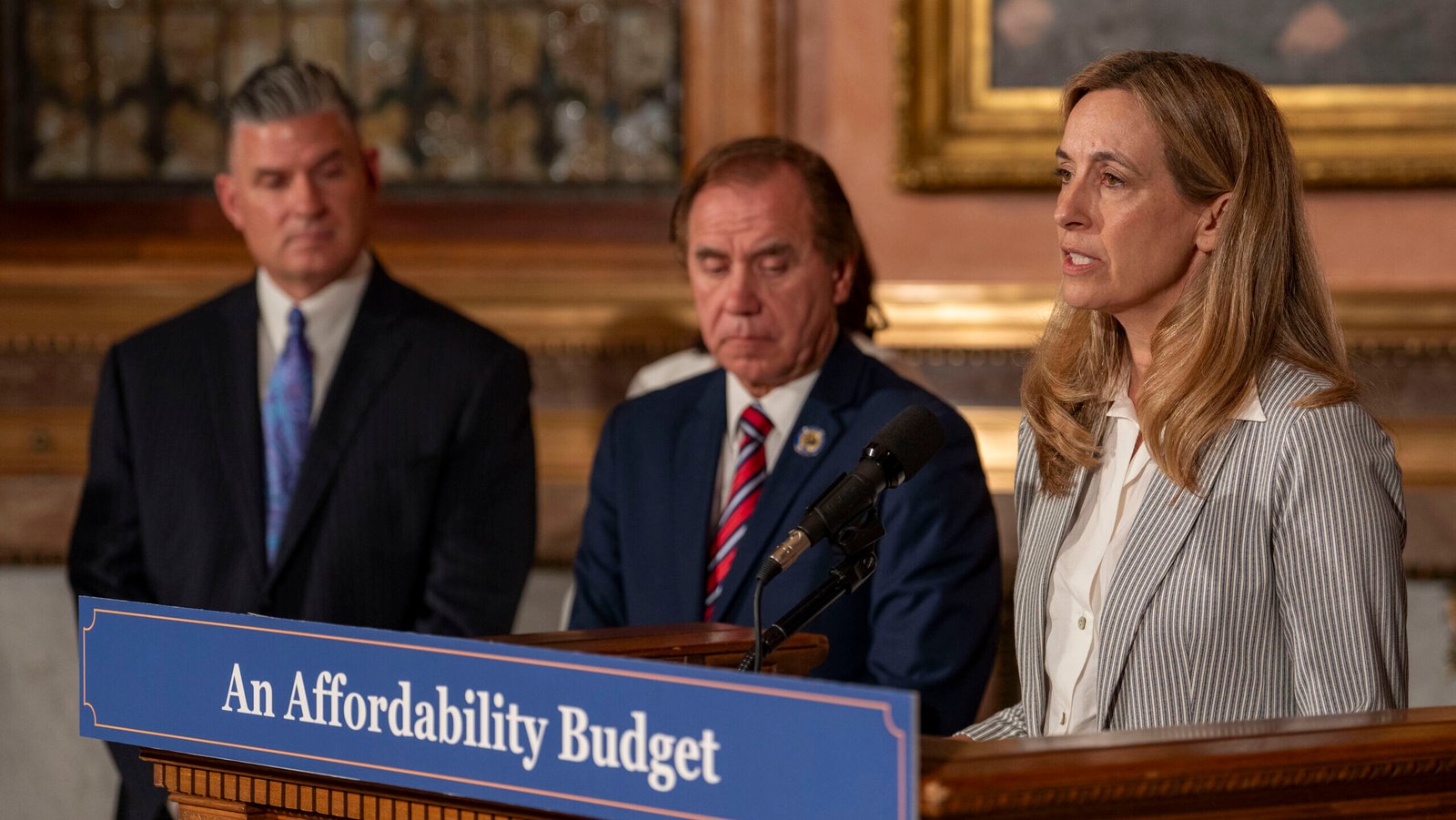
In New Jersey, surplus is often used to support annual spending, and a nearly $61 billion budget Sherrill signed into law on June 30 continues that tradition for another year. Drawing from the reserves gave Sherrill and fellow Democrats who control the Legislature the means to cover an increase in annual appropriations that is projected to outpace revenue growth during the 2027 fiscal year.
As a result, just over $6 billion is projected to be left in the reserve account by June 30, 2027, according to the updated budget summary obtained by NJ Spotlight News.
NJ’s peers
Fiscal policy experts at the nonpartisan Pew Charitable Trusts in March compared states’ surplus fund balances relative to annual spending as of the 2025 fiscal year. Across 50 states, the median fund balance was enough to support government operations for nearly 92 days — about 25% of annual spending.
New Jersey’s undesignated fund balance during the 2025 fiscal year totaled more than $8 billion, or about 14% of annual spending. That would have been enough funding to cover operations for roughly 52 days, according to the Pew analysis.

Sherrill, a former congresswoman, has made it a top fiscal policy goal to curb state government’s habit of spending more than it collects from taxes and other resources.
In March, her administration projected a $3 billion gap between forecast annual revenues and expenditures. The budget approved by lawmakers and Sherrill late last month made progress on that structural imbalance, in part by reducing some planned spending, including on property tax relief for some senior homeowners.
Changes to business tax policies enacted by the governor and majority Democratic lawmakers are also expected to generate hundreds of millions of dollars in new revenue. As a result of these and other budget adjustments, the imbalance is now expected to total less than $1.4 million, according to the updated budget summary.
“It is the most fiscally responsible budget in years,” Sherrill said when she highlighted the spending plan on June 30.
Democratic lawmakers defended their recent budget work by comparing the final reserves projection with Sherrill’s estimate in her March budget proposal. Under that plan, state government as of June 30, 2027, would have had less than $5.4 billion in the reserve account. Now the projected year-end balance is $6.08 billion, equaling about 10% of planned annual spending, according to the updated budget summary.
“This is a budget that will move New Jersey forward in the face of difficult fiscal conditions,” said longtime Senate Budget and Appropriations Committee Chair Paul Sarlo (D-Bergen).
Five weeks
Republican lawmakers, though, offered a much different take. They contend that Sherrill and the Democrats are risking the state’s fiscal stability by spending reserves and not reining in appropriations further.
“A $6 billion surplus on a $60-plus billion budget is not healthy at all,” said Assemblyman Gregory Myhre (R-Ocean) as lawmakers debated the state budget on the Assembly floor. “That’s five weeks of spending – five weeks,” Myhre said. “That’s not a good savings account.”

It was during the COVID-19 pandemic, in 2020, when New Jersey most recently experienced what can happen when state government’s budget reserves are lacking.
A combination of significant job reductions and forced business shutdowns triggered major state revenue losses, overwhelming the roughly $1.5 billion in budget reserves on hand at the time. Policymakers enacted emergency spending cuts, and state government also borrowed roughly $4 billion to help sustain the annual budget. New Jersey taxpayers are still paying off the principal and interest for that debt.
The inadequacy of New Jersey’s budget reserves heading into the health crisis was among the issues detailed in a more than 900-page report on the state’s response to the pandemic that was released by former Gov. Phil Murphy’s administration in 2024. The analysis credited Murphy and lawmakers for prioritizing a rebuilding of budget reserves in the immediate aftermath of the pandemic.
“Having robust surplus funds was thus one of the major learnings from the pandemic, as the flexibility of a large surplus would have meaningfully alleviated fiscal pressures from revenue loss and allowed New Jersey to spend more freely on emergency interventions,” the report said.
Bigger budget
State government’s budget reserves would remain “substantial” relative to historic levels, even after the latest planned spend down occurred, according to Thomas Koenig, budget and finance officer for the nonpartisan Office of Legislative Services, who spoke to lawmakers during public testimony earlier this year.
The state budget’s size, though, has increased in recent years, and the latest hike in annual spending is pushing total appropriations to a record $60.7 billion.
“We are still just one mild recession away from wiping out what is projected to be a $6 billion surplus at year-end.” — Mark Magyar
The Sweeney Center for Public Policy at Rowan University has issued a series of multiyear spending and revenue projections in recent years to help gauge risk in state budgeting, and the surplus is analyzed as part of its regular modeling.
Mark Magyar, the center’s director, said the Sherrill administration “stuck to its guns” on spending, including by requiring savings to offset any new line items lawmakers added to her final budget draft.
The revenue surge in the spring supported some new spending, including a $120 million bailout for Jersey City municipal government, and it was also used to pad year-end reserves, Magyar noted.
“It’s important to understand that the state is still carrying a $1.35 billion structural deficit – even with the corporate tax increases — and we are still just one mild recession away from wiping out what is projected to be a $6 billion surplus at year-end,” he said.
This story is made possible in part by the Corporation for Public Broadcasting, a private corporation funded by the American people.



