
The basics:
- Sherrill signs $60.7B FY2027 budget into law
- Budget includes record property tax relief, full pension funding
- Republicans and business groups criticize employer costs, process
- Supporters cite reduced structural deficit, fiscal discipline
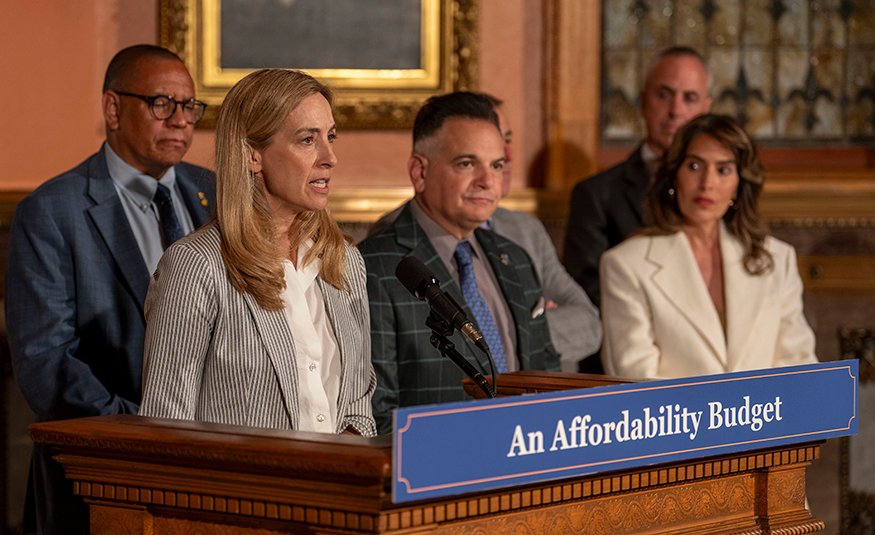
Nearly two weeks after Gov. Mikie Sherrill signed New Jersey’s $60.7 billion Fiscal Year 2027 budget into law, debate continues over whether the state’s largest-ever spending plan strikes the right balance between affordability, fiscal discipline and economic competitiveness.
Supporters argue the budget delivers on Sherrill’s promise to make New Jersey more affordable through record property tax relief, expanded tax credits, full pension funding and historic education investments while cutting the state’s structural deficit roughly in half. Critics counter that the spending plan continues a pattern of high spending shifts additional costs onto employers and once again relied on a budget process that left lawmakers, businesses and the public little time to scrutinize the final package.
While Sherrill and Democratic legislative leaders reached a framework agreement about a week before the June 30 deadline, negotiations over legislative priorities, appropriations and budget language continued almost until the finish. Budget committees advanced the legislation during a rare Sunday evening session after receiving hundreds of pages of documents shortly before the vote. The Legislature gave final approval June 30, and Sherrill signed the budget into law later that night – only hours before the constitutional deadline.
The $60.7 billion budget (Assembly Bill 5327/Senate Bill 2027) ultimately matched the spending level Sherrill first proposed in March while preserving a projected surplus of more than $6 billion, making a sixth consecutive full pension payment and reducing the state’s structural deficit to roughly $1.35 billion.
“When I took office, I promised New Jersey families that affordability would be the north star of every decision we made. With the passage of our first budget, we are delivering on that promise,” said Sherrill. “It is an affordability budget that takes on the rising costs of housing, health care and property taxes while standing up to Trump’s chaos and cuts.”
She added, “It is the most fiscally responsible budget in years. It cuts our structural deficit in half and puts us in a stronger position for the future without raising taxes on individual New Jerseyans.”
Restoring Stay NJ funding
One of the most significant changes during budget negotiations involved the Stay NJ property tax relief program. Lawmakers restored roughly $100 million above Gov. Mikie Sherrill’s original proposal while redesigning the program to better target benefits toward middle- and lower-income seniors. The enacted budget ultimately provides $756 million for Stay NJ, with homeowners earning $100,000 or less eligible for the maximum annual benefit of $6,500, while reduced benefits are available for households earning up to $200,000. The program is part of the budget’s record, more than $4.1 billion property tax relief package, alongside ANCHOR and Senior Freeze.
The plan also includes:
- $7.3 billion for the state’s sixth consecutive full pension payment
- Projected surplus of approximately $6.08 billion
- Structural deficit reduced to roughly $1.35 billion from more than $3 billion projected when Sherrill took office
- Record $12.4 billion for K-12 education
- Record $1.4 billion for preschool education
- Temporary 25% increase in the Child Tax Credit for tax years 2026 through 2028 (S4531/A5329)
- Nearly $1.1 billion in operating support for NJ Transit
- Approximately $2.1 billion for transportation capital projects
The budget also increases funding for first-time homebuyer assistance, restores Summer Tuition Aid Grants, expands child care assistance, continues investments in children’s mental health initiatives, and provides funding for programs addressing homelessness and veteran housing.
Spending transparency
Beyond appropriations, the spending plan supports several priorities Sherrill has emphasized since taking office, including additional funding for the state’s new Budget Report Card, which allows residents to track state spending; and the Permitting Dashboard, designed to let businesses monitor project approvals across multiple state agencies through a single online portal.

State Treasurer Aaron Binder said the final package balanced fiscal discipline with key investments. “This budget demonstrates a steadfast commitment to fiscal discipline, maintaining a full pension payment, responsible surplus, and support for shared priorities like property tax relief and school funding,” he said. “I’d like to thank all who’ve been engaged in the process of crafting this budget.”
Democratic defense
Democratic leaders defended both the process and the final product.

“This is a budget that will move New Jersey forward in the face of difficult fiscal conditions,” said Sen. Paul Sarlo, D-36th District, chairman of the Senate Budget Committee. “Working in collaboration with Gov. Sherrill, the Assembly and my colleagues in the Senate, we kept the budget at $60.7 billion, the same level as proposed by the governor. We continued our emphasis on affordability with the largest amount of property tax relief in state history and a substantial increase in child tax credits to help working families. We are also maintaining our commitment to fiscal responsibility with another full pension payment, the continued reduction in the structural deficit and a surplus of more than $6 billion that will help contend with economic consequences of federal cutbacks.”
Assemblywoman Eliana Pintor Marin, D-29th District, chair of the Assembly Budget Committee, echoed those sentiments.

“This budget reflects what responsible governing looks like,” said Marin. “We reduced the structural deficit, maintained a budget of $60.7 billion, kept a surplus of more than $6 billion, fully funded our $7.3 billion pension payment, and continued our commitment to funding our schools with another record-breaking amount.
“We proved once again that fiscal discipline and keeping our promises to New Jersey families go hand in hand.”
‘Responsible governing’
She added that the budget “expands the Child Tax Credit by 25 percent, continues historic property tax relief, invests in supporting children’s mental health, strengthens child advocacy centers across the state, and provides critical support to organizations and many nonprofits that people rely on every day.”

“This budget reflects our commitment to responsible governing while ensuring New Jersey remains a place where families can succeed and our economy can continue to grow,” said Senate President Nick Scutari, D-22nd District.
Assembly Speaker Craig Coughlin, D-19th District, said the spending plan “delivers for New Jersey families” while “being responsible stewards of the people’s money.”

“I’m especially pleased to pass a budget that includes another year of record property tax relief for New Jerseyans, including our decision to make StayNJ sustainable for retirees, so that homeowners can count on that benefit being there for them,” Coughlin said. “We’re proud of the way this budget sticks up for our neighbors, our communities, and our families.”
GOP response: Budget ‘fails’

Republicans argued the final product failed to deliver on Sherrill’s affordability pledge and criticized both the spending level and legislative process. “This budget fails in the categories the governor herself rightly laid out: affordability, transparency, pork, taxes, general gross unfairness,” said Sen. Declan O’Scanlon, R-13th District, the Senate Republican budget officer. “It fails by any objective measure of success.”

Assembly Republican Budget Officer Brian Rumpf, R-9th District, also blasted the spending plan. “We have a new governor who came in with the promise of affordability,” Rumpf said. “And what we have this year in New Jersey is anything but affordability.”
Other Republicans continued to criticize the state’s school funding formula, arguing many districts remain under financial pressure despite record statewide education spending.
Alongside the appropriations act, lawmakers approved several companion measures that provide the fiscal framework supporting the budget. Among the most significant were:
- A5322/S4536, temporarily capping certain corporate net operating loss deductions (projected to generate approximately $485 million in FY2027)
- A5323/S4537, modifying the Alternative Business Calculation deduction under the Gross Income Tax (projected to raise about $120 million annually)
- A5324/S4533, establishing an employer healthcare assistance assessment for certain employers with workers enrolled in Medicaid (projected to generate approximately $145 million annually)
- A5325/S4534, reducing business formation fees by $25
- S4538/A5326, a supplemental appropriations bill authorizing approximately $358.8 million in additional FY2026 spending, including assistance for Jersey City, World Cup expenses, and other initiatives.
The supplemental spending bill became one of the session’s most contentious issues, with Republicans criticizing it as a vehicle for last-minute appropriations outside the primary budget.
Business groups react
Business organizations generally acknowledged several positive investments but argued employers again shouldered much of the budget’s revenue burden.
New Jersey Business & Industry Association President and CEO Michele Siekerka applauded efforts to keep overall spending relatively flat and highlighted investments supporting Sherrill’s Saving Time and Money agenda and the New Jersey Manufacturing Extension Program.

Still, she said the overall package remains problematic. “At the end of the day, this budget still raises taxes on businesses – yet again – and uses some gimmicks to pay for the new spending, which inherently means a bigger structural hole in next year’s budget,” Siekerka said.
“Nearly all of the revenue-raisers in this budget are on the backs of business, despite having one of the worst business tax climates in the nation,” she continued, criticizing those companion bills while also complaining about the process.
At the end of the day, this budget still raises taxes on businesses – yet again – and uses some gimmicks to pay for the new spending …
– Michele Siekerka, president and CEO, NJBIA
“We cannot continue to find ourselves in the dark until the last minute, so we can understand what’s included and what the impact to taxpayers will be,” Siekerka stressed. “We continue to call for better transparency as we proceed forward.”
Sending ‘the wrong message’

The New Jersey Chamber of Commerce acknowledged the budget debate has concluded but urged policymakers to shift their attention toward long-term economic competitiveness. “With the budget now signed, it is time to turn the page,” said Tom Bracken, NJCC president and CEO. “We encourage the administration and Legislature to work together on a pro-growth, pro-business agenda that supports entrepreneurs, helps existing employers grow, attracts new investment and strengthens New Jersey’s reputation as a destination for business.”
Bracken said supporting economic growth “was not a central focus of this budget.”
“New Jersey’s employers – those who create jobs, drive investment and fuel our state’s economy – were given minimal support,” he said. “In fact, funding dedicated to supporting small businesses was significantly reduced, and the budget includes measures that make it more costly for employers to do business in New Jersey. These policies send the wrong message at a time when New Jersey should be working to attract and retain businesses, not making it more costly and cumbersome to operate here.”
He added that New Jersey will continue facing fiscal challenges unless policymakers prioritize private investment, innovation, job creation, expanding the tax base and economic growth.
“That should be a vigorous focus now – and should be pursued aggressively,” Bracken emphasized.
‘That cumulative effect matters’
The Chamber of Commerce Southern New Jersey similarly applauded targeted investments while expressing concern over the cumulative impact of new employer costs.

“The FY2027 budget includes several meaningful investments that will benefit our region,” said Christina Renna, president and CEO of CCSNJ, citing funding for Rowan University’s Shreiber School of Veterinary Medicine, continued NJ Transit support for SJ Connects and expanded shared services funding.
At the same time, she cautioned that businesses evaluate the state’s overall business climate rather than individual policies. “Employers aren’t reacting to a single tax increase or one new regulation,” said Renna. “They’re responding to all of it at once: higher taxes, new employer assessments, more compliance requirements and rising legal and operating costs. That cumulative effect matters.”
She added that South Jersey businesses compete directly with neighboring Pennsylvania and Delaware for investment and talent. “CCSNJ looks forward to working with the governor and Legislature to build on these positive investments while pursuing policies that strengthen New Jersey’s competitiveness, encourage private investment and support continued economic growth throughout South Jersey,” said Renna.
The debate continues
While the fiscal year is now underway, debate surrounding the first Sherrill administration budget remains active.
Democratic leaders maintain the spending plan demonstrates that New Jersey can invest in affordability while strengthening its long-term fiscal position through a reduced structural deficit, full pension funding and targeted tax relief. Republicans and much of the business community argue the budget continues a pattern of bigger government and rising spending, increasing employer costs and last-minute budgeting that they say undermines both transparency and the state’s economic competitiveness, especially on the heels of some notable defections such as Samsung and ExxonMobil.
For Sherrill, the state’s first-term budget is no longer a proposal or a political negotiation — it is now the blueprint for her administration’s first full fiscal year. The coming months will determine whether supporters’ promises of greater affordability or critics’ warnings about competitiveness prove more prescient.
The post NJ budget debate continues after $60.7B spending plan signed appeared first on NJBIZ.



