
Ken LaRoe introduces himself as both a “rabid environmentalist” and a “rabid capitalist.”
He came out of retirement at age 63 to found Climate First Bank, a financial institution focused on environmentally sustainable investment.
“I wanted to do something with the rest of my life that gives back and also makes a lot of people a lot of money,” LaRoe said. “I think the two have to go together, at this point, to save the planet.”
Climate First Bank markets itself as the first FDIC-insured community bank dedicated to combatting the climate crisis. According to LaRoe, it prioritizes funding for renewable energy and invests only in loans and securities that benefit the environment — giving no money to fossil fuel companies or weapons manufacturers, for example.
The bank’s fintech arm, OneEthos, also developed software to streamline loan applications for solar panels. Businesses in the solar industry can use the technology to offer customers credit options in real time.
Dan Gawrych, who owns Tampa-based solar installment company Lunex Power, initially heard of Climate First when his customers began using the bank to finance their solar panels. He became a client a few years later, after his company experienced a sudden wave of growth. Climate First was the only financial institution that would approve the credit request Gawrych needed to buy new vehicles, hire additional staff and finance commercial property on North Dale Mabry Highway.
“Without that, I wouldn’t have never been able to handle the volume that we did at that time,” Gawrych said.
As the community bank landscape continues to decline across the country, Climate First’s environmental mission seems to have helped it earn customers. The bank established $900 million in assets within three years. Now five years old, it holds nearly $2 billion in total assets.
That figure, LaRoe said, represents large-scale renewable investment.
“We put solar on the roof of almost 10,000 homes. We’re at almost half a billion dollars in consumer solar loans, and then have tens of millions more in commercial and large-scale solar,” LaRoe said. “We’ve contributed to a really significant amount of draw-down in atmospheric carbon.”
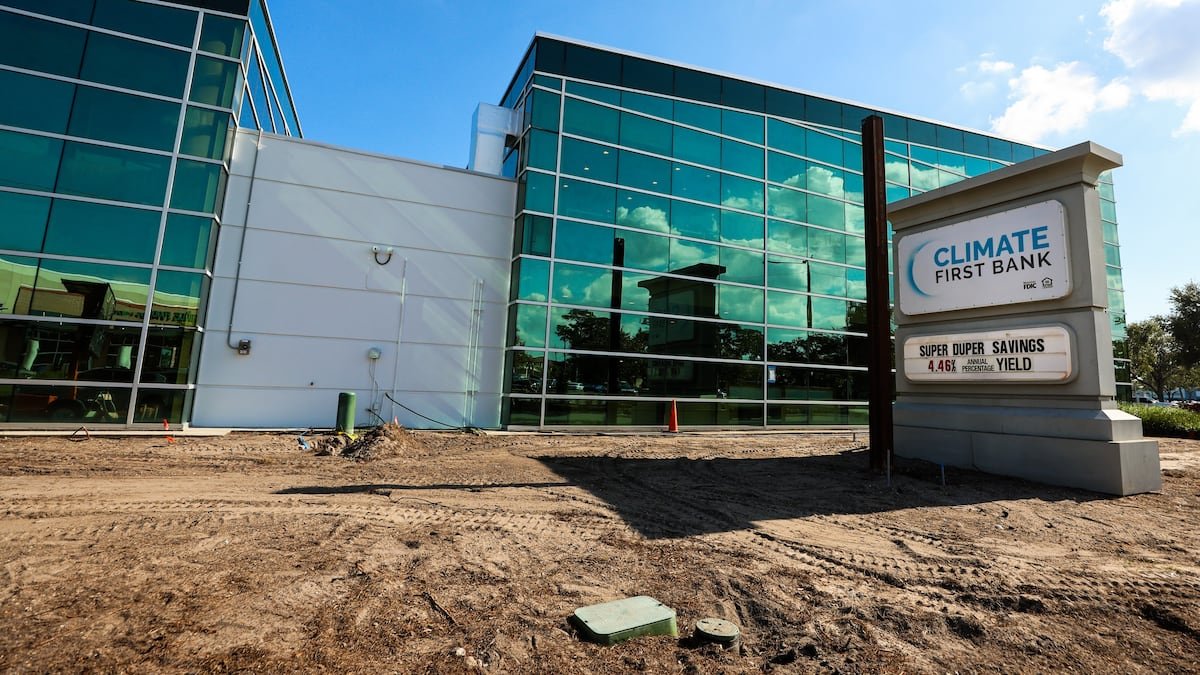
Climate First is headquartered in St. Petersburg, having opened a new office at 182 37th Ave. N last fall. It operates branches in three locations across Central Florida, but it lends in 44 states and has depositors in all 50 (plus Puerto Rico).
The bank is a member of the Global Alliance for Banking on Values, an international network of 74 financial institutions that seeks to “drive sustainable social and environmental change.” It also has a B-Corp certification, making it one of 16 American banks to meet certain standards for social and environmental business practices.
“Any of the deposits that come to us, the vast majority go to good,” LaRoe said. “Whether it’s solar on somebody’s rooftop, or whether it’s a loan to a medical clinic, or whether it’s a loan to a nonprofit.”
OneEthos allows Climate First to specialize in loans related to solar energy, a fast growing sector. The Environmental Protection Agency estimates that renewable energy generation has tripled over the last two decades. As of now, roughly 11% of the Sunshine’s State’s energy is solar.
Data from the Solar Energy Industries Association shows that Florida has the third-largest solar energy capacity among all U.S. states, surpassed only by California and Texas. LaRoe wants to nudge those numbers upward.
“I think it’s incumbent upon the first world nations to support the nations that can’t afford to decarbonize,” LaRoe said.
He is cognizant of the ups and downs of the market, which Gawrych jokingly referred to as the “solar coaster.” When the Trump administration tightened qualifications for the Federal Investment Tax Credit — which was previously 30% for all solar projects, with a 2032 phase-out — Climate First adjusted its loan offerings to reflect the new market.
“They’re being aggressive, but doing their homework at the same time,” Gawrych said. “I think that’s what’s helping them exponentially grow, in a good way, because they’re actually not approaching things as traditional bankers.”
Climate First added $67 million in its most recent round of fundraising, picking up backing from major investment firms Wellington Management and AllianceBernstein. LaRoe said he hopes the bank will eventually put together an initial public offering.
“The plan from the start was to go public, and I feel very committed to that for my shareholders,” LaRoe said.
If the bank does go public, it would be in a position to acquire other small financial institutions. LaRoe said he didn’t yet know how Climate First would reconcile its environmental mission with the holdings of those banks.
“There’s going to be people that aren’t going to agree with us, and there’s going to be those that will,” LaRoe said. “I think it’s just part of the game now.”



