
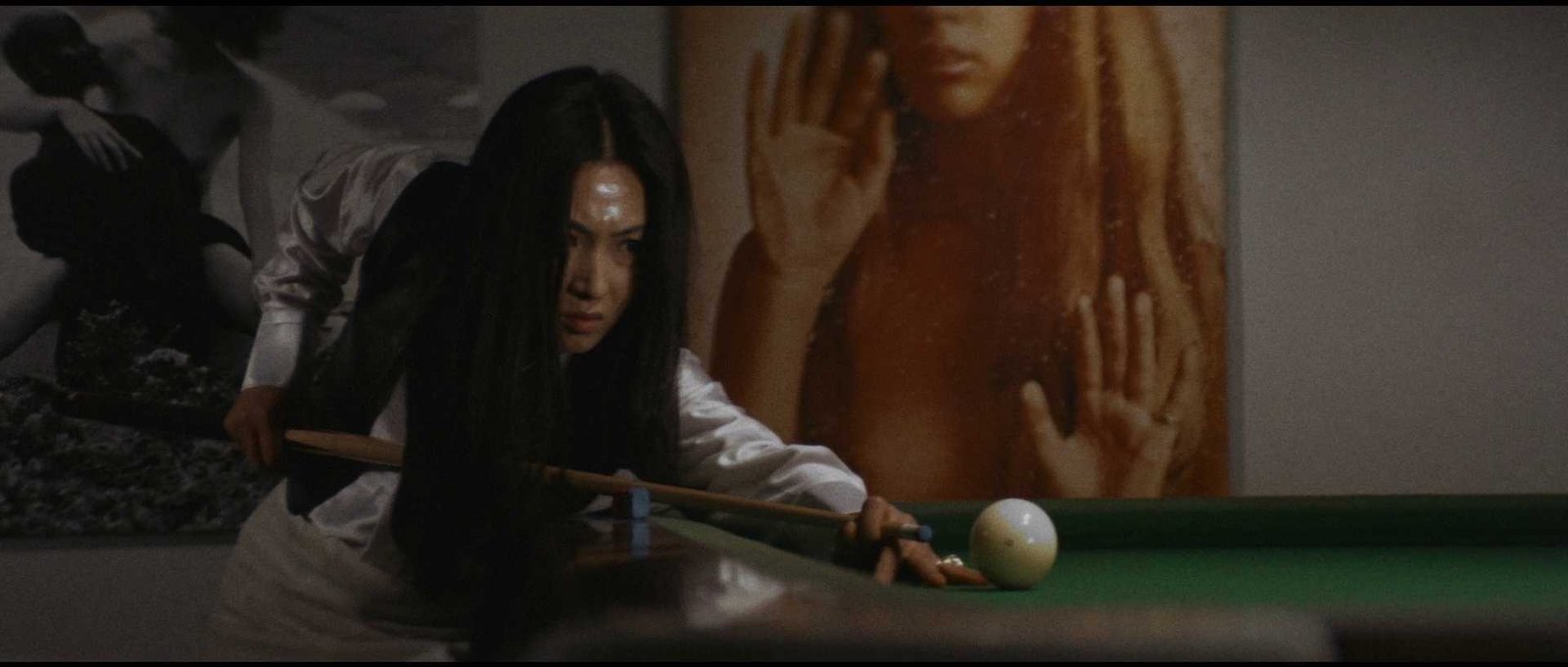
Meiko Kaji is one of Japan’s most celebrated actresses. Although her career spans several decades and includes a wide variety of genres and characters, she is best known for two iconic roles: the “Female Prisoner Scorpion” series and “Lady Snowblood”. Her portrayals of women who challenged male-dominated narratives and fought confidently against patriarchal structures made her an icon far beyond Japan. One of the performances that laid the foundation for these later characters was her role as Nami in Kazuhiko Yamaguchi’s “Wandering Ginza Butterfly” films, which followed shortly after the “Stray Cat Rock” series, where she likewise played the leader of a gang of young women confronting the yakuza, the police and anyone reckless enough to stand in their way. Beyond its exploration of changing gender roles, “Wandering Ginza Butterfly” also examines the effects of Japan’s recession on society, particularly on younger people and those who have become increasingly disenfranchised.
Buy This Title
on Terracotta by clicking on the image below
After being released from prison, Nami Higuchi (Meiko Kaji) returns to Tokyo’s famous Ginza district. Hoping to rebuild her life, she also wants to atone for the crime she committed by contacting the family of her victim and supporting them financially. With the help of Ryuji (Ryo Ikebe), a regular at her uncle’s billiard hall, she finds work as a hostess at the Broncho Club, run by Kayo (Akiko Koyama), who is initially wary of the newcomer. However, Kayo has more pressing concerns, as members of the Owada clan are attempting to force her to sell the club as part of their campaign to gain complete control of Ginza.
As time passes, Nami becomes the club’s most popular hostess. She supports the other women working there and even makes sure customers settle their bills. Nevertheless, the Owada clan intensifies its pressure, blackmailing Kayo into selling the club under outrageous conditions. Determined to help the woman who gave her a second chance, Nami takes matters into her own hands by challenging the gang leader to a duel at the billiard table.
Although Nami in “Wandering Ginza Butterfly” is less famous than Meiko Kaji’s later characters, she clearly serves as their blueprint. One of the strongest links between Nami and her roles in “Lady Snowblood” or the “Female Prisoner Scorpion” series is her compassion and determination to survive in a world dominated by men and capital. Like Ryuji, Nami is also an orphan who has found a sense of belonging in the neon-lit streets of Ginza. The affection with which she looks upon the district is defined by both nostalgia and the feeling of finally returning home after a long absence. That same nostalgia shapes Yamaguchi’s portrayal of Ginza as a refuge for society’s outcasts despite the crime and exploitation surrounding it. It becomes an almost mythical place worth protecting, even as it seems destined to disappear.
“Wandering Ginza Butterfly” is both an entertaining thriller and a study of a community undergoing profound change. Although the full impact of Japan’s economic recession would not become apparent until later, its consequences are already visible in Ginza through declining numbers of customers, struggling business owners and criminal organizations eager to exploit the situation. Nami’s plan to outwit one of the gangsters and win both his money and his stake in a nightclub feels like one final act of resistance—or perhaps one last practical joke—reminiscent of Paul Newman’s character in “The Hustler”, an obvious source of inspiration for Nami. While Yamaguchi undoubtedly romanticizes aspects of this world, he also conveys genuine affection for the outsiders who have found a home there and shaped its identity over the years.
As with many features starring Meiko Kaji, “Wandering Ginza Butterfly” relies heavily on her charisma and screen presence. Any shortcomings in the story are easily overshadowed by the subtlety of her performance, which communicates complex emotions through restrained gestures and remarkably expressive facial expressions. Whether portraying Nami’s attempts to atone for her past by supporting the widow of one of her victims or quietly defying the gangsters through intelligence rather than violence, Kaji brings emotional depth to a character who could easily have remained one-dimensional. Although Nami lacks the biting social criticism that defines her counterpart in the “Female Prisoner Scorpion” series, Kaji effortlessly balances dramatic intensity with quieter, deeply human moments.
“Wandering Ginza Butterfly” is a compelling blend of drama and thriller set against the neon-lit streets of Tokyo’s famous Ginza district. While the story occasionally follows familiar genre conventions, Meiko Kaji’s magnetic performance elevates the feature, giving Nami an emotional depth that would become the defining characteristic of many of the actress’s most iconic roles.



