
“The Robber” is the first feature directed by Song Hyeon-bum, who co-wrote the screenplay with Kang Da-yeon. Produced by the Korea National University of Arts School of Film, TV and Multimedia, the 88-minute Korean production is handled by M-line Distribution.
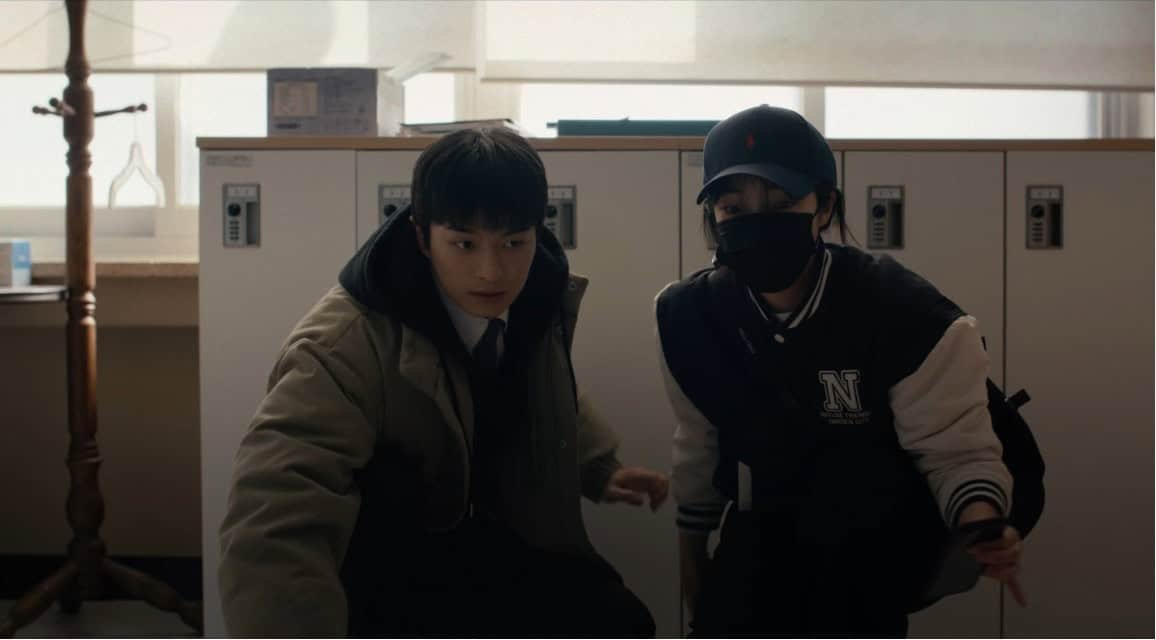
After an incident in Seoul, Juho, a teenager with kleptomania, transfers to a high school in a quiet coastal town. He intends to avoid trouble and remain unnoticed until graduation, but his urge to steal continues. When some of his own belongings disappear, he suspects that another thief is attending the school and begins following Dohee, the class president and a model student who shares the same uncontrollable compulsion. After discovering each other’s secrets, Juho and Dohee become friends and accomplices, bound together by their mutual weaknesses.
Sitting next to Juho in the classroom is Min-jun, another model student who competes with Dohee for the highest grades in their class. When Juho and Dohee steal an object connected to him, they discover that his respectable image conceals a criminal operation involving deepfakes and blackmail. Their acts of petty theft consequently draw them into a much more dangerous case, forcing the two teenagers to confront crimes with consequences far beyond anything they had previously imagined.
As I mentioned in previous reviews of the Korean features in BIFAN, the scripts, at least in terms of conception, were of the highest caliber this year. “The Robber” is no exception, with the main idea of two high school thieves first clashing, then becoming friends, and eventually facing someone who is even more of a criminal than they are providing a rather appealing basis for the story. It also happens that Song Hyeon-bum’s handling of this idea is quite good, particularly because it allows him to explore a number of social issues.
To begin with, the fact that the two thieves essentially come from broken families, even if on different levels, is rather interesting in itself. They eventually come together when they ask each other, “Why do you steal?”, a question no one has ever asked them before. The fact that their kleptomania is neither treated nor even diagnosed, with everyone simply considering them thieves, adds even more to this comment as much as the permeating accusation regarding the parents of this generation.
The inclusion of Min-jun, who deals with deepfakes and blackmail, moves in the same direction. At the same time, it highlights how AI and the impact of social media can be implemented for criminal purposes, destroying people’s lives in the process. In this regard, Song paints the school environment as a truly dog-eat-dog and quite dangerous setting. The concept is somewhat far-fetched and implemented for fiction here, but it does not actually stray that much from the truth. The involvement of the adults, who either make things worse, collaborate, or simply have no clue, adds to both of the aforementioned comments.
At the same time, the movie combines coming of age and romantic aspects nicely within the narrative. This element benefits most from the chemistry between Son Sang-yeon as Juho and Ji Hye-won as Dohee, with their relationship and the way it is transformed being among the best aspects of the story. The ending of their arc is a bit cheesy and lagging, particularly during and around the running sequence, but in general, it concludes the story nicely, with the very last scene being brilliant. The brief action could have been handled a little better, but overall, it works well within the story.
Jung Da-bin’s cinematography captures the various settings through muted colors, while the night scenes are definitely impressive. The way the voyeuristic scenes involving the crimes work is also excellent, highlighting the quality of the framing. Park Sang-eun’s editing results in a fittingly fast pace that, with the aforementioned exception, neither lags nor rushes, allowing the story to unfold leisurely throughout its 88-minute duration.
“The Robber,” despite some issues in the ending, emerges as a very competent debut that makes the most of its intriguing central idea. Song Hyeon-bum is a director who is bound to make some noise in the years to come.



