
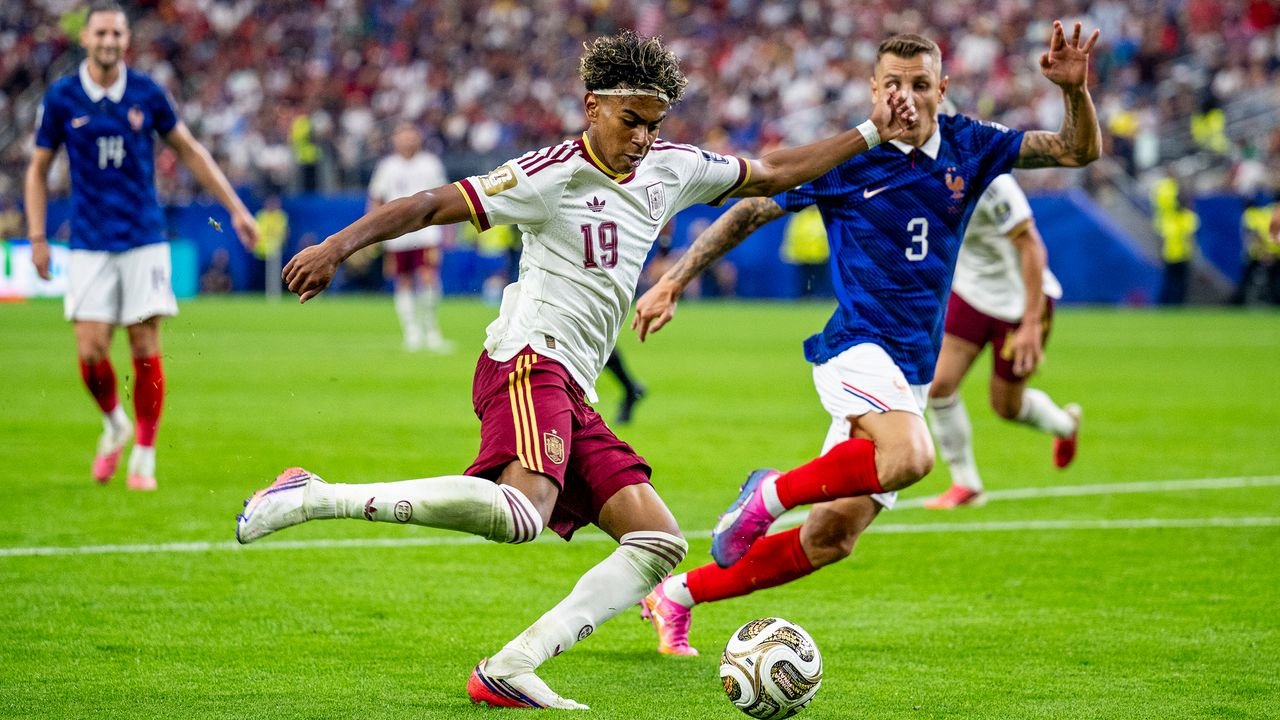
An eighteen-year-old soccer phenom—still young enough to be called a boy, and to act like it—is not typically someone known for doing the dirty work. He doesn’t usually submit to structure. Especially not when he announces himself as the sport’s heir apparent, at sixteen, by rocketing in a long-range goal to equalize against France during the semifinals of Euro 2024 and leading his country to that prestigious title. Not when he scores sixteen goals for Barcelona in twenty-eight La Liga appearances and earns upward of thirty-five million euros a year. Not when he dates an influencer with a million Instagram followers, and is featured on a four-hundred-foot billboard outside a World Cup stadium, and appears in an ad campaign with David Beckham and Timothée Chalamet, and has a nickname that includes the word “ego.” An eighteen-year-old like that isn’t supposed to work like a gear in a fine watch, as part of a complex, precise system. Everyone was waiting for Lamine Yamal to take over the World Cup, the way Erling Haaland had, and Kylian Mbappé, and Harry Kane, and Lionel Messi. When Spain took on France in the semifinals of the World Cup, it was supposed to be Yamal’s turn to dazzle—to seize the sport’s future from its past with some great individual performance. That is what an eighteen-year-old in that situation is expected to try to do.
But, then, Yamal, Spain’s prodigiously talented forward, is no longer eighteen. His nineteenth birthday fell on the day before the semifinal against France. And when France’s Lucas Digne loosely corralled a Spanish cross into the penalty box, popping up a header, Yamal sensed an opening: racing up the right, on Digne’s blind side, Yamal threw himself toward the ball, striking it with his shoulder just as Digne swung his leg around to clear it. It was a heady, calculated play, just short of reckless, and it worked. Digne caught Yamal’s leg and sent him sprawling. Mikel Oyarzabal fired the ensuing penalty shot into the goal’s upper right-hand corner to give Spain a 1–0 lead. From that point on, the flow of the match was in Spain’s favor.
France looked as stunned as everyone else. They came into the semifinal as the tournament favorite, for good reason. They’d swept through the World Cup so far, showing their stylistic flexibility and technical flair, scoring goals and smiling at bullies. Spain was—well, who could say? They’d tied tiny Cabo Verde, the sixty-seventh-ranked team in the world, in their first group-stage match. They’d made it into the knockouts by beating Saudi Arabia and Uruguay. They’d allowed one goal all tournament, in the quarterfinals against Belgium, but they hadn’t scored many, either.
Just you wait, Spain’s fans could say. They’d got this far without much of a contribution from one of the best young players in the world, and who would bet against him? Yamal had come into the tournament with an injured hamstring. He’d been healing, rebuilding his strength, managing corporate demands. He’d scored a single goal so far, against Saudi Arabia, and had yet to record an assist. But, finally healthy, he was bound to break out.
That’s how the French defenders approached him, anyway—with deference. The French seemed preoccupied by him, with or without the ball. Yamal responded to the extra attention with uncanny maturity: as if it weren’t there. Spain played with a plan, a team-oriented tactical approach that involved moving the ball side to side, forward and back, cycling it around and through the French defense. When they lost the ball, their press was immediate yet patient, and without obvious harried effort, they often got it right back. They held their shape, disciplined, content to let the French chase the ball this way and that and worry about Yamal springing some sudden attack. During one such long series of passes, when Digne was distracted by Yamal on the right-hand side, far from the goal, Pedro Porro passed the ball to a teammate at the top of the box and immediately cut into the acres of space that Digne had left behind. Porro received the ball back and easily scored.
Yamal nearly added a third—a beauty—but was called offside. By then, the outcome was beyond doubt. He heads into the World Cup final without a signature match still, but, watching Spain expose the pretensions of France, I started to think that was cause for praise, not impatience. Yamal played an excellent match, but the most important player for Spain was the midfielder Rodri, who controlled the center of the field masterfully, stepping into passes, blocking through balls, disrupting France’s audacious attacks, and serving as the anchor of Spain’s smooth, clockwork offense. Rodri has yet to score a goal this tournament—scoring is not really his thing—but he is the one who has led Spain to the final, in part by maintaining the team’s beautiful balance. There is more to soccer than what you can see in the highlights or on the score sheet. Recognizing this is a skill that Yamal seems to be mastering early. He has started twelve matches for Spain at the World Cup and the Euros. (He came off the bench during the draw against Cabo Verde.) Spain has won every one of them. ♦



