
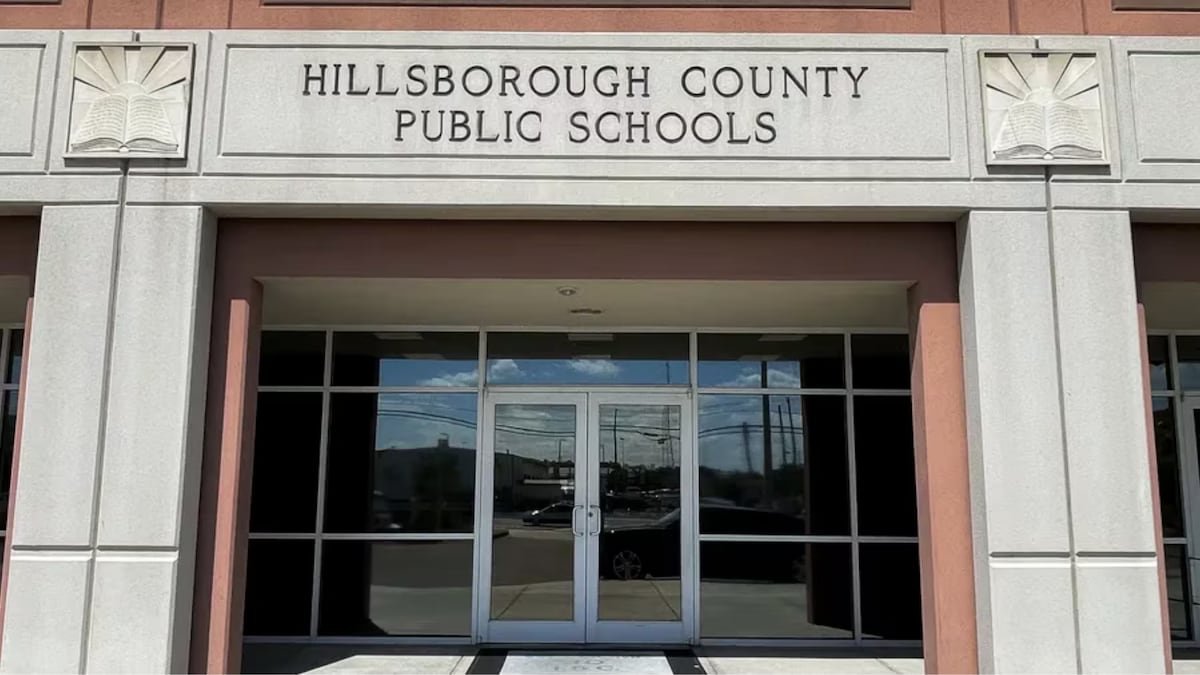
Hillsborough County’s school board on Tuesday approved the district’s ability to obtain tax anticipation notes up to $300 million to be able to provide a short-term, temporary cash bridge to pay employees in a timely manner.
The short-term revenue measure allows local government agencies to cover immediate operations while they wait for incoming expected tax revenue that comes later in the year.
District officials emphasized it was not a budgeting issue, but a cash-flow timing issue, and one that may be exacerbated by the growing presence of charter schools.
Chief financial officer Jamie Lewis said the district relies heavily on property tax revenue to fund its general operations, but that the funds are not evenly distributed through the year. For the 2026-27 year, he said, the district anticipates receiving about $912 million in property tax revenues, but property tax collections typically begin in November and the district tends to receive the money after December. Their payroll obligations begin July 1.
He called the move “a temporary cash bridge to the timing gap between expenditures and the receipt of property tax revenue,” which would allow the district to pay employees on time and fund charter school distributions.
School board member Jessica Vaughn said the tax notes had been an Achilles heel for previous boards. The district must pay interest on the advance, and it is unclear whether the growing charter school system will contribute to that interest payment.
“It’s interesting to see, you know, that we need it,” she said. “Would we still need to go out for this if we weren’t frontloading the money for the charter schools to pay their employees early as well?”
“We’d be in a lot better shape from a cash standpoint if we were not doing that, and so that is one of the biggest levers that’s causing our request here tonight,” Lewis replied. “I can’t say it’s the only (challenge), but it is a major challenge for us.”
Lewis said it was the district’s decision to start payroll on July 1 to make sure employees were receiving the referendum early.
Vaughn said she’d heard of charter school employees who weren’t being paid in a timely manner.
“Is it a possibility that we could be frontloading those salaries, giving it to the charter schools, but they do not pass it on and pay those employees early?” she asked. “Is there anything else that then regulates to follow up to make sure that money gets passed on to their employees early?”
Superintendent Van Ayres said he had heard similar concerns and said charter school boards had the authority to determine what to do with the funds the district was required to provide them.
“We’re giving the money early under our guise of making sure employees get access to funds early, but they may not use it for that at all?” Vaughn said. “So, we might be paying interest just to give a blanket amount of charter schools to spend at their discretion?”
“That’s a fair statement,” Ayres said.
Lewis said several other districts use tax anticipation notes and it was simply a tool to help the district keep up with the timing of cash flow.
The Tampa Bay Times Education Hub reports on Florida’s schools and universities and the students they serve. You can contribute to the hub through our journalism fund by clicking here.



