
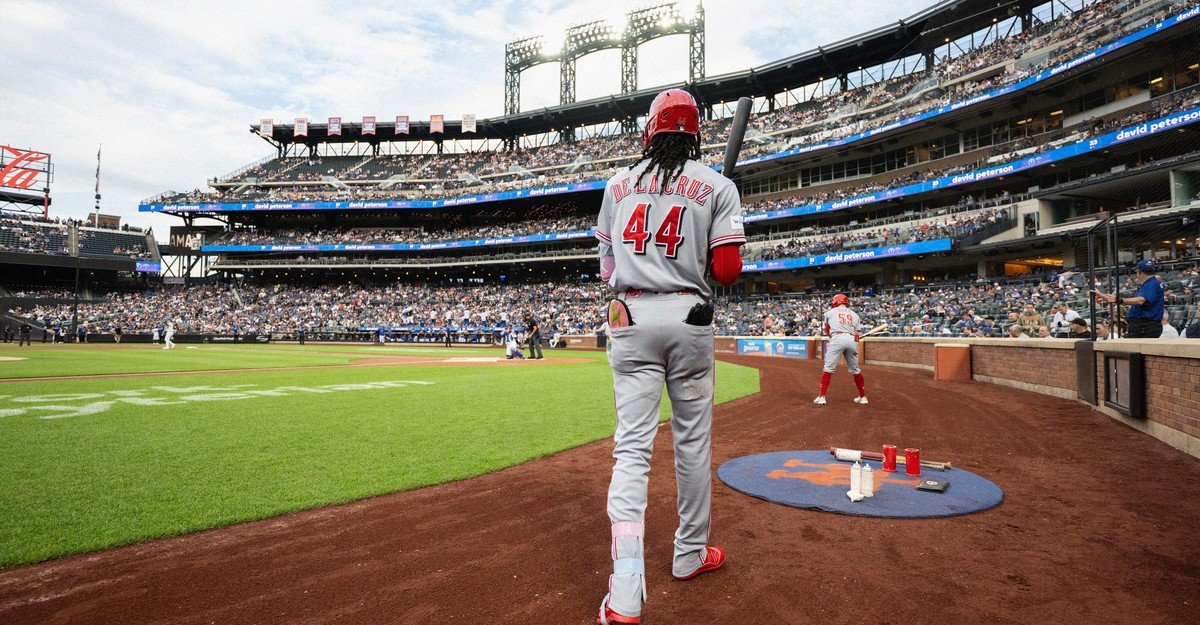
On May 26, the New York Mets were doing terrible (generally) and really terrible (acutely). They were at the bottom of their division and down six runs to zero against the Cincinnati Reds, a team whose payroll and—if I may—swag levels were dwarfed by the Mets’. The pitcher for the Mets had recently been booed off the mound by his own fans. Things were, by any objective measure, not going super well at Citi Field. But that night, like every other night this season, the stadium looked, sounded, and felt like a European nightclub on New Year’s Eve: flashing lights; booming music; an in-game announcer taking to a 17,400-square-foot screen and imploring fans to make some noise, with fans happily obliging. If you were a time traveler or even just someone who hadn’t been to a game in a few years, you would have been very, very confused.
I am 38, which means I’m old enough to remember when live baseball was largely devoid of artificial sound. This was when you could hear an entire stadium go silent for a particularly high-stakes at-bat, when big crews of in-game producers did not take any spare moment as a chance to play a pop song or advertise some inscrutable financial-services company, when stadium screens displayed the score and not a series of vaguely baseball-related TikToks. These days, baseball is wall-to-wall stimulation, from before the game starts until well after it ends. A few years ago, about 50 percent of the empty air at the Rogers Centre, where the Toronto Blue Jays play, was occupied by music cues and other sound; now that figure is closer to 95 percent. The Yankees play a sound effect from Star Wars every time the strike count reaches two, and they have since 2021—four years before they allowed their players to have facial hair. Thirty years ago, the walk-up song was a new phenomenon, and it was played only at the beginning of every at-bat; now many stadiums pipe in music between every pitch.
In this way, baseball is explicitly following other sports, which were earlier to invest in state-of-the-art multifactor sound systems, huge screens, and sophisticated lighting schemas. (“It’s about time baseball caught up with the NBA,” Aaron Boone, the manager of the Yankees, recently told a reporter who asked about being “suddenly deluged” by noise at games.) The previous time the New York Knicks won an NBA Final, in 1973, in-game sound was basically unheard of in basketball—too distracting for players and fans. Now multimillion-dollar speakers blast music virtually every minute, and spectators wear ear protection as though they’re at a concert, which they effectively are. Meanwhile, SoFi Stadium, where the Los Angeles Rams and Chargers play, is watched over by the Infinity Screen, a rubber band–shaped video monitor that weighs well over 1,000 tons and is in fact bigger than the football field it hangs over. Many stadiums now give away sensory kits (headphones, fidget spinners) just so neurodivergent fans can survive the game. Attending a sports game is twice as expensive as it was a quarter-century ago, but at least there’s no arguing that you’re not getting something for the money.
Sports have always been entertainment, fundamentally. But over the past few decades, new technology has enabled more constant stimulation, and the new economics of sports management have encouraged it. Many organizations are focusing not on season-ticket-holding die-hards but on more casual fans who want a big night out, are willing to pay for it, and may need to be guided through a game with aural or visual cues about how to feel at any given moment. Teams have amassed big data on their fans and developed sophisticated market-segmentation strategies: Moms who spend on food, say, might lead stadiums to add more vendors to attract them. Stadiums and arenas are looking more like theme parks. Mascots, once an afterthought, are celebrities—Gritty, the beguiling ogre that represents Philadelphia’s hockey team, the Flyers, has significantly more Instagram followers than any of the team’s players.
Even the food is weirder, more outrageous, more photogenic. A vendor at Citi Field sells a novelty egg roll filled with local delicacies from every visiting team: hotdish for the Minnesota Twins; Cuban sandwich for the Miami Marlins; clam chowder, unfortunately, for the Boston Red Sox. The Indiana Pacers and its affiliated WNBA team, the Fever, have also experimented with “unique culinary items,” Joey Graziano, the teams’ chief commercial officer, told me, “so that you can have that Instagrammable photo with that incredible piece of cake shake that you want all of your fans to be able to see that you acquired only at a Fever game.” Right!
Any given team is competing for attention with other teams, sure—but really, it’s competing with concerts, and restaurants, and social media, and Netflix. Everything is opportunity cost, and we have so many more opportunities. Graziano told me that the coronavirus pandemic taught stadiums that people want to do less—“but what they want to do, they want to do with more intensity,” he said. “You could really argue that it’s a completely irrational decision to ever get off your couch.”
Intensity: Last year, when Russell Kovshoff started working for the Whitecaps, Vancouver’s major-league soccer team, production was “very minimal,” he told me. By the time he’d remade the team’s programming, a year later, he had introduced flags, pyrotechnics, drag queens, a 50-person dance crew, a 100-person choir. His goal, he said, was to take soccer, a centuries-old sport with strict rules about in-game noise, and find ways to “fill it with entertainment.”
In 1971, the great baseball writer Roger Angell observed that “more and more, each sport resembles all sports; the flavor, the special joys of place and season, the unique displays of courage and strength and style that once isolated each game and fixed it in our affections have disappeared somewhere in the noise and crush.” He was lamenting sports’ televised age, which was still relatively new and which he believed had helped usher in an era of “excessive excessiveness,” one that threatened to “lay waste our powers of identification and enthusiasm and, in time, attention.”
Angell believed that baseball would survive all of this, mostly because baseball was a little boring—inherently slow; immune to spectacle; “rustic, unviolent, and introspective”; the only of the major team sports whose events were unhurried by any external clock.
Baseball people like baseball because it is baseball. We like that it is specific, and we like that it rewards noticing. In San Francisco, you can hear the seagulls, and in good seats at any stadium, you can hear the thump of a fastball as it hits leather, if you listen closely enough and no one is playing a DJ Khaled song.
A few years ago, Louisville’s minor-league baseball team, the Bats, instituted a new themed night: “No ad reads, videos or on-field promotions, just baseball in its purest form.”
Vincent Zielen, the Bats’ director of marketing, has been working in baseball for a decade, and he told me that Nothing Night was a response to something he’d been noticing more and more over the past few years. “There’s definitely a push for more entertainment, constant engagement,” he said. Nothing Night is both a reaction to the trend and an example of it—just another themed night, one where the theme is “baseball.” Zielen’s job is to do whatever it takes to bring in new fans, especially young ones. The sport “needed to get more energetic, more youthful,” Zielen said. “And with today’s generation, the way to do that is with constant engagement. The Savannah Bananas have kind of proven that.”
There it is. Zielen wasn’t the only person to mention the Bananas, the barnstorming exhibition team whose slogan is “We Make Baseball Fun!” and that is often described as baseball’s version of the Harlem Globetrotters. Bananas players do backflips, perform skits, and dance on the field. (Not at all surprisingly, many are also TikTok celebrities—similar skill set.) Last season, the Bananas sold 2.2 million tickets, which would have made them the 20th-most-popular major-league baseball team if they were a major-league baseball team, which they absolutely are not. Not that that seems to matter much: “All these kids are now expecting that Savannah Bananas–type engagement,” Zielen said.
And so the question that he and his team are trying to answer is: “How do we create that vibe from the onset, when folks get out of their car in the parking lot to when they leave? We don’t want it to be dull at any point.”
Dullness is the essence of baseball, but it may also be the enemy of people actually watching baseball. From 2007 to 2022, annual game attendance dropped nearly 20 percent. In 2023, Major League Baseball introduced a raft of changes designed to make the game faster, zippier, more lucrative, more exciting, more broadly appealing. Most notably, the league added, for the first time in history, a clock.
Angell, the baseball writer, had died the year prior; we will never know what he would have made of this change to the game’s basic nature. But plenty of baseball people were grumpy about it. (The only thing baseball people love more than being slightly bored is being grumpy about baseball.) They are grumpy about the Bananas too, and about the noise. But baseball attendance has been shooting up. In 2024, I spent a lot of time complaining about how irritating it was to be at a game these days, but I also did something that I previously had not thought was possible: I watched my toddler sit through an entire nine innings, utterly delighted by all there was to hear and see.
The Bats hosted their first Nothing Night of the season on May 15. It featured no flashing lights, no scoreboard animations, no ads, no music other than that from an organ. The idea went properly viral. But, Zielen said, “we didn’t get the butts in seats that we wanted”—the weather wasn’t great.
The next night was Star Wars night. Zielen’s team rigged up special sound effects, dressed the players in themed jerseys, gave away 2,000 “space swords,” and had 30 people walking around the stadium dressed as various characters, taking selfies. There was a costume contest between innings, a drone show afterward, and, as Zielen put it, “that constant engagement.” The stadium was full.



