
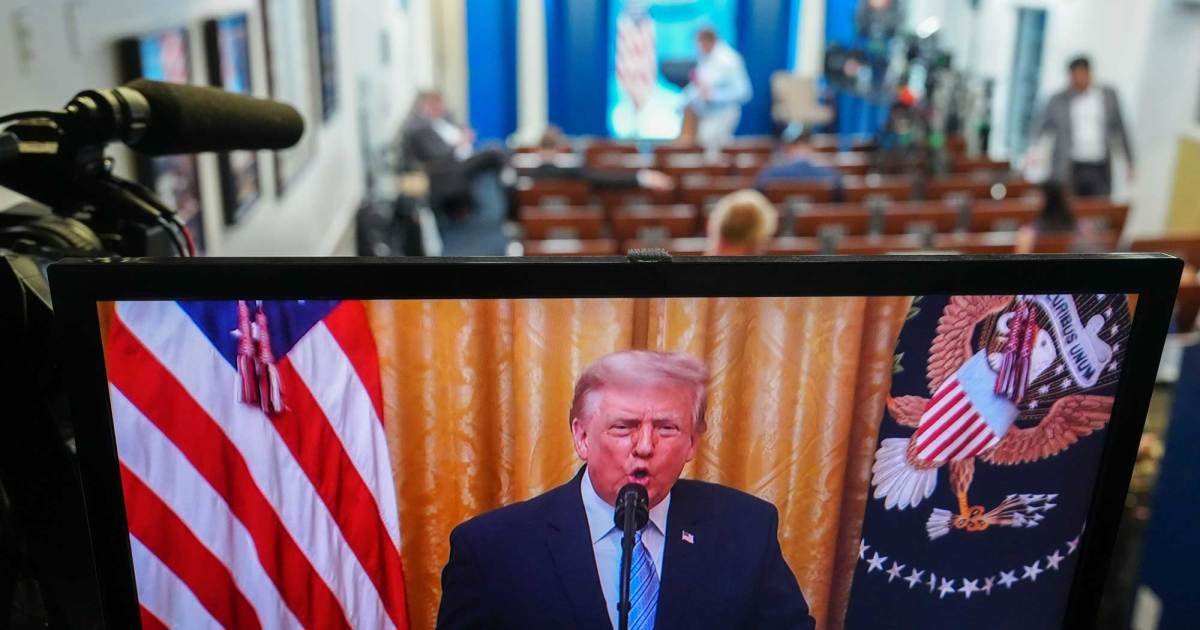
On Thursday night, after days of buildup, Donald Trump delivered a speech on election security in which he suggested US elections were threatened by China. He repeatedly pointed to China and its purported efforts to hack voter and election data and to mount influence operations to foment anti-Trump sentiment. But he provided no proof of Chinese interference with US elections or of any voter fraud. And, perhaps more significantly, he left out a big piece of the picture: Russia.
As Trump assailed US elections as totally rigged and lacking credibility—again, without offering any evidence of this—he fixated on Beijing. The connection was not clear. He seemed to be saying that China has been involved in subverting US elections, including the 2020 contest that he lost and that he has falsely insisted (ad naseum) was stolen from him. He denounced the supposed Deep State for having “worked to actively suppress and downplay information about the extent of China’s sinister election meddling, covering it up from both the president and the American people.” In 2020, though, the major culprit in terms of election meddling was not China, but Moscow.
Who says so? Trump’s own intelligence community.
In August 2020, the Office of the Director of National Intelligence released a brief statement assessing foreign efforts to influence the ongoing presidential election. It noted that the intelligence agencies had concluded that China and Iran favored Trump’s defeat. But the statement provided no details on what, if anything, China and Iran were doing to thwart Trump’s reelection.
As for Russia, the statement was more direct. It said Moscow was “using a range of measures to primarily denigrate” Vice President Joe Biden, the Democrats’ presidential candidate. It noted that a “pro-Russia” Ukrainian parliamentarian named Andriy Derkach “was spreading” false claims—alleging that Biden had engaged in corruption in Ukraine—to “undermine” his candidacy. It added, “Some Kremlin-linked actors are also seeking to boost President Trump’s candidacy on social media and Russian television.”
Asked about this intelligence assessment at the time, Trump said, “I don’t care what anybody says.”
A month later, Trump’s Treasury Department sanctioned Derkach and called him “an active Russian agent for over a decade” and accused him of running an ongoing operation—by putting out bogus information about Biden—to discredit the Democrat. Treasury Secretary Steven Mnuchin declared that “Derkach and other Russian agents” had employed “manipulation and deceit to attempt to influence” the US election.
Trump’s own administration was saying Moscow was actively interfering with the 2020 election.
Months after that contest, the US intelligence community released an assessment of “foreign threats” to the 2020 race. This is what it said about the Russian effort:
We assess that Russian President Putin authorized, and a range of Russian government organizations conducted, influence operations aimed at denigrating President Biden’s candidacy and the Democratic Party, supporting former President Trump, undermining public confidence in the electoral process, and exacerbating sociopolitical divisions in the US. Unlike in 2016, we did not see persistent Russian cyber efforts to gain access to election infrastructure…A key element of Moscow’s strategy this election cycle was its use of proxies linked to Russian intelligence to push influence
narratives—including misleading or unsubstantiated allegations against President Biden—to US media organizations, US officials, and prominent US individuals, including some close to former President Trump and his administration.
The report also evaluated Beijing’s involvement in the 2020 election: “We assess that China did not deploy interference efforts and considered but did not deploy influence efforts intended to change the outcome of the US Presidential election.” It added, “We did not identify China attempting to interfere with election infrastructure or provide funding to any candidates or parties.”
That’s a big difference. Russia ran an extensive operation to help Trump. China did not do much, if anything.
Trump has long denied that Putin intervened in the 2016 campaign and helped him win the White House—though various investigations, including a bipartisan Senate intelligence committee inquiry and special counsel Robert Mueller’s investigation concluded the Kremlin covertly aided Trump. In this speech, Trump made China the bad guy, ignoring Russia’s interventions in US elections.
If Trump were serious about combatting foreign attempts to mess in US campaigns, he’d address Putin’s meddling. Yet that would never happen. This speech was meant to back up his unfounded and hysterical claim that US elections have been wracked with rampant fraud—which is why, in his deluded telling, he lost in 2020—and he sought to blame China for that. The real culprit, Russia, was MIA.



