
Mother Jones illustration; Neil Constantine/NurPhoto/AP; Unsplash
Ashley Brouillette had not heard from her ex-husband, David Brouillette, since November. She says one of their last interactions was a three-minute voicemail in which David told her that someone should slit her and her daughters’ throats.
Then, last week, Ashley got a call from a journalist, who asked if she recognized her ex-husband among the ICE agents photographed after the fatal shooting of Johan Sebastián Durán Guerrero in Biddeford, Maine. She did. The news caught her off guard, so she reached out to David: He told her he’d shot Durán and that he’d acted in self-defense because, he claimed, Durán tried to hit him with a car. Ashley doesn’t believe him. After watching the limited surveillance footage of the incident, she believes her ex-husband “murdered” Durán, a 25-year-old Colombian man whose daughter recently celebrated her third birthday.
Durán was not the target of ICE’s operation in Biddeford. After coming to the United States in 2023, he got jobs cleaning a veterinary office and delivering food. In a press conference, Durán’s partner, Martha Karolina Rojas Álvarez, described him as someone whose joy was contagious. “He always said I was his life, and that he dreamed of a whole lifetime with me,” Rojas said through a translator. “He always told me, Until we’re little old people.”
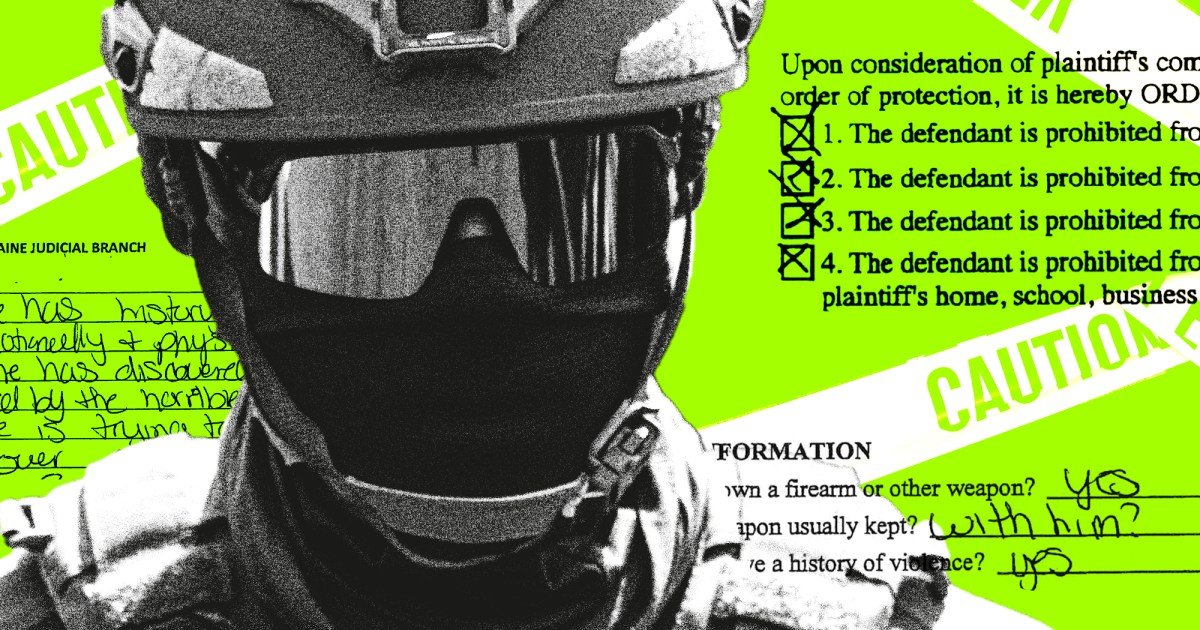
After the killing, Ashley says, David told her that she needed to talk about his character in a positive way. “I’m not going to lie for you,” she replied. She says he also asked her not to talk about abuse that had happened in their marriage, which ended in 2009. When reached by Mother Jones, Ashley accused David of years of violence and abuse, allegations that were corroborated by her mother and echoed comments Ashley had made to a child welfare official years ago, according to court records. The Augusta, Maine, police department did not find documentation of the alleged abuse, but she and her mother recalled harrowing details. One time, Ashley alleges, David threw hot water at her while she held their daughter. Another time, he allegedly pointed a gun at her and said he should shoot her in their bathtub. Now, with David on the phone, Ashley repeated that she wouldn’t lie for him.
Another ex-wife, Lucinda Brouillette, said in a statement to reporters that she “unequivocally” believes David is capable of extreme acts of violence. In hundreds of pages of court records, she has accused him of physical and verbal abuse, including allegedly dumping a plate of spaghetti on his 13-year-old daughter’s head and then tackling her while she cried. “I have feared for a long time that his anger, aggression, and escalating behavior would eventually result in severe, life-threatening violence, and I often believed I would be the one on the receiving end of it,” Lucinda wrote.
While surveillance footage captures the moments before and after the shooting, no videos have emerged to show the moment when David allegedly killed Durán. What has become clear in the days afterward, however, is that there are many reasons why ICE should have avoided hiring him in the first place. “The seriousness of the allegations—domestic violence—you’d think would likely be disqualifying for someone who’s going to be armed by the government,” says Claire Trickler-McNulty, an ICE official in the Biden and first Trump administrations. Making matters worse, ICE records suggest that David may have been eligible to skip a significant portion of the agency’s training for new recruits, given his prior work history. ICE asked for additional time to respond after missing an initial deadline for this article last week, and we were not able to reach David. The agency has not yet confirmed that he was the shooter.
Ashley believes her ex-husband should have never had access to a weapon in a personal capacity, much less in an official one: “He does not belong in careers that involve guns.”
David Brouillette joined ICE earlier this year. He’d long wanted to be a police officer, even in high school, according to one of his childhood best friends, Scott Collins. “I always thought it was a superiority thing,” Collins told us. “He always wanted to be in a position of power.”
After Gardiner Area High, David joined the Maine National Guard in 2007 and then the Army in 2010, deploying to Afghanistan for about nine months. “Afghanistan destroyed him,” an estranged relative told the Associated Press. Afterward, he worked as a corrections officer, then as a police officer with the Department of Veterans Affairs. He was also briefly a volunteer firefighter, though Frank Wozniak, his former boss at the Town of Manchester Fire Department, told Mother Jones he fired David for threatening to “punch me in the face and take my job.” (Wozniak told David to get out of the firehouse and never come back; the town’s next fire chief rehired him.)
David struggled financially. In 2020, he pleaded for a Maine court to reduce child support payments required by his second divorce. “I am NOT ABLE to survive,” David wrote in a handwritten statement. He added, “PLEASE PLEASE reduce my [child support].”

In January 2025, he quit a truck-driving job due to unspecified health issues, but a judge argued he was actually “voluntarily underemployed” and declined to reduce his child support payments that November. About two weeks later, he told Ashley he was going to work for ICE, which was offering signing bonuses of up to $50,000. After years of bouncing between jobs with little apparent success, ICE’s recruitment drive offered a lifeline.
Ashley didn’t believe the agency was actually hiring him; he’d previously claimed he was joining the Secret Service, which never happened. “Yeah, sure, buddy,” she recalls thinking. Collins, his childhood friend, only found out that David had joined ICE after the July 13 shooting. “I think it speaks volumes of the vetting process, and how little these ICE agents are trained,” Collins says. “To be honest, I was surprised anybody would give that man a gun.”
For months, Democratic lawmakers have raised concerns that ICE, while hiring more than 12,000 new officers and agents, has rushed them onto the street without adequate preparation. Calls for more training and for the dissolution of the agency have grown as ICE has launched high-profile and violent campaigns in cities from Minneapolis to Chicago, brutalizing protesters around the country and fatally shooting at least five people in their vehicles.
An ICE spokesperson emphasized to the AP that David had “nearly a decade of federal law enforcement experience,” and that he had “required training, including use of force training.” But what vetting did he undergo before hitting the streets? According to a current job posting for deportation officers, David may have been eligible to skip a significant portion of ICE’s training for new recruits because of his tenure with the VA Police; the posting notes that anyone with “Local, State or other Federal Law Enforcement training with arrest authority will be exempted” from ICE’s basic training program in Georgia—a multiple-week program where recruits learn the ins and outs of their new job, including de-escalation techniques designed to prevent the use of force.
Marc Brown, who retired from the Federal Law Enforcement Training Centers in 2024 and is now a policing expert at the University of South Carolina, told us that under the Biden administration, it was not common for recruits of any federal law enforcement agency to skip large parts of training, even if they had prior experience. “You don’t usually get a full pass, especially if you go into a totally different program,” he said, noting that working for the VA Department or many other federal departments is different from working for ICE. “Those are two totally separate systems; they need training on that new mission,” he said.
VA police aren’t like municipal police who patrol streets and conduct traffic stops. Instead, Brown said, they primarily function as security guards for VA hospitals. (The VA Department did not respond to questions about whether its officers receive training on use of force against people in vehicles; ICE did not respond to questions about David’s training.)
“It’s very clear at this point that officers are being rushed out to make these arrests, and there’s an operational failure taking place.”
The ICE job posting says that while recruits with former law enforcement experience can skip basic training, they do need to complete the “Deportation Officer Transition Program,” a newer program that Brown was unfamiliar with. In total, training for deportation officers takes about 50 days, according to the posting—though in a Reddit forum 10 months ago, recruits with law enforcement experience shared that they were allowed to do a virtual training from home. One officer with prior experience at the Department of Homeland Security said it only took him three days.
Trickler-McNulty, the former ICE official, confirmed that allowing former law enforcement officers to skip ICE’s basic training is a new change under Trump 2.0. She worries that instructors are losing an opportunity “to lay eyes” on these recruits, and to see “how they’re interacting and responding to training before they’re out in the field.”
Ryan Schwank, an ICE instructor and attorney who resigned in February, says that even recruits who do attend ICE’s full training program are not prepared for the jobs they’re asked to do. The agency’s instruction on vehicle stops is “fairly short and kind of rote,” he told WBUR last week, noting that officers are tested on their ability to pull over a vehicle under ideal conditions. “We don’t test them on their ability to handle complex crises or how to handle the types of situations we’re seeing happen,” he added, like the situation in Maine. “The officers are being put in a situation where they’re dealing with the public and these vehicles, and their training doesn’t line up with the role they’re expected to fulfill,” Schwank said. “It’s very clear at this point that officers are being rushed out to make these arrests, and there’s an operational failure taking place.”
Starting this month, ICE is reportedly increasing its core training program from 42 days to about 71, with more instruction about high-risk vehicle stops. But the agency is still not always conducting full background checks before sending recruits out, which means it may not have known about David’s history when it hired him. The AP recently found other officers who were hired despite questionable records; one was accused of lying in a police report to justify a charge against an innocent woman. Another failed to graduate from a police academy.
A DHS spokesperson told the AP, “ICE is committed to ensuring its law enforcement personnel are held to the highest standards and rigorously vets them throughout the hiring process.” But the spokesperson acknowledged that some applicants receive “tentative selection letters” and are allowed to begin working “on a temporary status” before the full background check is complete.
ICE has still not explained how thoroughly it investigated David’s background before giving him a gun. What is clear from court records and interviews is that the agency hired him despite accusations of abuse by two ex-wives and years of professional struggles.
In Maine, Durán’s family is living with the results. At the press conference, Durán’s partner, Rojas, described Durán’s devotion to their 3-year-old: “He lived for her; everything he did, he did in the name of his gorda.” Through tears, Rojas said her daughter asks for her dad every night, but that she has not had the strength to tell her that he is not coming home.
The family’s lawyer has called ICE’s decision to arm Brouillette so “reckless” that it could justify criminal charges against the people who hired him.



