
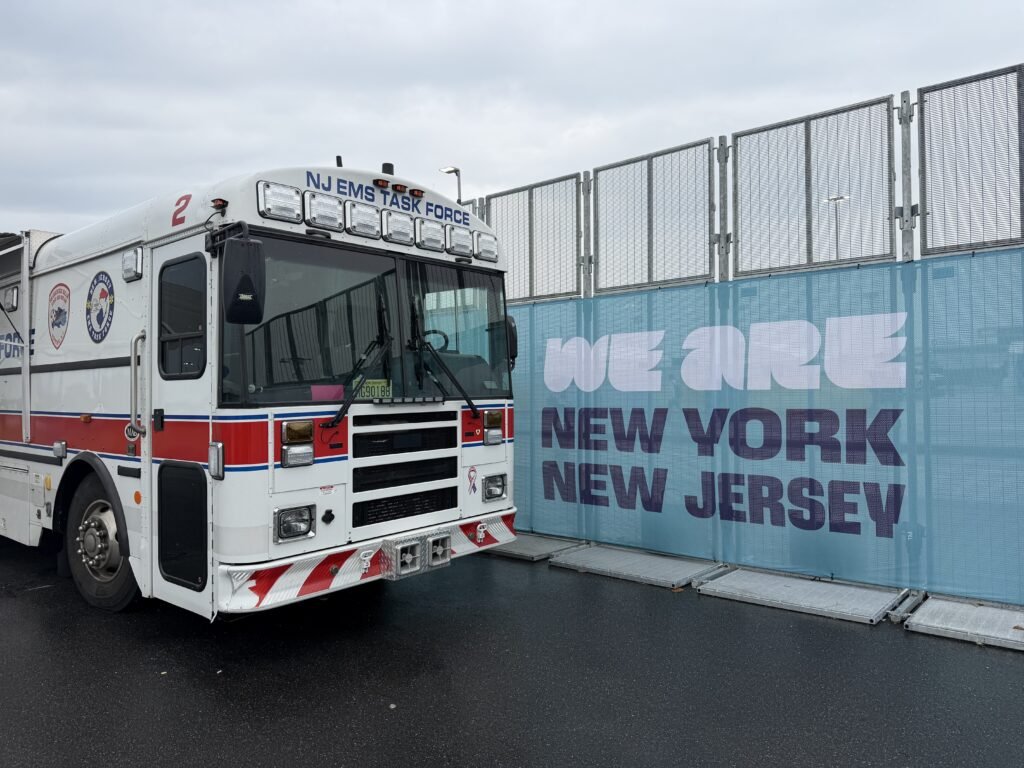
New Jersey’s EMS Task Force outside MetLife Stadium preparing for the World Cup matches. (Photo courtesy of the task force)
Members of New Jersey’s Emergency Medical Services Task Force spent July 4th evacuating a Voorhees nursing home of more than 200 people after the facility’s air conditioning failed during a heat wave that would lead to a record 29 deaths statewide.
Other members were deployed to help local responders at fireworks events in five counties and America250 celebrations along the Delaware River, to track wildfires in South Jersey, and to standby at World Cup matches in East Rutherford, an assignment that would eventually involve 8,500 personnel hours over five weeks, its largest undertaking ever.
The nonprofit task force, which was founded to manage large-scale emergency medical responses in the wake of the 9/11 attacks, serves as a statewide backup for local emergency services, coordinates emergency preparedness for large-scale events, and leads regional emergency response planning. But as of August, it has just 60 days of funding left, according to its president, Michael Bascom.
“We have zero funds to sustain, repair, or replace any of our equipment,” Bascom told the New Jersey Monitor, let alone money to continue to pay its handful of staff.
The task force had pushed Gov. Mikie Sherrill and Democratic leaders in the Legislature to include $500,000 for its work in the most recent budget, but the $60.7 billion budget she signed in late June did not include it. Bascom said it is now requesting at least $8 million in one-time capital funding while it searches for sustainable revenue.
“If our organization fails to maintain — there IS NO OTHER backup. Local EMS cannot absorb the work scope. Hospitals cannot replace it,” Beau Huch, a longtime EMS advocate and director of government affairs for the law firm Porzio, wrote in a funding request to lawmakers this spring.
“This is not a warning bell ringing. This is an emergency siren blaring,” he added.
Senate Democrats declined to comment on the request.
A spokeswoman for Sherrill said she is grateful to the first responders, including the EMS task force, who have worked hard to protect public health during high-profile sporting events, extreme heat and summer celebrations, an “especially demanding period.”
“Federal partnership has been essential to supporting New Jersey’s preparedness for health threats. As certain funding comes up for renewal and as other COVID-era federal funding streams end, the State remains committed to exploring ways to sustain key preparedness work. At the same time, no state can fully absorb the fiscal impact of expiring federal funds and broader federal policy changes,” Sherrill spokesperson Maggie Garbarino told the New Jersey Monitor.

Sen. Declan O’Scanlon (R-Monmouth), a sponsor of a bill to codify the task force, said it’s the state’s responsibility to protect residents and that failing to fund the organization “could be a life-or-death thing.”
“It’s just a continued demonstration that this administration, like the previous one, doesn’t give a damn. It would have been easy if they cared,” O’Scanlon told the New Jersey Monitor.
Most of the task force’s 200 members work full-time for other emergency response organizations, which cover the cost of their deployments with the task force.
It maintains equipment valued at $70 million, Bascom said, including 19 medical ambulance buses that can transport ten times as many patients as a regular ambulance, oxygen generators, field hospital shelters and more, all available for use by local responders in the state’s 21 counties. Repair needs are estimated at close to $30 million, he said.
Bascomb said its funding needs were amplified over the Independence Day weekend, when several ambulance buses malfunctioned. Severe thunderstorms swept through the state that Saturday, causing extensive flooding and damage.
“We learned a lot from Saturday, lessons we’ll take on the road to the next mission and beyond,” Bascom wrote in an email to task force members, thanking them for their work.
The state Department of Health is tasked with maintaining and coordinating the activities of the task force under the 2017 law that formalized the group. But the $1.1 million in federal funding the department provided last year to ensure the task force could operate through the World Cup will soon be gone, Bascom said.
The soccer matches are now history, but Bascom said the task force’s work continues, including its mandate to staff all events at MetLife Stadium. In 2025 alone, task force members deployed at least 225 times to evacuate nursing homes or hospital facilities and assist with major emergencies and led 1,500 hours of emergency preparedness training, according to task force data.

Once funded as a function of the state Department of Health, Bascom said the task force was pushed to become a nonprofit under Gov. Phil Murphy, but the grant money officials said would be available has not yet materialized. The group played a key role in the state’s COVID-19 response, setting up testing sites, vaccine clinics and field hospitals, but funding has been sporadic and unreliable, he said.
The Department of Health did not respond to a request for comment.
O’Scanlon took a swipe at Democratic legislators for focusing too much on pork, a Trenton-insider term for money that legislative leaders add to the budget for pet projects, during this year’s budget process.
“Emergency preparedness should come before one dime of pork, and it didn’t,” he said. “The priority was pork over preparedness.”



