
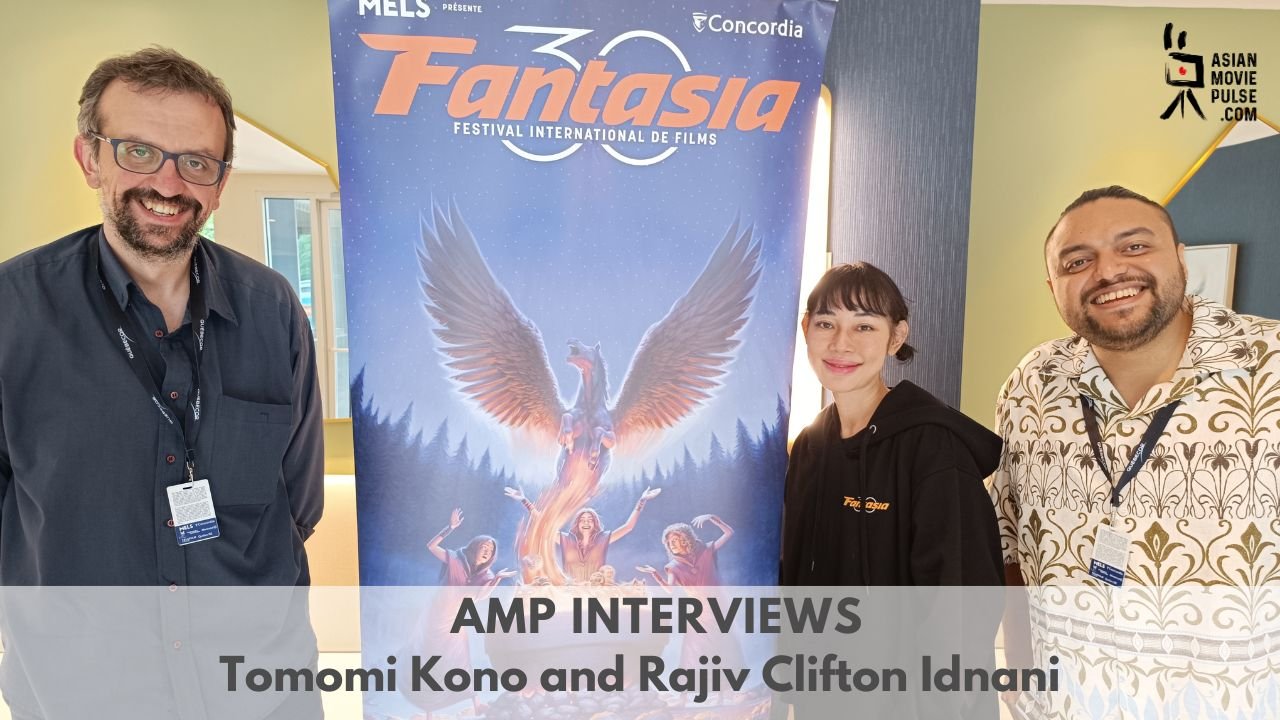
Philippine folklore, body horror and questions of self-acceptance come together in “My Missing Half”, a Philippines–Japan co-production currently being developed by writer-director Rodiell Veloso. Japanese producer and actress Tomomi Kono, credited as Tomomi Furuyama in the project’s official market materials, and Filipino producer Rajiv Clifton Idnani presented the feature at the 2026 Frontières International Co-Production Market, held during the Fantasia International Film Festival in Montreal.
Produced through This Side Up and Ihr HERz Inc., “My Missing Half” is conceived as a black comedy, horror production and road movie. The project was among the titles selected for the 2026 Frontières Market, where Kono and Idnani continued their campaign to secure international financing and post-production partners.
Speaking to Asian Movie Pulse, the two producers discussed the film’s unusual interpretation of the manananggal, their collaboration with Veloso and the difficulties of financing a visually ambitious Filipino genre feature.
A Manananggal Who Wants to Become Human
“My Missing Half” centres on Zisa, a manananggal who does not want to live as a monster. A manananggal is a type of aswang from Filipino folklore whose upper body separates from its lower half at night, grows bat-like wings and flies away to hunt for human flesh.
Traditional stories depict the detached lower body as an inanimate shell waiting for the creature’s return before sunrise. Veloso’s screenplay changes that rule by giving the lower half a personality and desires of its own.
Zisa ran away from home at the age of 18 and has since been saving money for an experimental brain-altering operation. The procedure is intended to remove her predatory instincts and prevent her from transforming, finally allowing her to live as an ordinary human.
The night before the surgery, however, an excited Zisa drinks too much and has a one-night stand. Her date subsequently becomes her midnight meal. When she wakes the following morning with a severe hangover, she realises that she has also lost the lower half of her body.
She eventually discovers it surrounded by police officers, forensic investigators and journalists, all of whom believe they have found the mutilated remains of a murder victim. With her secret in danger of being exposed and her operation approaching, Zisa sets out to recover the missing half before it is too late.
The resulting journey brings together a group of characters connected to different periods of Philippine history. Zisa is accompanied by the ghost of a Catholic priest from the Spanish colonial era, a half-American drag queen associated with the period of American military occupation, a wandering Japanese spirit originating from World War II and her unremarkable human ex-boyfriend, whose principal contribution is owning a car.
Veloso has described the intended tone as a meeting between “Little Miss Sunshine” and “Addams Family Values,” combining the structure of a dysfunctional-family road movie with macabre humour, supernatural characters and Filipino history.
The Other Half Has Her Own Story
The search eventually leads the group to a large Halloween beauty pageant, where Zisa discovers that her lower half was not stolen. Instead, the legs, nicknamed Shirley by the filmmakers, deliberately escaped.
Shirley embodies Zisa’s anger, hatred, monstrous instincts and the parts of herself that she has spent years attempting to suppress. When Zisa finally locates her, Shirley rejects the proposed reunion and challenges the idea that becoming human requires erasing everything uncomfortable or socially unacceptable within her.
“What you only want is to look human,” Shirley tells her.
The confrontation changes the central question of the narrative. Zisa’s journey initially revolves around whether she can become physically complete again. By the conclusion, the more important question is whether she can acknowledge her identity without forcing every part of herself into a socially acceptable form.
The film consequently treats bodily separation as both a supernatural condition and a metaphor for self-rejection. Rather than resolving the conflict through the conventional restoration of Zisa’s body, the upper and lower halves ultimately choose to continue separately.
Finding the Project’s Filipino Producer
Veloso and Kono first developed “My Missing Half” while studying together at the Busan Asian Film School. Because the story is rooted in Filipino folklore and is planned to shoot in the Philippines, the production still required a Filipino partner with local knowledge and access to national financing.
Idnani encountered the project at the Asian Contents & Film Market during the Busan International Film Festival. He had travelled to the market to seek financing for his existing projects, but returned home having agreed to produce another one.
A fellow producer encouraged him to listen to Veloso’s pitch. Veloso did not yet have a completed screenplay, but he had prepared a treatment and spent approximately 50 minutes narrating the entire story from beginning to end.
Idnani said the director’s enthusiasm was immediately evident. Instead of requesting only a logline or written synopsis, he listened to the full presentation and became increasingly attracted to the combination of folklore, comedy, horror and personal themes.
“I actually fell deeply in love with the story,” Idnani said. “The way Rodiell told it was very passionate.”
That meeting established the Philippines–Japan partnership now supporting the project. Kono brings the Japanese production structure through Ihr HERz, while Idnani and This Side Up are handling its Filipino foundation.
Financing an Ambitious Filipino Genre Film
At the time of the interview, the screenplay had reached its second draft and approximately 20 percent of the projected financing had been secured. The feature carries an estimated budget of US$1.2 million, a substantial amount within the independent Filipino sector.
The producers intend to apply for public support in both the Philippines and Japan. They are also discussing possible partnerships in South Korea and Singapore, whose national film funds could contribute to the international co-production structure.
Securing these sources could bring the financing to approximately 60 or 65 percent, allowing principal production to begin. A significant portion of the remaining budget would then be directed towards post-production and visual effects.
The concept requires the filmmakers to create a protagonist whose upper and lower bodies operate independently, while also presenting flying creatures, supernatural companions and other genre elements. Post-production support is therefore not merely a finishing expense but a fundamental part of making the central premise convincing.

The team is also producing a short proof of concept supported by a grant from the QCinema International Film Festival. Shooting was scheduled to begin on July 31, with the completed short expected to premiere at QCinema in November 2026. The producers hope it will subsequently travel to festivals and provide potential financiers with a clearer demonstration of the feature’s visual language.
Recognition at BIFAN and International Markets

“My Missing Half” has already travelled through several development and pitching platforms. It was presented through the AtMovie Global Track Japan Pitch connected to the Cannes Marché du Film, appeared at an Asian project-pitching programme in Thailand and was selected for the 2026 NAFF Project Market at the 30th Bucheon International Fantastic Film Festival.
The project received both the Asian Discovery Award and the Badclay VFX Innovation Award at NAFF. The latter is particularly relevant to a production whose narrative depends heavily on the visual separation and independent movement of its protagonist’s body. Asian Movie Pulse previously reported on the complete list of BIFAN’s 2026 NAFF winners.
Veloso has also been accepted into a competitive screenwriting workshop led by Filipino National Artist Ricky Lee, where he is continuing to develop the screenplay.
The Frontières appearance represents another stage in that process. The Montreal market officially listed Veloso as writer-director and Kono and Idnani as producers, categorising the project as a black comedy, horror feature and road movie.
The Producers’ Casting Ideas
No principal cast members had been formally attached at the time of the conversation. Veloso’s preferred choice for Zisa’s upper half is Maris Racal, whom the director considers capable of balancing the production’s comedy, vulnerability and supernatural elements.
Racal previously starred in Antoinette Jadaone’s “Sunshine,” playing a young gymnast confronted with an unwanted pregnancy shortly before national-team trials.
Movement director Madge Reyes is expected to portray the lower half and has already performed the role for the proof-of-concept short. Idnani explained that Reyes’ physical expertise is essential to the question of how a pair of legs can communicate emotions without a face, dialogue or conventional gestures.
Producing Across Several Countries
Alongside “My Missing Half,” Kono and Idnani are developing several projects linking Japan and the Philippines. Kono spoke about her involvement in three international co-productions, including a Japanese feature expected to shoot most of its material in Cebu.
Idnani is also producing “Daughters of the Sea,” the second feature by Martika Ramirez Escobar, director of “Leonor Will Never Die.” The project is structured as a Philippines–Spain co-production, with France potentially joining, and is being filmed in separate stages across the participating countries.
He is additionally developing “Once Here,” a feature documentary directed by Pabelle Manikan about fishing communities in the West Philippine Sea. Rather than approaching the territorial conflict solely through geopolitics, the documentary will concentrate on the everyday lives of fishermen affected by China’s presence in the region.
The number of simultaneous projects reflects the economic conditions facing independent producers. Idnani acknowledged that personally meaningful films do not necessarily provide a reliable income, with his company’s commercial and advertising work helping to finance its independent activities.
Kono similarly emphasised the importance of advancing several projects at once. Different films are suited to different development laboratories, markets and distribution strategies, while delays affecting one production do not necessarily prevent another from moving forward.
For “My Missing Half,” that international network has allowed a culturally specific Filipino story to develop through collaborations involving Japan, South Korea, Singapore and Canada. The production’s challenge is now to transform its collection of awards, market selections and potential partnerships into the financing required to put both halves of Zisa on screen.



