
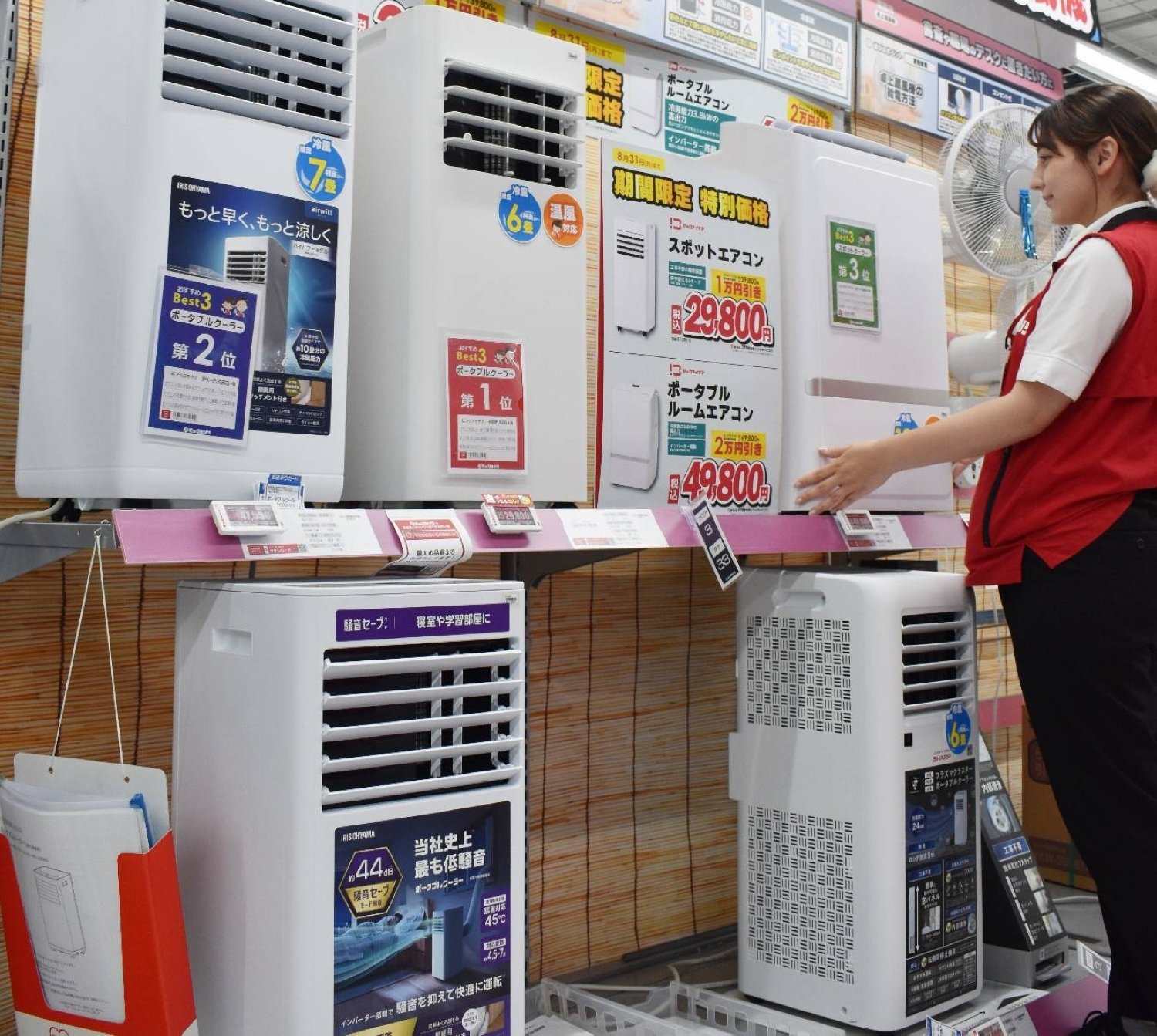
Japanese electronics makers and retailers are enjoying strong demand for portable air conditioners, with some areas recently experiencing “cruelly hot” days, featuring temperatures of 40 degrees Celsius or higher.
Such products are popular because they have relatively low prices and do not require installation work, and some consumers are seeking them as second or third air conditioners for their homes, industry sources say, adding that manufacturers and shops are expanding their lineups.
At major electronics retailer Bic Camera’s outlet in the busy Yurakucho district of Tokyo’s Chiyoda Ward, portable models priced at between ¥30,000 ($183) and ¥50,000 are selling well.
Currently, buyers of conventional air conditioners need to wait for about a month for installation work to be conducted, due to a last-minute surge in demand ahead of the introduction of stricter energy-efficiency standards in 2027, which could push up prices, according to an official of the store.
Meanwhile, many portable models, unlike conventional types, do not come with an outdoor unit and only need a duct installed to the window.
“We recommend portable products to customers who need cooling equipment right now,” the official said.
In addition, an increasing number of people are using portable machines in rooms without air conditioning, such as kitchens and washrooms.
An official of Pan Pacific International Holdings, the parent of discount store operator Don Quijote, said that sales are particularly robust in Hokkaido, where air conditioners are not widely used.
The portable air conditioner market is seeing newcomers and new products.
Bic Camera launched private-brand portable air conditioners last year, while furniture and household goods retailer Nitori Holdings followed suit this year.
Electronics maker Sharp has introduced a high-performance model equipped with an air-purifying function, priced at around ¥90,000.
Portable models “may sell out sooner than expected” although they are less energy-efficient than conventional air conditioners, a Nitori Holdings official said.
A Don Quijote official said, “Price competition is likely to heat up going forward and product differentiation will become necessary.”



