
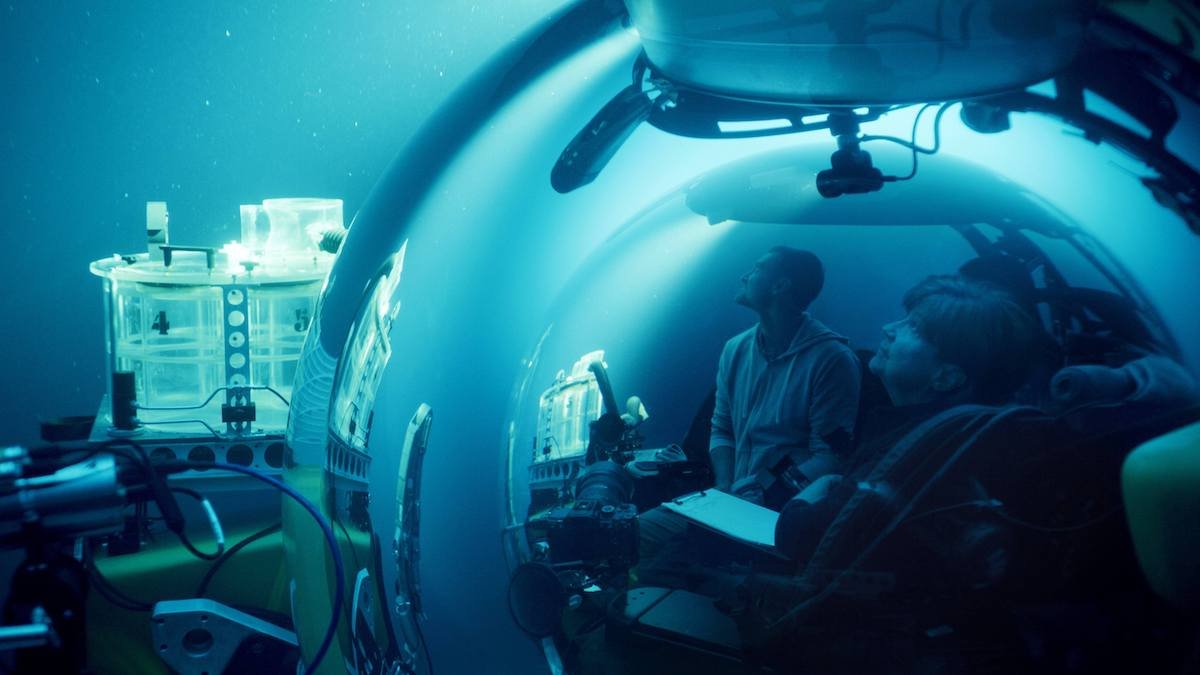
Watching A Life Illuminated, the lovely new documentary about marine biologist Dr. Edith Widder, I kept thinking of a scene in the 1997 movie Contact, in which Jodie Foster plays an astronaut who sees a celestial event too beautiful to describe.
At a loss for words, she says, “They should have sent a poet.”
Four decades ago, when Widder first descended in a submersible craft in search of light-producing sea life, they did send a poet. Widder has spent her long career studying deep-sea light, and when she first witnessed explosions of light emitting from ocean creatures far below the surface, she explained, metaphorically, that what she saw was “like the Fourth of July.”
Other marine biologists teased her about it: Really? Underwater fireworks? But she took it in stride.
Teasing, and worse, were nothing new to her.
In the documentary, which played Saturday at the Woods Hole Film Festival, director Tasha Van Zandt recounts how Widder’s long career has included being the only woman on ships where fellow sailors (and scientists) carried old seafaring superstitions about letting a woman on board.
Later, when Widder tried to be the first scientist to capture footage of a giant squid on film, in its natural habitat, her technique was dismissed as too crazy. Until it worked.
A Life Illuminated tracks Widder’s attempts to show the world the bioluminescent organisms — in other words, creatures that emit light from their bodies — that she saw in a submersible four decades ago.
The central conflict of the film is that at the time, the fireworks-like display that she witnessed couldn’t be captured on camera. So A Life Illuminated is largely about her years of attempts, with the benefits of ever-improving technology, to show the world what only she saw, more than 40 years ago.
I won’t ruin the movie for you, but will say it’s well worth seeing. Anyone who sees A Life Illuminated is in for some mesmerizing camerawork.
And there’s nothing dry about the story, in any sense. At one point, Widder finds herself hundreds of feet down, in a deep-sea submersible, when she suddenly realizes that it’s taking on water.
The Woods Hole Film Festival and A Life Illuminated
The Woods Hole Film Festival was maybe the most perfect place to see the film. Woods Hole, a small village in Cape Cod, is world famous as the home of the Woods Hole Oceanographic Institute. WHOI’s longstanding partnership with the festival includes hosting many of its screenings.
Outside WHOI’s Redfield Auditorium, where A Life Illuminated screened Saturday night, are parts of the Alvin, the famous submersible commissioned in 1964 and used, since then, for deepwater missions like exploring the Titanic wreckage. (The Alvin is still active; the parts outside the Redfield have been replaced with newer ones.)
Widder is based in Florida, but has strong connections with Woods Hole and Massachusetts. A native of the Bay State, she visited in 2022 for a talk with Samuel Harp, WHOI’s vice president for advancement and chief marketing officer, in which she shared footage that would soon find its way into A Life Illuminated.
Harp and Woods Hole Film Festival founder and executive director Judy Lasker spoke before the screening about the bond between the institute and the festival.
A Life Illuminated screened as part of the film festival’s Bringing Science to the Screen initiative, which highlights films that teach audinces about the world around them.
On Saturday, the initiative brought some poetry to the screen, too.
You can read more about the Woods Hole Film Festival here, and read more of our festival coverage here.
Main image: Dr. Edith Widder, right, in A Life Illuminated. Courtesy of the Woods Hole Film Festival.



