
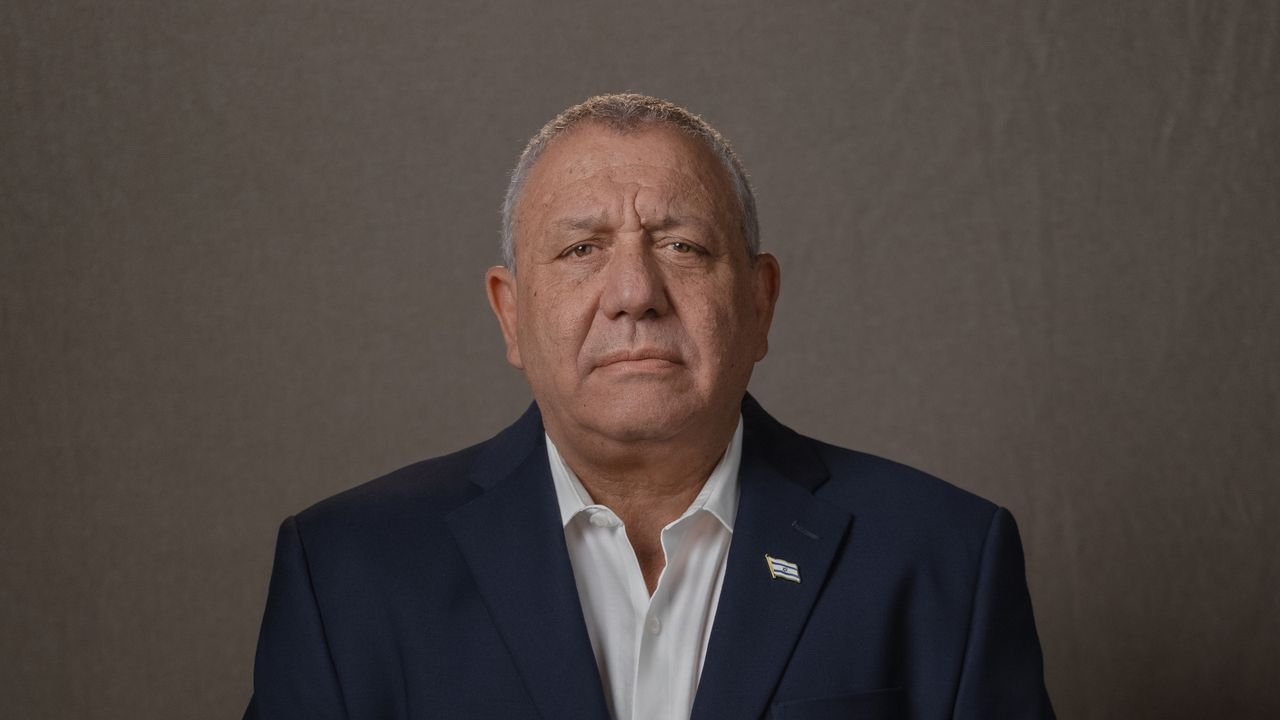
Since the collapse of the Oslo peace process and the outbreak of the second intifada, a generation ago, popular opinion has moved steadily rightward. By contemporary Israeli standards, Eisenkot can plausibly be described as a small-“d” democrat of the center-left. At the urging of his consultants, and in response to the political realities of post-October 7th Israel, he is tacking further toward the center. He seldom voices reservations about the scale and prosecution of the war in Gaza. He recently called New York’s mayor, Zohran Mamdani, antisemitic for asking the federal government to arrest Netanyahu under an International Criminal Court warrant. Eisenkot also avoids the language of a two-state solution, at least as an impending possibility. In June, he told an interviewer for Channel 12’s “Meet the Press,” “I have never said two states for two peoples, because I understand the depth of this religious-national-social conflict, and anyone who talks about ‘peace now’ and two states doesn’t understand the conflict.”
As I followed Eisenkot’s campaign and spoke with him at length, it became clear that the most adhesive aspect of his appeal had little to do with ideology or policy. If he wins (and that, despite recent surges in the polls, is far from assured, considering Netanyahu’s political skills), it will be because he is, in manner and character, the anti-Bibi. What’s more, he reflects back to many Israelis something of themselves. Eisenkot is a broken man. He has suffered profound loss. In no small measure, he is a politician whose deepest connection to Israeli voters is his grief.
Shortly after six-thirty in the morning on October 7, 2023, Eisenkot was at home in Herzliya, north of Tel Aviv, when news reports started arriving from southern Israel. Thousands of Hamas militants, led by the élite Nukhba forces, had just broken through the Gaza fence at more than a hundred points. They entered Israel by land on motorcycles and in pickup trucks, by sea in motorboats, and by air on motorized paragliders. With astonishing speed, they infiltrated some twenty kibbutzim and the small city of Sderot. A killing spree began. There were soon reports on radio and television of families locking themselves in their safe rooms, begging by phone for help. For hours, little came.
As Eisenkot absorbed those first reports, he called out to one of his five children, his twenty-five-year-old son, Gal.
“Gal, wake up,” he said. “It’s war.”
“What are you talking about?” Gal said.
“It’s war,” Eisenkot said again.
Gal, who was studying bioinformatics at Tel Aviv University, was home for the weekend. “His idea, his dream, was to be either a doctor or a scientist,” Eisenkot told me.
He drove Gal to his apartment in Tel Aviv to collect his uniform and gear and then took him to a rendezvous point where he joined his fellow-reservists. Gal had been trained as a combat medic.
Four days later, with a ground invasion of Gaza imminent and an attack on Hezbollah in Lebanon under consideration, Netanyahu asked Eisenkot to become part of a small war cabinet. Eisenkot had served under Netanyahu as chief of the general staff from February, 2015, to January, 2019, but was now a political opponent. Netanyahu hoped to present a united front to a deeply divided public, much of which had come to loathe and distrust him. After months of mass demonstrations against his effort to curtail the power of the judiciary, he urgently needed support for the coming war. Before the Hamas attack, many reservists, including pilots in Air Force units, had threatened to refuse service in protest of the danger they believed Netanyahu posed to Israeli democratic institutions.
“I joined the war cabinet, even though I never in my life thought I would be at the same table with Ben-Gvir and Smotrich,” Eisenkot told me. “The first meeting”—on October 11th—“was very dramatic. Bibi called me to sit at a meeting at five in the evening. When I walked into the room, I didn’t know what it would be about. This was the first time Bibi realized what it is to lose your balance. It was very strange. At first, I didn’t know what we were doing. Then I realized that they had called me in to talk about a targeted killing of Hassan Nasrallah,” the leader of Hezbollah. “I didn’t know that Netanyahu had just gotten off a call with Biden, and Biden had told him, ‘Do not.’ There was a presentation, and it was said that the attack would be at 7 P.M. After the chief of the general staff stopped speaking, Netanyahu turned to the war cabinet and said, ‘What are your thoughts?’ ”



