
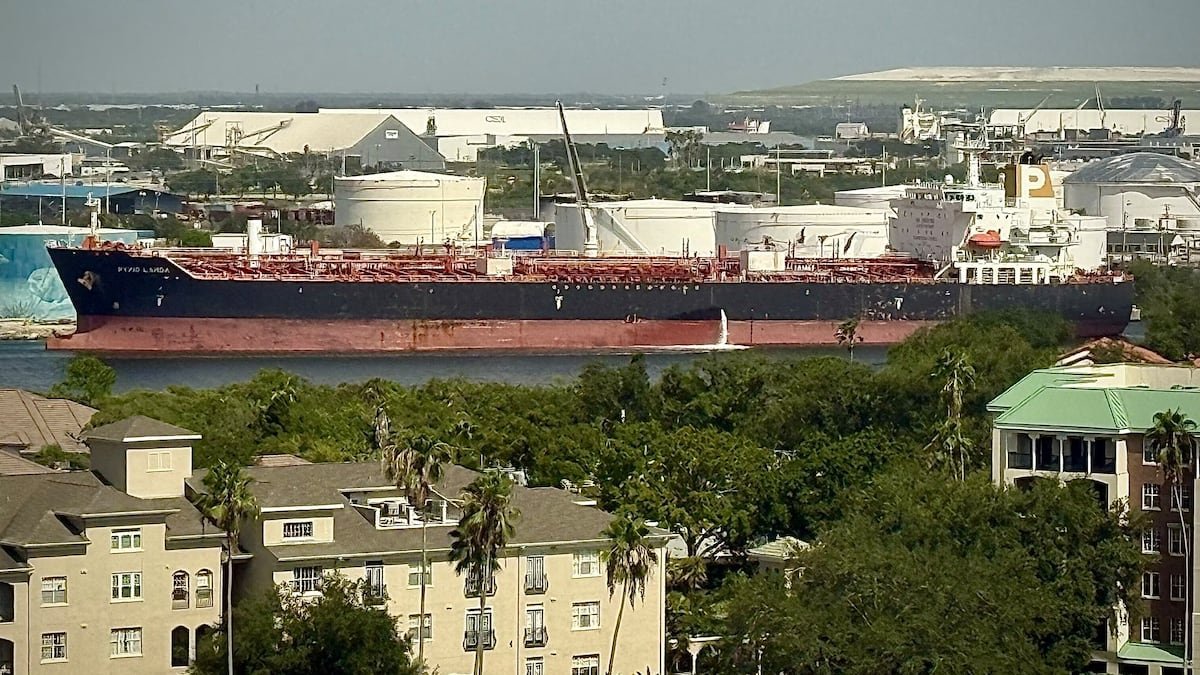
TAMPA — Last week, a Russian-crewed ship skirted past MacDill’s Air Force Base in Tampa, the home of U.S. Central Command.
It continued east of the base to stop at Port Tampa Bay’s Citgo terminal, where it docked about 6 miles from the base. The 600-foot-long oil tanker, the Pyxis Lamda, drew attention for its size. And in a Facebook post made by a Tampa oil shipping firm, it sparked a debate about national security that spread on social media.
“With Russia remaining one of America’s foremost geopolitical adversaries, how does allowing a foreign-flagged, Russian-crewed tanker to make a Jones Act voyage further national security?” the post from Overseas Shipholding Group read.
The Jones Act is a more than 100-year-old law that requires ships used in domestic trade be U.S.-made, owned and crewed. The Trump administration in March waived the law to address rising energy prices amid the Iran war, U.S. Press Secretary Karoline Leavitt wrote on X, and to allow oil, natural gas, fertilizer and coal to “flow freely” to U.S. ports.
As the Trump administration considers extending the act’s waiver, some industry officials are raising concerns about national security and U.S. jobs.
U.S. Central Command declined to comment on the ship’s appearance in Port Tampa Bay.
“This is the broadest, widest waiver we’ve ever seen in the history of the Jones Act,” said Michael Doyle, who served as U.S. Maritime Commissioner during both the Obama and Trump administrations. “Could there be somebody on board who has surveillance equipment?”
Here’s a bit more about the Jones Act and what it means for Port Tampa Bay.
What is the Jones Act?
In short, the law is intended to provide a “significant degree of protection for U.S. shipyards, domestic carriers, and American merchant sailors.”
It’s a section in the Merchant Marine Act of 1920. Congress passed the law to help the domestic shipping industry after German submarines destroyed the U.S. merchant fleet in World War I.
Basically, it requires that any ships carrying cargo or passengers between U.S. ports must be built and registered in the country, U.S.-owned and crewed by Americans.
This means that if a company wanted to bring petroleum from a Texas port to a Florida port, it cannot hire foreign-built or owned vessels. That’s not the case now that the Trump administration waived the act.
International ships also had to leave U.S. waters after making one delivery in a domestic port under the act. Now, these ships can stop at any domestic port and make as many stops as needed across the country.
The waiver could mean that crew on U.S. ships lose their jobs as companies look to cut costs by using waived ships to carry goods instead, said Michael Roberts, a senior fellow at Hudson Institute’s Center for Defense Concepts and Technology.
“I am personally very sympathetic to the crews whose jobs are at risk,” Roberts said. “This waiver is an absolute betrayal of them.”
The law has previously faced criticism for potentially slowing shipments in disaster situations, such as in the wake of Hurricane Maria in Puerto Rico. A study by the Cato Institute, a libertarian think tank, alleges the law has been “suppressing intra-U.S. trade.”
Ian Ralby, a lawyer and CEO of consulting firm I.R. Consilium, said the Jones Act is a protectionist law. This means it intends to protect the U.S. market, even if it’s at the expense of free market values.
What does this have to do with national security?
Overseas Shipholding Group CEO Sam Norton told the Tampa Bay Times he isn’t suggesting the Russian crew aboard the Pyxis Lamda are spies.
“But it’s possible,” Norton added. “You would ask yourself, ‘Why are you even allowing this window of opportunity for admitted hostile nations to be able to easily operate within strategically important elements of your economy?’”
Shipments of oil are especially critical for Florida since it has no pipelines from major refineries in other Gulf Coast states like Texas, Louisiana and Mississippi, Norton said.
Ships from other countries already dock in U.S. ports to bring international goods but would leave after one stop. They must comply with the U.S.’s complex regulations for inbound vessels that are enforced by U.S. Customs and Border Protection and the U.S. Coast Guard. Both agencies have the authority to board and inspect vessels and examine shipping manifests and cargo.
Foreign ships must provide a notice of arrival and departure as well as a cargo declaration, and their crew must carry at least one form of identification. With the waiver, shipping companies are instead able to hire foreign ships to travel between U.S. ports with no restrictions on the nationality of the crew.
The impact of the waiver is already being felt with more U.S. registered ships being “laid up” or idle, said Doyle, the former U.S. Maritime commissioner.
The waiver runs counter to the Trump administration’s “America First” focus to create blue-collar jobs for American workers, he said, and has not proven successful at lowering gas prices.
A vibrant U.S. shipping industry is also in the national interest because the U.S. military sometimes needs to hire domestic ships to transport military equipment to overseas conflicts, Doyle said.
“What are we doing giving American jobs away to the Russians and Chinese?” he said. “It just doesn’t make any sense, and these vessels are operating tax-free.”
The waiver has also helped oil companies save money as gas prices remained high, Norton said.
“The current administration points to the Jones Act and says, ‘Well, this is the cause of all of your problems. We’ll just waive the Jones Act and it’ll go away,’” Norton said. “In the meantime, oil companies are making record profits and exports are at record levels.”
How often is this act waived?
Not often.
The Trump administration temporarily waived the law for 10 days when Puerto Rico faced a crisis situation after Hurricane Maria. Previous administrations also waived the law for about 18 days amid pipeline damage from Hurricane Katrina.
There are other ways it can be waived, such as for small passenger vessels or on specific boats Congress chooses. This year’s four-month waiver is the longest that the law has been suspended in modern times.
In the emergency situations, Ralby said, the waiver supported U.S. efforts.
“It doesn’t make a lot of sense to do that in the longer term,” he said.
The waiver will expire Aug. 16. With the U.S. and Iran recently renewing their conflict, the Trump administration is considering another extension, according to a recent Reuters report.



