
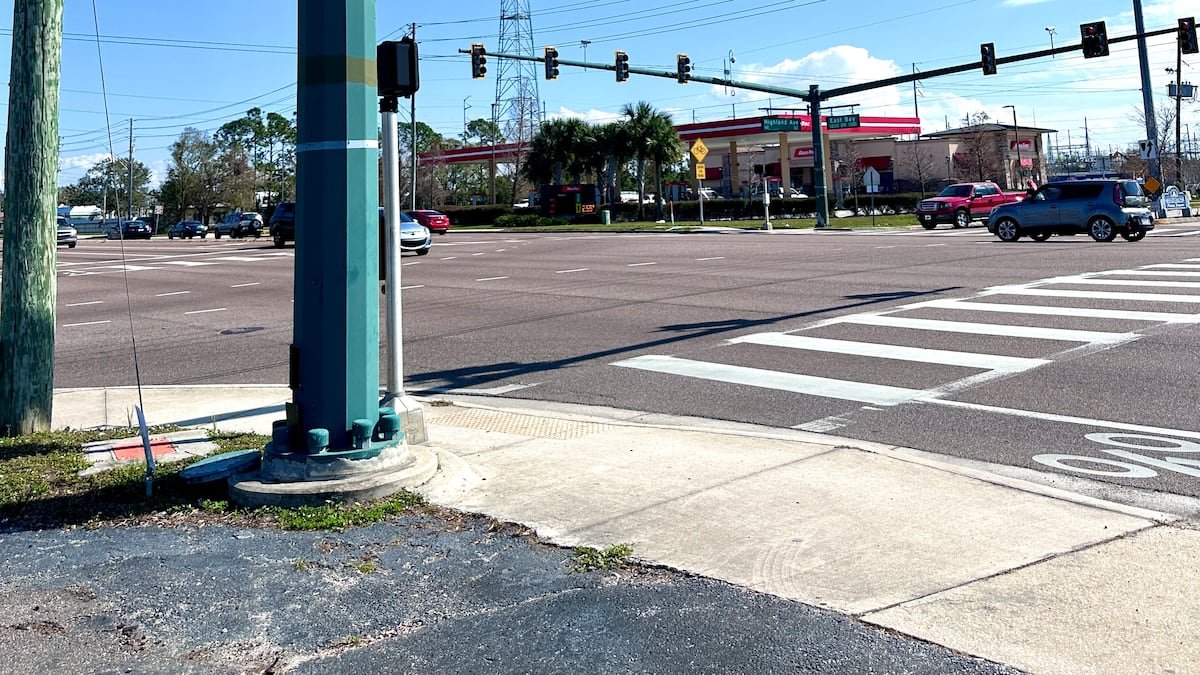
Forward Pinellas is recommending a series of improvements — from resurfaced pavement and retimed traffic signals to protected bike lanes and reconfigured intersections — to ease congestion and improve safety along one of Largo’s busiest corridors.
The countywide transportation and land-use planning agency presented the recommendations to the Largo City Commission during a July 14 workshop, capping a study it conducted with the Florida Department of Transportation. The roughly 7-mile stretch of the East Bay Drive/Roosevelt Boulevard corridor runs from 20th Street, just west of HCA Florida Hospital, to Lightwave Drive, just east of St. Pete-Clearwater International Airport.
“The goal of this study was to evaluate how to improve safety and mobility and access along this corridor,” principal planner Nousheen Rahman told the commission. The corridor was one of nine in the county chosen for improvement based on its “potential to connect people to jobs, housing and job training opportunities,” she said, because it “serves as both a local roadway and a regional connector.”
“Many entities have been working to improve this corridor,” Rahman said. “And our goal in this was to help fill some of those gaps and provide a more cohesive vision for this roadway.”
The study lands amid a broader push to revitalize parts of Largo. New commercial, residential and mixed-use projects, including the $85 million Horizon West Bay development that opened downtown in May, along with code changes and strategic planning have spurred a rebirth in once-neglected areas, among them stretches of Clearwater-Largo Road and Missouri Avenue.
During her 30-minute presentation, Rahman said the study, fully funded by Forward Pinellas and FDOT, unfolded in three phases. The first examined existing conditions and data, which showed safety as a chief concern; crashes along the corridor have climbed in recent years, she said, though efforts to address them are already underway.
“The county manages all the signals in this corridor,” Rahman said, noting officials recently added intelligent video analytics and retimed signals from Highland Avenue to 58th Street North. Seven more are scheduled for retiming on the west side, from 20th Street to Fourth Street.
The plans drew praise from some commissioners.
“If this works it’s going to be a ‘Thank you, Jesus!’ moment, because I am so sick and tired of running from red light to red light,” Commissioner Curtis Holmes said. He added that he has “heard this from the county for years and years and years that these signals are synchronized, and they are not. They are not. … They are horrible.”
After Commissioner Mike DiBrizzi and Mayor Woody Brown agreed the timing needed work citywide, Rahman noted the county has installed a high-tech system with software upgrades in recent years and that the study focused only on this corridor.
“The county manages many more signals,” she said. “But we’re just focusing on the ones for this project.”
Phase One also found that weekday ridership on Pinellas Suncoast Transit Authority buses along the corridor has risen since October, when PSTA doubled service frequency, cutting the wait between buses from 30 minutes to 15. Phase Two, which added community outreach and future modeling, pinpointed a half-dozen intersections with the greatest safety concerns and cataloged residents’ most-requested fixes. “Separated and protected bike lanes were resoundingly at the top,” Rahman said.
In February 2025, the City Commission voted to spend $2.7 million to have FDOT install buffered bike lanes along a 1.6-mile stretch of East Bay Drive.
“So it’s good to see those bike lanes coming online as a result of the construction,” Rahman said, adding that under state law, the lanes will serve both e-bikes and traditional bicycles.
Modeling showed traffic volume in the corridor is expected to grow through 2045 under recently adopted land-use rules that will shift jobs toward the east side of the city. Even so, Rahman said, trip lengths should shrink over that period, “which would allow the involved entities to make the multimodal improvements” being proposed.
Phase Three closed out the study with an action plan. It “entailed taking the data from the existing conditions analysis and the modeling and, of course, community feedback and coming up with mid-term, short-term and long-term solutions,” Rahman said.
The ideas “are not official FDOT designs or plans, just the possibility of improvements based on the existing right of way,” Rahman said. Among them: resurfacing the corridor between U.S. 19 and Lightwave Drive, which would bring it in line with other resurfacing already underway.
The study flagged some 800 possible areas for improvement, Rahman said, then used a scoring system to zero in on three of the most pressing: the intersections at East Bay Drive and Belcher Road, along with Starkey Road and Bay Vista Drive. Suggested fixes there include bus bays, midblock crossings and, over the long term, possible reconfiguration of some intersections.
“Our main goal is to advance the priority projects that have community buy-in,” Rahman said. “It’s not just about project readiness.”
Brown asked whether bus bays — pull-off areas that let buses exit the travel lane — have been used on other major county roads. “No, it’s something new that we’re exploring,” Rahman said.
The mayor said some city bus stops already cause backups. “My one concern is the buses getting back out in the traffic lane,” he said, though he welcomed the fresh approach. “I think we are willing to try things new here in Largo. So I’d be interested.”
Next steps, Rahman said, include presenting the plan to other commissions and “trying to advance some of the short-term recommendations and incorporate what we can into our priority list.” Brown asked whether the Pinellas County Commission was among those slated to hear it.
“No,” she replied. Asked why, Rahman said she “was not asked to” — even though four county commissioners sit on the Forward Pinellas board: Brian Scott, Chris Scherer, Rene Flowers and Kathleen Peters, according to the organization’s website.
“I think it’s important,” Brown said of the county’s involvement. “You mentioned the three entities along this corridor, and Largo is one, and we’re on board. The state has been helpful with a lot of these improvements for multimodal and pedestrian, and I think the county needs to get there, too.”
“I agree with you,” Rahman said.
To view the Forward Pinellas study of the East Bay Drive/Roosevelt Boulevard corridor, visit forwardpinellas.org.



