
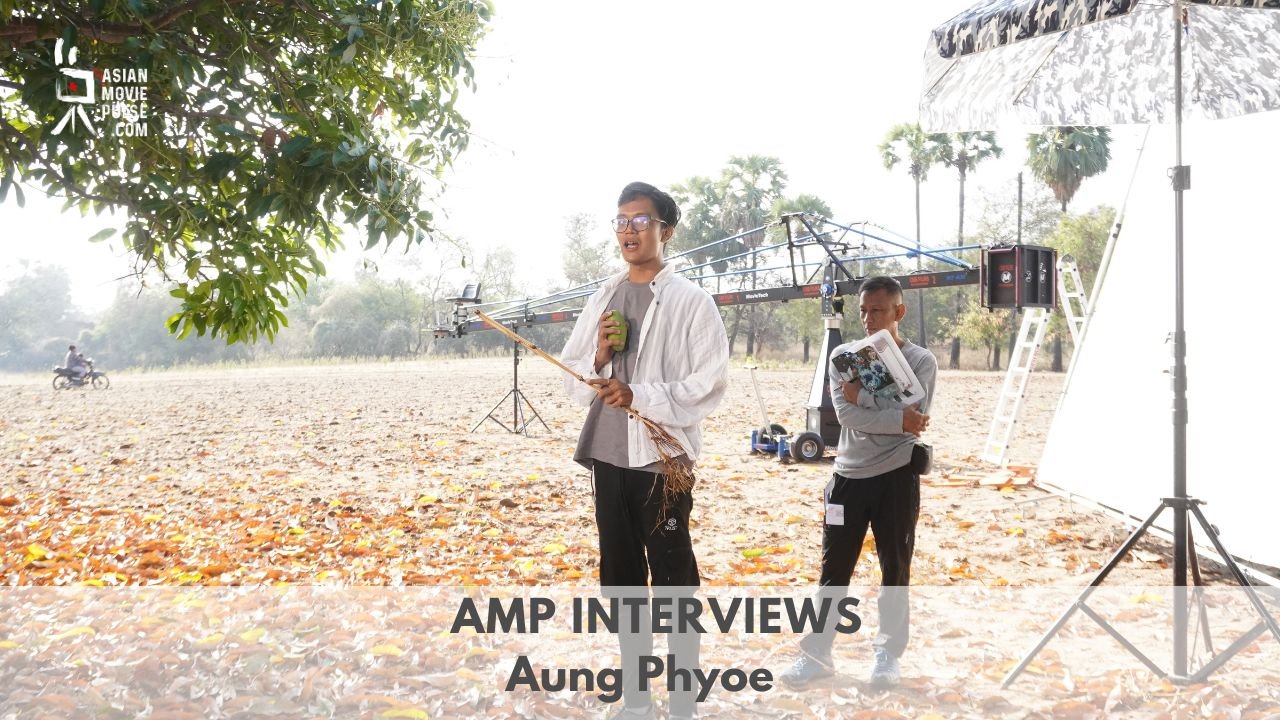
Yangon-based director Aung Phyoe did not expect his feature debut, “Fruit Gathering”, to leave the Karlovy Vary International Film Festival with its highest honour. The Myanmar, Czech Republic and France coproduction competed in the Crystal Globe Competition before receiving the Grand Prix, an outcome that surprised a filmmaker who continued to identify imperfections in the completed work.
Speaking with Asian Movie Pulse following the award, Aung Phyoe discussed the difficult production process, the influence of Rabindranath Tagore, his memories of factories and weaving houses, the ambiguous relationship between San Kyi and Theint Theint Oo, censorship in Myanmar and the increasing obstacles faced by a new generation of Burmese filmmakers.
An Unexpected Crystal Globe
Since “Fruit Gathering” was Aung Phyoe’s first feature, the director arrived at Karlovy Vary without expecting to win the Crystal Globe. Even after completing the project, he continued to view it critically, noticing sections he considered successful alongside others he believed could have been improved.
Expecting an award, he suggested, would have been an unreasonable way to approach a festival. When members of the production received indications that the movie might be recognised, he assumed it would receive a smaller distinction or perhaps a special mention.
“I never expected the Crystal Globe,” he stated, describing the victory as a pleasant surprise.
The award arrived after an unusually long and complicated production. The project had secured financing, but the pandemic and Myanmar’s political upheaval caused repeated postponements. Further problems emerged after shooting, leaving the production unable to complete essential post-production work, including its colour correction.
Without naming the company involved, Aung Phyoe said the team had a particularly difficult experience with one of its original French partners. He acknowledged that the Burmese team’s inexperience with international coproduction structures had made them vulnerable, while adding that certain people were willing to take advantage of filmmakers coming from a country with limited experience in this field.
The production eventually found further support in the Czech Republic, allowing the editing, grading and other post-production work to be completed. This intervention was particularly important to Aung Phyoe, since the colours formed an essential part of the visual approach he had envisioned.
“It was tough,” he admitted, while also recognising that the difficulties resulted partly from the team’s own naivety and lack of international experience.
From Tagore to Myanmar’s Monsoon Season
The title originated during the lengthy writing process, when Aung Phyoe already had a clear understanding of the setting and the basic characteristics of his protagonists but had not yet settled on the final narrative.
After growing up reading mainly novels, he began exploring poetry approximately a decade before making the feature. He felt trapped by the structure of prose and wanted to engage with a more fluid literary form. Rabindranath Tagore’s poetry was widely available in Myanmar, where his collections had been translated into Burmese, and the title of “Fruit Gathering” immediately connected with the director’s childhood.
Check the review of the film
Aung Phyoe grew up in a region where villagers gathered fruit shortly before the arrival of the monsoon. Although Tagore’s collection had its own literary context, the translated title evoked mango groves, seasonal rituals and memories from the director’s early life.
He initially struggled to connect these associations with the characters and environment he had imagined. Consequently, the screenplay passed through several substantially different versions. An early draft revolved around a young woman preparing to marry a man while her female friend arrived for the wedding, creating rivalry and emotional complications over the course of a single evening.
Gradually, elements drawn from the director’s observations, research and personal experiences reshaped the story into its final form.
Within the completed production, fruit gathering represents a point of culmination. It is the moment when something previously planted has reached maturity and must finally be collected. At the same time, it takes place immediately before the first monsoon rain, making it a symbol of transition and the end of one stage before another begins.
Women, Factories and Childhood Memories
The garment factory setting emerged partly from Aung Phyoe’s journeys on Yangon’s circular railway. Seeing women travelling to and working within the industrial outskirts awakened memories of environments he had known during childhood.
His grandparents operated a traditional weaving house, while his father also worked in a factory. Although the manual weaving of his childhood differed significantly from the mechanical processes shown in “Fruit Gathering”, workplaces primarily occupied by women felt familiar to him.
When he observed the garment workers of Yangon, he recognised an environment he wanted to explore. It was not identical to the world in which he had grown up, but it carried subconscious connections to the spaces, sounds and patterns of labour that had surrounded him.
Casting presented another major challenge. Aung Phyoe felt that Myanmar offered few performers between established mainstream stars, who often relied on their existing screen personas, and people with little or no acting experience. Since he did not want to cast celebrities, and they would not work with him, he searched through performers who had appeared in Burmese independent shorts and experimental productions.
Nandar Myat Aung, who plays San Kyi, had previously worked with him on “Evening Clouds”, a short developed partly while he was seeking support for the feature. That experience allowed them to understand each other’s working methods, although the actress requested more rehearsal time for the longer production.
Nandar Myint Lwin caught his attention through footage from earlier experimental work. Her appearance immediately corresponded with the way he imagined Theint Theint Oo, leading to an extended rehearsal process with both leads.
Instead of initially asking the actresses to interpret the dialogue, he instructed them to memorise their lines without considering their logic. He believed that performers reveal their thought process when they memorise dialogue according to its meaning, producing a predetermined quality in the eventual delivery.
The rehearsals therefore concentrated on pauses, physical blocking, movement and rhythm. Since many sequences involved long takes and large numbers of extras, the performances had to be carefully choreographed in collaboration with the assistant directors and casting team.
For the most emotionally uncomfortable scenes, Aung Phyoe also told the performers that he had experienced comparable emotions himself. He wanted them to understand that he was not judging them or asking them to reveal something he could not comprehend.
Love Is Not a Binary Thing
The uncertainty surrounding Theint Theint Oo’s intentions was deliberate. Aung Phyoe did not want to define her simply as a good or bad person, nor provide a definitive answer as to whether she loved, manipulated or exploited San Kyi.
“We all grow up thinking that love should be good,” he explained, noting that people expect affection to produce particular forms of behaviour. Reality, however, is less stable because feelings can change according to circumstances, emotional states and previous experiences.
“We don’t really know what another person is feeling, and even the feeling is not consistent.”
Theint can appear manipulative, and the relationship contains elements of power play. Nevertheless, the director wanted certain moments of affection to feel entirely genuine to both women and to the audience.
For Aung Phyoe, love cannot be reduced to a permanent yes or no. A person can be truthful during one moment of intimacy without maintaining precisely the same feelings indefinitely.
“Love is not a binary thing,” he said. “At the moment of affection, you feel it, and you are truthful to that. Those moments are precious, but it cannot be consistent.”
Yangon and the Imagined Safety of Home
The contrast between crowded Yangon and Myanmar’s open rural spaces was also presented from San Kyi’s psychological perspective rather than as an objective statement that village life is necessarily better.
The director described Yangon as congested, dirty and brutal, with inadequate public transport and few comfortable public spaces. After spending years in such an environment, a person may naturally long for the open landscapes and breezes associated with childhood.
However, the rural region to which San Kyi wants to return is no longer necessarily safe because of Myanmar’s civil war. The plantation that feels heavenly to a temporary visitor may represent another exhausting workplace to someone employed there.
This difference is expressed through the two protagonists. San Kyi experiences the plantation briefly and views it as an escape from Yangon, while Theint understands the labour and hardship connected to the same setting.
The contrast is therefore emotional rather than logical. The rural landscape represents the openness San Kyi lacks in the narrow rooms and crowded factories of the capital, regardless of whether returning there would actually solve her problems.
Rewriting the Story Through Editing
Aung Phyoe described editing as “the last stage in which you can write”. The first cut closely followed the screenplay, but it proved overly long, with some passages moving mechanically from one event to another while others dragged.
He and editor Emily Swe removed a considerable amount of material and gradually abandoned a strictly logical structure in favour of a more episodic and rhythmic form. Time jumps needed to feel intentional, while seasonal changes became essential for conveying the passage of time.
The opening was expanded beyond its brief description in the screenplay. Instead of allowing San Kyi and Theint to meet and immediately become friends, the finished sequence separates their encounters across different parts of the working day. Images of the factory and its routines create breathing space between these meetings, allowing their relationship to develop within a more tangible sense of time.
Conversely, the conclusion was shortened. The screenplay originally included additional material explaining what happened after the main confrontation and how the situation was resolved inside the smaller factory. Aung Phyoe felt these explanations reduced the emotional momentum after the story had reached its peak.
He therefore removed as much explanatory material as possible while preserving enough narrative logic for viewers to understand the outcome. Although the process was challenging, he described editing as the part of production he enjoyed most.
Independent Cinema Under Pressure
Discussing the current state of Burmese cinema, Aung Phyoe rejected the idea that Myanmar has no commercial industry. Mainstream companies continue to produce large numbers of melodramas, comedies, television series and shorts designed for social media.
However, the market produces more titles than local cinemas can release, encouraging distributors to rely heavily on stars whose names can secure screening dates. Aung Phyoe has never worked within that system and remains more concerned about the decline of independent production.
Before 2020, emerging directors could access small local funds, workshops and collaborators willing to work without payment. The economic and political situation has since made even short productions extremely difficult. Transportation has become expensive, crews cannot afford to donate their time and most directors who were ready to make their first feature have left Myanmar.
Local festivals that previously exhibited independent shorts have also disappeared, while Burmese filmmakers increasingly struggle to compete for selection alongside technically and stylistically developed work from elsewhere in Southeast Asia. Aung Phyoe nevertheless noted that several local shorts continue to be completed every year and circulated among small networks of filmmakers and friends.
“People are still making films,” he said, although those works receive far less recognition than they once did. His account echoes wider discussions concerning censorship, exile and the resilience of Myanmar’s independent community.
A Possible Myanmar Release and a Second Feature
“Fruit Gathering” also faced censorship requirements before its international circulation. According to Aung Phyoe, the production had to submit the feature to Myanmar’s censorship authorities even for overseas screenings, and the officials requested the removal of a particular scene.
A domestic theatrical release initially appeared unlikely because distributors did not know the director or the performers. The Crystal Globe victory may have changed the situation slightly, with the producers reporting some potential interest.
Aung Phyoe believes the authorities regard the production primarily as a love story and therefore consider it relatively safe. Nevertheless, it remains uncertain whether a distributor will accept a work without established stars or a familiar commercial style. The producers are also considering private screenings or renting a small venue for members of Myanmar’s independent cinema community.
Meanwhile, the director has begun writing his second feature. The proposed story centres on a woman in her fifties and her son, who is in his mid-twenties, living in contemporary Yangon. Both experience separate losses and heartbreaks but remain unable to reconcile with one another.
While San Kyi conceals her loss in “Fruit Gathering”, Aung Phyoe wants the characters in his next project to confront theirs directly and discover how to move forward. The screenplay remains at an early stage, with the director currently concentrating on its emotional foundations before seeking development programmes and financing.



