
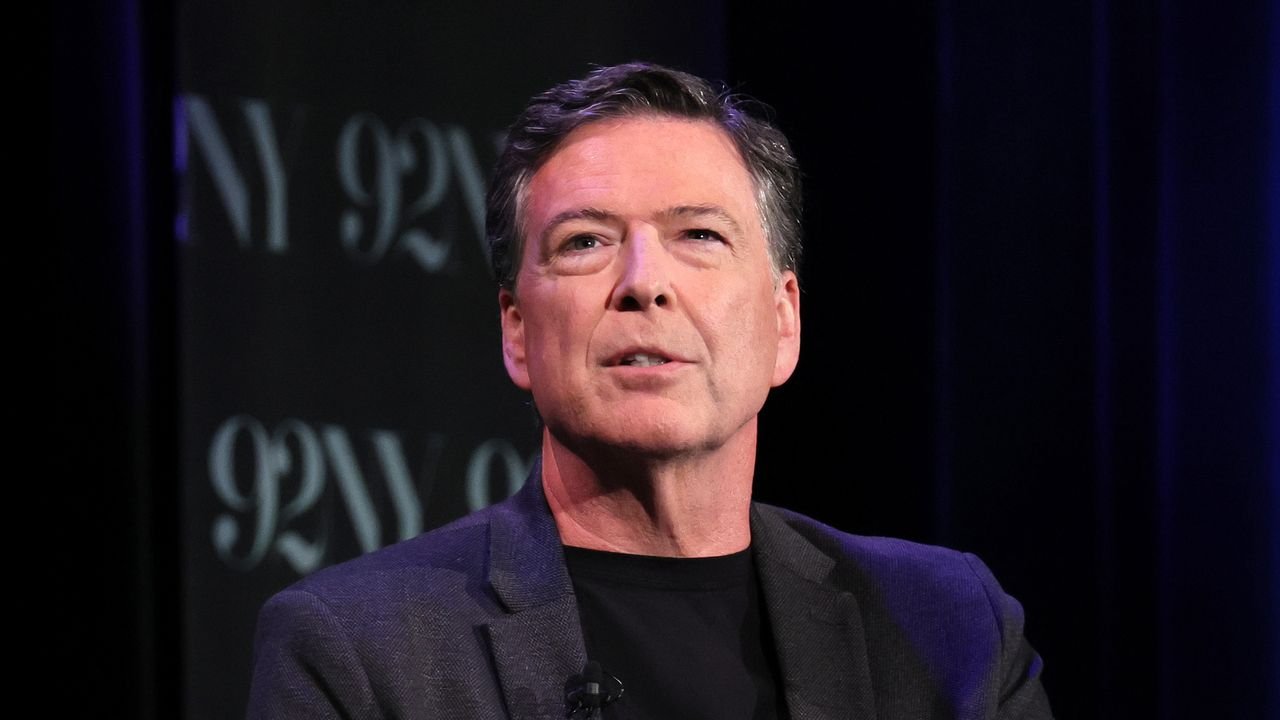
Of all the prosecutions of Donald Trump’s enemies, the case against James Comey has always stood out for its tragicomic excess. The story begins in May of 2025, when Comey, vacationing on a North Carolina beach, posted a photo on Instagram of seashells arranged to read “86 47.” The former F.B.I. director’s caption described this as a “cool shell formation”; the Secret Service treated it as an actionable threat against Donald Trump, the forty-seventh President—“86” supposedly being organized-crime slang for killing and not, as most others understood it, a term used in restaurants for an item that has been taken off the menu.
Comey took down the photograph and agreed to an interview with Secret Service agents the next day, but the agency took the remarkable step of tailing Comey and his wife as they drove home to Virginia. At one point, agents lost track of their car, after the Comeys turned off the highway to visit the gravesite of their son, who had died in infancy three decades earlier. The interrupted surveillance wasn’t a problem for the Secret Service, however, as a tranche of documents filed in federal court this week by Comey’s lawyers show. In an extraordinary, and legally dubious, move, a senior Justice Department official had directed the Secret Service to obtain emergency electronic tracing of Comey’s cellphone—a measure that requires evidence of “imminent threat to life.” In a review of the episode, one Secret Service official wrote, “I suggested that pinging the cell phone is legally questionable.” A more senior official agreed, the official continued, “but said we might anyway.” Another official, who led the questioning of Comey later that day, concluded, in an e-mail to colleagues, “This incident will constitute a story that we will be telling the rest of our careers.”
Eleven months later, Comey was charged with having “knowingly and willfully” made “a threat to take the life of, and to inflict bodily harm upon, the President of the United States.” A “reasonable recipient who is familiar with the circumstances,” the indictment alleged, would understand the seashell photo “as a serious expression of an intent to do harm to the President of the United States.” This is not a case any normal prosecutor would bring under any normal circumstances. The sole signatory on the indictment, Matthew Petracca, a former state Medicaid-fraud lawyer, had been appointed as an Assistant U.S. Attorney just two days earlier. But Trump has been after Comey for the better part of a decade, since firing him as F.B.I. director, in May, 2017, assailing him as “a proven LEAKER & LIAR,” “a weak and untruthful slime ball,” and a “dirty cop.”
In the new court documents, Comey’s lawyers argue that the indictment should be dismissed for two reasons: that the First Amendment permits punishment only for making “true threats,” not merely repeating “a well-known political slogan”; and that the Constitution bars selective and vindictive prosecution. If Comey has broken the law, so, it seems, have many others. During Joe Biden’s Presidency, the conservative influencer Jack Posobiec tweeted, “86 46.” In 2024, then Representative Matt Gaetz—whom Trump nominated for Attorney General—wrote, after various Republicans were removed from leadership positions, “We’ve now 86’d: McCarthy McDaniel McConnell.” In fact, as the acting Attorney General Todd Blanche has acknowledged, the term “86 47” is “posted constantly.”
In addition to the strength of their legal arguments, the new documents offer a glimpse into the Trump Administration’s frantic efforts to gin up a case against Comey. After questioning Comey and his wife, the Secret Service backed away from opening a full investigation. Federal prosecutors in Virginia were also reluctant to pursue the seashell case—although they did bring a separate, and nearly as questionable, perjury prosecution against Comey. (It was later dismissed because Lindsey Halligan, the U.S. Attorney who oversaw the case, had not been legally appointed.) Federal prosecutors in North Carolina stepped in, and turned to the F.B.I., which obliged with a full-scale investigation. That pursuit ramped up, the documents show, after Trump fired Attorney General Pam Bondi in April for, among other things, failing to punish his political enemies with sufficient vigor. In May, shortly after Comey’s indictment, Blanche—by then the acting Attorney General and angling to get the top spot on a permanent basis—contended that the government had more to go on than the single photo. “Rest assured, it’s not just the Instagram post that leads someone to get indicted,” Blanche asserted.



