
On August 5, 2026, Ukraine’s Defense Intelligence reported that North Korea began deploying a specialized ballistic missile unit of roughly 90 personnel to Voronezh Oblast in western Russia. The unit is projected to operate six transporter-erector-launchers and maintain an inventory of up to 120 KN-23 and KN-24 short-range ballistic missiles under the operational integration of Russia’s 112th Guards Missile Brigade. Stationing the detachment inside Voronezh establishes direct access to Western Russian rail and road networks less than 250 kilometers from the Ukrainian border while placing launch facilities beyond the reach of standard Ukrainian tube artillery and tactical drones.
Pyongyang transferred an initial shipment of 40 solid-propellant missiles to Russian storage infrastructure alongside technical crews, reopening an established supply corridor that had previously delivered approximately 150 missiles between late 2023 and August 2025. The integration of additional North Korean maneuvering ballistic vectors directly leverages persistent shortages in Ukraine’s Patriot interceptor inventory while expanding Russia’s total operational salvo size without requiring the creation of new Iskander-M brigades.
Related topic: New video confirms North Korea provided M1991 240mm rocket launchers to Russia to fight against Ukraine
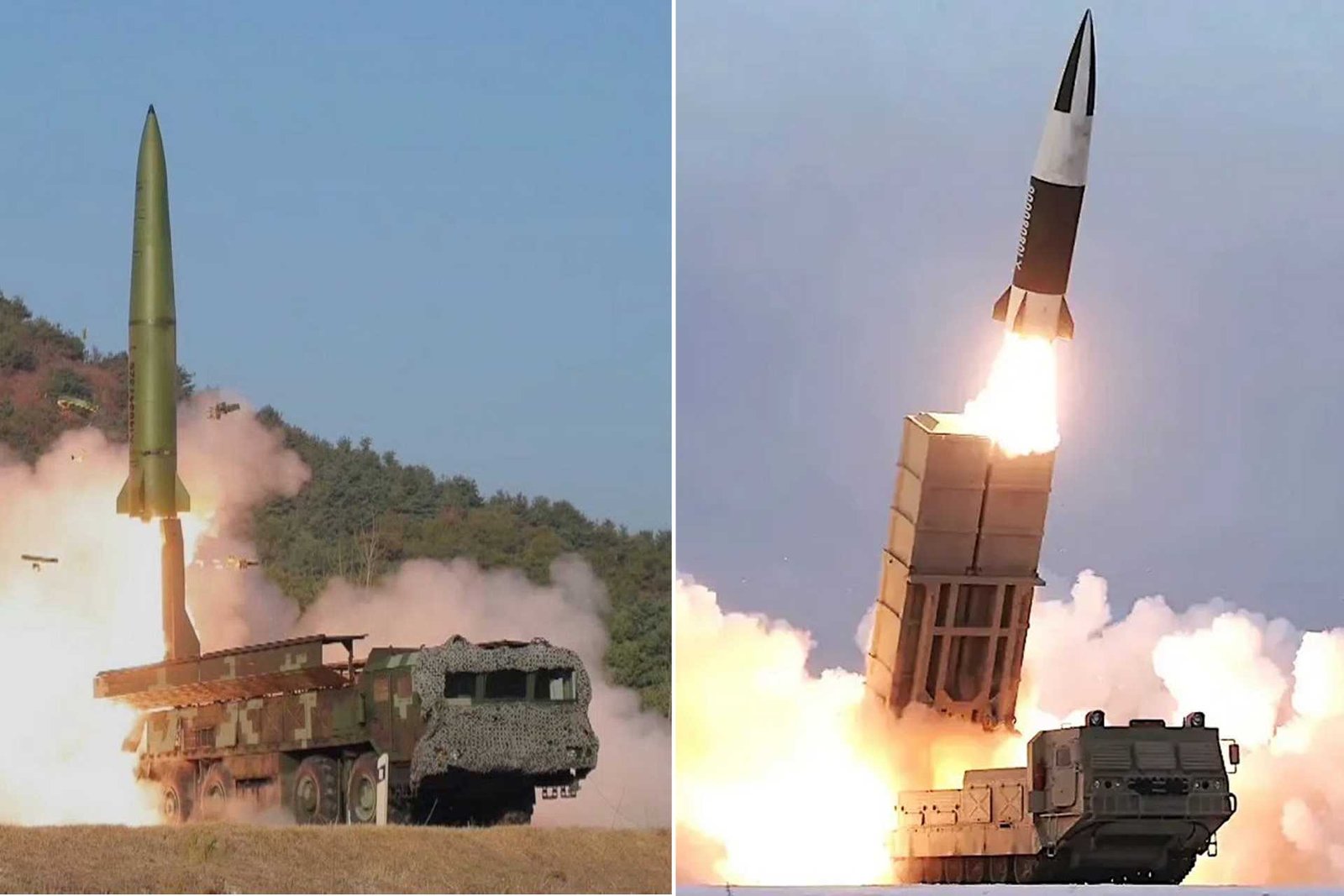
The addition of 120 KN-23 and KN-24 ballistic missiles would allow Russia to increase the size, frequency, and complexity of attacks against Ukraine, while preserving the Iskander-Ms and further straining Ukraine’s limited Patriot interceptor inventory. (Picture source: North Korean MoD)
On August 5, 2026, Reuters announced that Ukraine’s Main Directorate of Intelligence assessed that North Korea was preparing to deploy a ballistic missile unit to Russia’s Voronezh Oblast with roughly 90 personnel, six transporter-erector-launchers (TELs) and up to 120 KN-23 and KN-24 ballistic missiles for future strikes against Ukraine. Pyongyang has already transferred an initial batch of 40 missiles and associated personnel, while the final force structure, missile allocation and operating arrangements are expected to be settled through senior-level Russian-North Korean consultations. The unit is intended to operate with Russia’s 112th Guards Missile Brigade, meaning North Korean crews would likely depend on Russian storage infrastructure and command authorization even if they retained responsibility for launcher operation, missile preparation and maintenance.
Voronezh places the unit less than 250 km from the Ukrainian border, inside Russia’s western rail and road network, but outside the range of most Ukrainian artillery, drones and cruise missiles. The deployment coincides with Russia’s renewed use of North Korean ballistic missiles in late July 2026 after an interruption dating to August 2025, while Ukraine is experiencing a shortage of Patriot interceptors and an increase in Russian attacks combining ballistic missiles with drones and cruise missiles. The operational significance is not limited to 120 additional weapons; it is the creation of a foreign missile formation inside Russia’s strike structure, adding launchers, trained crews and a separate ammunition source without requiring Moscow to form and equip another Iskander brigade.
Russian procurement of North Korean ballistic missiles began in late 2023 after sustained use of Iskander-M missiles, cruise missiles and guided weapons had placed pressure on prewar stocks and current production. North Korea supplied approximately 150 KN-23 and KN-24 missiles between late 2023 and August 2025, while a separate Ukrainian total placed deliveries at 148 missiles by early 2025, indicating that most of the first supply cycle had already occurred before Russian use stopped in August 2025. The additional 40 missiles delivered during summer 2026 therefore represent the reopening of an established supply channel. If the planned 120-missile inventory includes those 40 weapons, Russia would still expect 80 additional missiles; if the 120 are separate, the current deployment cycle could reach 160 missiles.
The available information does not resolve that distinction, but both interpretations point to a stock far larger than a one-time demonstration batch. North Korea has also supplied millions of artillery rounds and deployed approximately 14,000 troops in connection with fighting in Kursk Oblast, of whom roughly 9,500 remained there by August 2026 without being directly engaged at that time. Russia was simultaneously preparing facilities in Voronezh for as many as 30,000 additional North Korean personnel, making the region a combined reception, training, staging, and logistics area for North Korean units supported by the 2024 Russia-North Korea mutual defense agreement. The KN-23, also known as Hwasong-11A, is the larger and longer-ranged weapon expected in the unit.
North Korea first displayed it in February 2018 and conducted its first flight test on May 4, 2019, followed by further launches on May 9, July 25, and August 6, 2019. The missile measures 8.77 m in length and 1.1 m in diameter, while estimated launch mass ranges from 3,415 kg to 8,729 kg because different calculations use different assumptions for propellant load, motor structure, and warhead weight. It uses a single-stage solid-propellant motor, which removes the fueling delay associated with older liquid-fuel Hwasong-5 and Hwasong-6 missiles and permits a launcher to move with the missile at a higher readiness state. Demonstrated and assessed range extends from 190 km on a depressed trajectory to 800 or 900 km with a reduced payload or range-optimized flight profile.
With a 500 kg warhead, a 450 km range is a more realistic planning figure, while the available payload volume is assessed at 500 to 1,500 kg. Some KN-23s employed against Ukraine were assessed to carry warheads close to 1,000 kg, double the commonly cited load, which increases blast and fragmentation effects against power facilities, industrial buildings, railway yards, ammunition depots and large headquarters complexes. The KN-23 is operationally difficult because it does not follow a simple, fixed ballistic arc. Its trajectory generally remains below 50 km altitude, where aerodynamic control surfaces can continue altering the missile’s path in relatively dense air. The missile can fly a depressed profile, execute a terminal pull-up maneuver, change pitch before impact, descend steeply, or extend range through aerodynamic lift.
These maneuvers force an air defense system such as the Patriot to update its intercept solution continuously rather than calculate a single predictable collision point. Guidance combines inertial navigation with possible satellite-assisted corrections, producing an estimated circular error probable (CEP) of 35 to 200 m, although Ukrainian assessments credited missiles used during 2025 with 50 to 100 m accuracy. The six launchers intended for Russia have not been identified by type, but if each carries two missiles, the unit could place 12 weapons in firing condition before reloading. A stock of 120 missiles would then provide ten complete two-missile loads per launcher, excluding training rounds, maintenance reserves and weapons rejected during pre-launch checks. The KN-24, or Hwasong-11B, fills a shorter-range tactical role and is not simply a smaller version of the KN-23.
First tested on August 10, 2019, this ballistic missile measures approximately 7.2 m long and 1.0 m in diameter, carries a 400 to 500 kg warhead, and has demonstrated a maximum range of 410 km. During the first test, two missiles reached an apogee of 48 km, flew 400 km, and attained 2.1 km/s, equivalent to Mach 6.2 under the stated atmospheric conditions. The missile uses a single-stage solid-fuel motor and is carried in rectangular canisters on tracked or four-axle wheeled launchers, normally with two missiles per vehicle. It also follows a low, maneuvering trajectory below 50 km and can conduct terminal pull-up maneuvers, reducing the time available for radar detection, track confirmation, and interceptor launch. Guidance is based on inertial navigation with possible satellite correction, with an estimated accuracy of 35 to 200 m CEP.
Its 410 km reach is sufficient for strikes against Ukrainian brigade and corps headquarters, air defense positions, rail junctions, ammunition depots, troop assembly areas, maintenance centers, and logistics hubs from firing areas inside western Russia or occupied Ukrainian territory. The KN-24 provides less range and a lighter warhead than the KN-23, but it allows Russia to assign a lower-cost imported missile to operational targets and reserve Iskander-M missiles for missions requiring greater accuracy, deeper reach or tighter integration with Russian targeting systems. Russia began using North Korean ballistic missiles in late December 2023, and the January 2, 2024 strike on Kharkiv provided one of the first confirmed cases. By December 2024, Ukrainian officials assessed that Russia had fired roughly 60 KN-23 missiles.
Early batches showed major reliability problems: in May 2024, Ukrainian authorities said close to half of the examined North Korean missiles had deviated from their programmed trajectories or exploded in flight. That failure rate points to inconsistent propellant manufacture, motor casting, control system performance, assembly tolerances, storage conditions or quality control, rather than a single design defect. Later missiles appear to have performed more consistently, and Ukrainian estimates for 2025 placed KN-23 accuracy at 50 to 100 m CEP, narrower than the earlier 35 to 200 m range. Russian use stopped after August 2025, then resumed on July 30, 2026, when a missile from the new 40-round batch struck Radushne in Dnipropetrovsk Oblast, destroyed a residential home, and killed several members of one family.
The pause of almost one year likely reflects exhaustion of the first inventory, delayed deliveries, production scheduling, or a decision to retain remaining missiles until a new supply cycle began. Nevertheless, the July 2026 strike confirms that recently manufactured missiles had moved from North Korean factories through Russian transport and storage networks into operational firing units. The immediate military problem for Ukraine is the interaction between missile quantity and interceptor scarcity. Russia increasingly combines Shahed attack drones, cruise missiles, Iskander-M missiles, and North Korean ballistic missiles in the same attack, using each category to impose a different demand on Ukrainian air defense. Drones can force radar activation, reveal defended sectors, and consume gun ammunition or short-range missiles. Cruise missiles approach at low altitude and require coverage along likely routes.
Ballistic missiles arrive at several kilometers per second during the terminal phase and can only be engaged by a much smaller number of systems. On August 5, 2026, Ukraine intercepted 98 of 115 drones but none of the 24 ballistic missiles included in the attack. The strike killed at least 17 people, injured dozens, and hit seven locations in Kyiv, including industrial buildings and warehouses. The Patriot remains Ukraine’s principal system against Iskander-M, KN-23 and KN-24 missiles, but the supplied interceptor stock is almost completely depleted. Russia does not need to destroy every Patriot launcher to gain an advantage; forcing Ukraine to expend interceptors faster than they are delivered can produce the same operational effect. North Korean production capacity determines whether the deployment remains a finite 120-missile package or becomes a recurring supply stream.
The February 11 Plant in Hamhung was expanded in 2024, while inspections in December 2025 and June 2026 showed roughly 90 Hwasong-11A airframes during the first visit and close to 80 missile bodies during the second. Those quantities indicate serial production in batches of dozens, not small-scale assembly for testing. Recovered missile wreckage contained more than 290 foreign-made electronic components, with about 75% linked to U.S. manufacturers, 16% to European companies and the remainder to Asian suppliers. North Korea therefore remains dependent on imported commercial electronics entering through distributors, intermediaries and third countries, but sanctions have not prevented access in sufficient quantities to maintain missile production.
Ukrainian assessments also found older manufacturing methods and less energy-efficient propulsion than in comparable Russian missiles, requiring larger airframes and motors to obtain similar range. These deficiencies reduce efficiency and can affect reliability, but they do not remove the missile’s operational value. A KN-23 that is less accurate than an Iskander-M still carries up to a 1,000 kg-class conventional warhead, follows a maneuvering trajectory, and may require one or two scarce Patriot interceptors. Russia gains value from the exchange even when the imported missile is technically inferior because the Ukrainian defensive resource used against it is more constrained than the missile supply itself.
The longer-term consequence is a combined Russian-North Korean ballistic missile force with two production bases, two missile families, additional launch crews and shared operational infrastructure. Russia can continue manufacturing Iskander-M missiles while using KN-23s and KN-24s to increase salvo size, preserve domestic stocks and allocate different missiles according to target type. More accurate Iskanders can be reserved for hardened command posts, air defense nodes or targets requiring tighter precision, while North Korean missiles can be used against power plants, substations, railway yards, warehouses, airfields, industrial zones and troop concentrations with larger physical footprints.
Integration with the 112th Guards Missile Brigade would also give North Korean personnel direct experience with Russian target selection, electronic warfare, camouflage, dispersal, reload procedures, battle-damage assessment and operations against Patriot-equipped defenses. Six launchers and 120 missiles would not independently determine the course of the war, but they could add two to twelve ballistic missiles to future strike packages over repeated cycles. That is sufficient to increase Patriot expenditure, raise the probability of leakage through defended sectors, and support winter attacks on Ukrainian electricity, transmission, fuel storage, and heating infrastructure. The main change is therefore not the arrival of another batch of missiles, but the establishment of a repeatable system linking North Korean factories, imported electronics, Russian transport networks, North Korean crews and Russian strike planning.
Written by Jérôme Brahy
Jérôme Brahy is a defense analyst and documentalist at Army Recognition. He specializes in naval modernization, aviation, drones, armored vehicles, and artillery, with a focus on strategic developments in the United States, China, Ukraine, Russia, Türkiye, and Belgium. His analyses go beyond the facts, providing context, identifying key actors, and explaining why defense news matters on a global scale.



