
(Music: “No One Is Perfect” by HoliznaCC0)
Anne Brice (intro): This is Berkeley Talks, a UC Berkeley News podcast from Strategic Communications at Berkeley. You can follow Berkeley Talks wherever you listen to your podcasts. We’re also on YouTube @BerkeleyNews. New episodes come out every other Friday. You can find all of our podcast episodes, with transcripts and photos, on UC Berkeley News at news.berkeley.edu/podcasts.
(Music fades out)
David Wilson: Good afternoon. It’s a beautiful day. Thank you very much. A beautiful day. We’ve defeated the rain. We’ve got the sunshine happening. We’ve got an outstanding speaker ready and we’ve got a live active and energized audience. I’m really excited to be here. First, I want to thank you for joining us for the 2026 Wildavsky Lecture in Public Policy. It’s wonderful to see as many people in this audience as possible, members of our community, our faculty, our staff, our students.
The Aaron Wildavsky Lecture in Public Policy was established to honor the memory of our founding Dean at the Goldman School, Aaron Wildavsky, and his lasting contributions to the field of public policy. Over the years, the lecture series has hosted talks and debates with extraordinary thinkers, including Jamila Michener, Dean Karlan, Larry Summers, Laura Tyson, and many others. The event symbolizes what is most unique about the Goldman School, research for public impact, a concern for justice, and a belief that public policy can create a better future and perhaps more hope.
My name is David Wilson. I’m the Dean of the Goldman School of Public Policy and a Professor of Public Policy and Political Science. I’m greatly excited to be here and about our speaker tonight is Jens Ludwig. Jens is an outstanding scholar and we look forward to hearing his remarks. But before we get started, I want to have a few housekeeping notes. Professor Ludwig will give his talk after which he and Professor Steve Raphael, who I’ll introduce shortly, will engage in Q&A. If you have questions, and you should have received some note cards, you can write those down as we go along. And at the end, we’ll make sure that we pass those up for comment.
Before I begin, I also want to recognize a few important folks in our audience, Mary Wildavsky. Mary, please raise your hand.
(Applause)
She is my wise sage and inspiration in many of these difficult days. So thank you for being here and thank you for your family for continuing to support this event. I want to recognize our former Dean, Henry Brady. Henry, say hello. I want to recognize our Associate Dean of the Goldman School, Hillary Hoynes, Professor Hillary Hoynes. Members of our GSPP selection committee for the Wildavsky lecture, if you’ll stand, raise your hand, wave. Thank you. I know you’re here. If not, just pretend like you are a member and just wave your hand there.
Outstanding. Very good. I also want to recognize our planning committee here, Elizabeth Mart, and many others on our staff who helped to make this event possible. All of our faculty members who are here and our staff who are here. And most importantly, I’d like to recognize our students.
Are there any MPP, MPA or MBP current students in the room this evening? Oh, come on. Raise your hand, celebrate, clap. I also want to recognize the many prospective students who are here today. If you’re here and you’re thinking about the Goldman School and you’ve been admitted, please celebrate a little bit with a round of applause. Yeah. Yeah. Thank you for agreeing to join us. You have, you have not. All right. And so now it’s my pleasure to introduce our moderator, Professor Steve Raphael. Steve is a Professor of Public Policy and the James D. Marver chair at the Goldman School of Public Policy. His research explores the economics of low wage markets, housing, and the economics of crime and corrections. Steve’s an amazing scholar, an instructor, and a faculty member, and we’re so excited to have him lead this event. So Steve, come up and take it away.
Steve Raphael: Thank you, Dean Wilson. It’s a great honor to be in conversation with Professor Jens Ludwig tonight, our 2026 Wildavsky lecturer. Jens is the Edwin and Betty L. Bergman Distinguished Service Professor at the University of Chicago, Pritzker Director of the University of Chicago Crime Lab, the Co-Director of the Education lab, and a co-director of the National Bureau of Economic Research Working Group on the Economics of Crime. Currently, the economic analysis of crime and criminal justice is actually a huge field in the United States, and Europe and Latin America. And it’s a relatively new field, a relatively young field in the discipline, probably about 20, 25 years old. And not surprisingly, it commenced with the beginning of Professor Ludwig’s career.
So if we just think about some of the major contributions he’s made over the course of his postgraduate life, some of his earliest research was conducting one of the largest social experiments that was administered to date in the United States involving housing mobility, whereby people in very, very, very poor neighborhoods living in public housing were given the opportunity to live in less poor neighborhoods, neighborhoods that were generally more safe, all done via randomized control trial in four different cities, then known as the Moving to Opportunity [sic] experiment.
And it generated enormous amounts of findings, including the finding that living in a safe neighborhood is the equivalent of being on very effective antidepressant medication. And then ultimately leading to after 10 or 15 years, findings by Raj Chetty and others that the long-term effects of growing up in poverty in terms of earnings and life outcomes are quite severe. That’s a lot of building on work that Jens has done. Aside from that, Jens is one of the first people to really apply machine learning and algorithmic prediction to thinking about innovations in criminal justice policy, involving such questions like, what’s the best way to decide who should be detained pretrial? And are we overdoing it? Could we achieve the same results we are with fewer people incarcerated on any given day?
He’s made enormous contributions to the economic analysis of gun violence, gun violence policy. And aside from that, he’s also made enormous strides and set new bars in terms of raising the rigor of research on criminal justice policy, cooperating with criminal justice agencies, building administrative databases that link across systems that allow us to learn things that we otherwise wouldn’t know, and many other things. And that’s not surprising. He’s the Founder of the Crime Lab in Chicago, so everybody has labs these days. Well, he’s one of the first people to have a lab. And in some ways he’s been pathbreaking in that domain.
So there’s people who get into something on the ground floor, and then there’s people who build the foundation of the ground floor. And our guest tonight is a foundational researcher whose contributions are immense. So tonight we’re going to hear about his work on gun policy and we’re going to hear something very interesting because in the last decade or so, or probably longer, Professor Ludwig has started to incorporate much of the insights in behavioral psychology and behavioral science into criminal justice policy, and into gun policy in particular.
So you’re in for a treat. So please join me in welcoming Jens Ludwig, our 2026 Wildavsky lecturer.
Jens Ludwig: Thank you, Steve. Thanks so much. Boy, what an amazingly nice introduction. Thanks so much for having me. It’s such an honor to be here for several reasons. One is I really, really believe in public policy and public policy schools. My entire professional life has been spent in public policy schools, since I went to graduate school back in the 1800s. I took my horse and buggy off. And I believe in what they’re doing. I really believe that an out-sized share of social progress stems from scientific progress. And so those of you who are thinking about getting an MPP, it’d be great if you came to Goldman, but the most important thing is please go get an MPP, because I really do think that this is just such a fundamentally important way to make the world better. Thank you for doing it.
It’s also an incredible honor because for those of us in the public policy world, Aaron Wildavsky is some combination of a hero and a legend. It’s always an amazing honor to be asked to come give a talk at the best public university in the world, but it is a particular honor to be asked to come and give a talk in honor of Aaron Wildavsky. So thank you. Thank you for having me here. What I wanted to do, maybe just for starters then, is tell you a little bit about why I wrote this book. What brought me to write the book and brought me here.
So I was a professor for 12 years at Georgetown before I moved to the University of Chicago in the fall of 2007. You might be wondering how could someone who looks like he’s 17 have been a professor for so long? That’s just one of the mysteries of public policy we’ll leave lingering out there. So fall of 2007, I get to the University of Chicago and Amadou Cisse is a Ph.D. student in the chemistry department. This is a picture of Amadou. He’s finishing his dissertation that fall.
So then if you think about the six or seven years before I get to the University of Chicago, Amadou, he’s back in Senegal with his family. He gets an admissions letter from the University of Chicago Graduate School. So something, I’m a first generation college goer myself. I didn’t know this before I went to get a Ph.D.. You don’t pay to get a Ph.D., they pay you to go. And the University of Chicago Chemistry Department is one of the very best chemistry Ph.D. programs in the whole world. So this family gets a letter that says, “We are going to pay your kid to get a Ph.D. in one of the very best chemistry departments in the entire world.” This is as close as we get in the real world to the Willy Wonka golden ticket. Life-changing event, gets on a plane, flies to O’Hare, eight hours of Chicago traffic later he shows up in Hyde Park, starts his graduate studies.
Seven years after that, he’s defending his dissertation in October 2007. He’s going to get his degree in the December graduation ceremony. Two weeks after he defends, he’s coming home to his apartment, which is a block from my office on the South side of the Midway. He’s on the stoop of his apartment building looking for his key to get in. And someone walks up and tries to rob him of his water bottle and his backpack. And I don’t know if he reflexively resisted, or if the backpack got caught on his shoulder or what exactly happened, but the guy robbing him wound up shooting him point-blank in the chest with a stolen 22. EMS comes, they race him Northbound on Lakeshore Drive where he’s pronounced dead in the Northwestern Emergency Department.
So whatever is the opposite of the Willy Wonka golden ticket is the call that the University of Chicago had to make to this poor family that night. So I say this partly because to remind us that behind every news headline and every statistic, there is a mom who has just lost the most important person in their lives. And in this particular case, the guy who did it, the kid who did it was an 18-year-old named Demetrius Warren. He’s currently spending 150 years downstate in the Illinois Department of Corrections. So in this case, two moms lost the most important people in their lives.
So this has led to a lot of conversation at the University of Chicago. We like to say that we’ve won more Nobel Prizes than any other university in the world. And yet you can see we’re not having nearly as much impact as we should have, literally in our own backyards. That’s a block from my office. So the universities, normally when they think about what we can do to be more helpful to our home city, we’re like, “Let’s round up five undergrads and send them to go tutor at the local elementary school,” seems pathetically inadequate to the scale of the problem. The National Academy of Sciences had just come out with a report, Blue Ribbon Commission in 2004, reviewing all the data and evidence about what we know about how to prevent gun violence in America. 350 pages, the conclusion is we don’t know anything that you would feel comfortable giving to a mayor, or a police chief, or a social policy commission or anybody in government to actually materially make a difference on this problem.
And so some Associate Dean type came to me and said, “What do you think we should do?” I said, “Let’s solve that problem.” That is what universities should be for, is answering really important open scientific problems that are preventing us from making more social progress. So we started the University of Chicago Crime Lab with that in mind. And our idea was, government doesn’t know what to do. They’ve got vast resources. We’re in the business in public policy schools of trying to make the world better. Could we start a research center to try and be an R&D partner to the public sector, to try and solve this problem? And what I’m going to do is I’m going to share, I think, the lessons that we’ve learned from doing that from the last 18 years. And the book stemmed from the fact that working really closely with government agencies and nonprofits in Chicago led me to see the problem … They see the problem very differently from what I would see when I would turn on the nightly news or watch a presidential debate about what to do about this problem in the U.S. And it’s really that.
So what the book is, is taking those lessons and then trying to put it into some comprehensive framework that makes seemingly disparate things make sense. And I think that winds up leading to a radically different kind of perspective on the problem from what we’ve had. And that’s what I want to tell you about. Maybe one other very quick thing about stage setting is I want to just as additional context point out, that the level of violence that we have in the United States, the level of lethal interpersonal violence that we have in the United States is something that you do not see in any other developed country in the world. So the United States is the bars at the left. You can see that I made up this slide myself. It’s incompetently made. The U.S. is the bar on the left there.
Our murder rate per capita is just off the charts compared to every other rich country in the world, including rich countries or developed countries that you don’t think of as being particularly well run. People in Turkey are looking at the news thinking, “What in the world is going on in the U.S.?” It’s really quite a statement. And then when I break up the murder rate between murders committed with guns and murders committed without guns, what you can see is almost all of the American exceptionalism is driven by murders committed with guns. That is the one way in which the U.S. is really unique. And here’s what’s particularly upsetting about that. So one of the things that people in Chicago will sometimes say is, why do the local papers spend so much attention on the murder problem, the gun violence problem in Chicago, given that it’s just a tiny share of all crimes? And you can see it in this pie chart. So the bluish color is the share of crimes police find about that are property offenses.
Overwhelmingly, the share of crimes are property crimes. The aqua-type color there is other violent crimes that don’t involve guns. Murders are the yellow sliver. You can’t even see it. It’s 0.2% or one fifth of 1% of all crimes. So from the perspective of the distribution of all crimes, this is like nothing, but economists over time have developed ways of measuring the social harms of different social problems. And when you look at the social cost of crime from the public’s perspective, what you see is murders account 0.2% of the crimes, but 70% of the social harm of crime. From the American public’s perspective, the crime problem in America is effectively gun violence. And that’s why I’m really focusing on that so much in the talk.
So why have we not made more progress on this problem? I argue, what I want to argue is that we have framed the problem incorrectly. I should also confess to you or calibrate expectations, this is about as funny as economics humor gets. So if you don’t like this, it is not going to get any better as we go. So we have framed the problem incorrectly. That then raises the question, how have we been thinking about this problem historically? And I think to me, one high level way to see the problem is we have been thinking about the problem too much like these guys. This is Milton Friedman at the top. This is Gary Becker at the bottom. These are the guys who really helped diffuse the idea that everybody is a rational benefit cost calculator before they do anything. And I think the problem is that we’ve not been thinking about gun violence nearly enough like this guy who’s Richard Thaler, who won the Nobel Prize a few years ago for behavioral economics, pointing out that people are people is one way to think about it.
So what is the conventional wisdom about gun violence? So many of you will be thinking back to this graph and think, “This is going to be a very short talk because I know exactly what’s going on here.” The United States is the bar to the left. The United Kingdom is the bar right next to it. The United Kingdom has very restrictive gun laws, not that many guns per capita. The United States has unusually loose gun laws among the developed countries of the world. We have something like four to 500 million guns right now in a country of 330 million people. The data show in principle, more guns in circulation could deter some crimes, defensive gun use and deterrence, but more guns in circulation also make the crimes that do happen more lethal, called the Instrumentality Effect in criminology. As an empirical matter, it turns out that the Instrumentality Effect dominates the deterrence effect. And when you have more guns, on net, the murder rate goes up.
So if you’re thinking, doesn’t the four to 500 million guns have something to do with the murder problem in America? Absolutely. But what I want to try and convince you of, is there’s a lot more to the story beyond that as well. And to try and convince you of that, let me try and take you on a virtual tour of the south side of Chicago, a place that feels very, very far from the sunny East Bay on a day like this. Imagine that we are at the Harris School of Public Policy on the South side of the Midway in Hyde Park. We leave the Harris School building, we make a right on 60th Street heading towards the lake. We get to Dorchester Avenue, we make a right on Dorchester. We walk almost exactly one mile southbound on Dorchester into the heart of the South side. We come to 71st and Dorchester and we get to this place, which is Easy Tree Recycling. “A tree is a terrible thing to waste” is their slogan.
And the interesting thing about Easy Tree Recycling, so this is Dorchester Avenue right here. And the interesting thing about Easy Tree Recycling, is right there at Dorchester and 71st, that is the boundary between two Chicago neighborhoods, Greater Grand Crossing to the West and South Shore to the East. And the interesting thing about Greater Grand Crossing and South Shore, is the shooting rate per capita in these two neighborhoods, it fluctuates up and down year over year, but pretty consistently the number of shootings per capita is about twice as high in Greater Grand Crossing as in South Shore.
Now here’s what’s interesting about that. Guess what is exactly the same East of Dorchester Avenue and West of Dorchester Avenue? Same city gun laws, same county gun laws, same state gun laws, same federal gun laws. Now, if you know anything about gun policy, you will think, “Well, I know Chicago’s got restrictive gun laws, but I also know that most of the crime guns in Chicago are coming in from Illinois, Mississippi, Alabama.” True, all true. But notice it is just as easy to drive a gun in the trunk of your car East of Dorchester Avenue as it is West of Dorchester Avenue from Indiana, Mississippi, whatever. So everything about the gun availability environment is the same in these two neighborhoods. And yet we’re seeing not a modest difference in gun violence, but fully twice as high in greater Grand Crossing than across the street.
So guns definitely matter, but there’s a lot more to the story. Or here’s how I have come to think about this myself, is gun violence equals guns plus violence. This is the high level analysis that you fly someone from Chicago in to tell you about. But there’s actually a really important insight from this. This is really a huge aha moment for me. And so the logic of this when you think about it is look, gun availability is the same, gun control’s the same on both sides of Dorchester Avenue. And yet the rate of gun violence is dramatically different. So that has to mean that the willingness of people to use guns to hurt one another independently matters, and it has to matter a lot, because the difference across these two neighborhoods is enormous. And that is really good news actually. That’s really good news because as an empirical forecast, set aside your own personal politics about gun control, if you are just making an empirical forecast, what are the chances that we are going to get big changes in either direction in gun laws in the United States at the national level anytime soon?
The odds would be very low, would be any honest forecast. Again, for better or for worse, depending on your politics. So if you thought that the only solution to gun violence was dramatic changes in national gun laws, you’d be super depressed. This is actually really good news, because it suggests there’s a whole other margin that we can then think about and act on to make a difference, and potentially a really big difference given the huge amount of variability that’s not explained by guns. So then that raises just another question, which is, OK, so then how have we been thinking about the question of why people use guns to hurt one another? We need to understand that then if we’re going to go down this road.
And so for the book, I spent a ridiculous amount of time trying to track down every opinion survey that I could find that asked representative samples of Americans, what do you think is the cause of crime and violent behavior and gun violence? And the data are very clear that almost all Americans believe one of two different conventional wisdom’s. These are going to be very familiar to everybody in the room. So one big segment of America thinks that violent crime gun violence is due to morally bad people who are just not afraid of whatever the criminal justice system is going to do to them. And so under that perspective, the only thing that you can do to prevent shootings is to threaten people with ever bigger criminal justice sticks. Everybody in this room has heard the term super predator before. I think that speaks to the ubiquity of this kind of perspective on the problem.
And most of the people who don’t believe that believe a different conventional wisdom that says, no, no, gun violence is actually due to economically desperate people who are going to do whatever it takes to feed themselves and their families. And then under that perspective, you think the only thing that I can do to prevent gun violence is to make the alternatives to crime more lucrative, to lure people away from criminal activity that’s involving them in violence and so on.
So here’s what’s interesting about that conventional wisdom or those conventional wisdom’s. So guess what else is exactly the same between Greater Grand Crossing and South Shore? The exact same Chicago Police Department works East of Dorchester Avenue and West. The third district spans both neighborhoods. The exact same Cook County court system, and prosecutors and public defender’s office, the same Illinois Department of Corrections and so on. Criminal justice system, exactly the same. It turns out that the level of poverty is exactly the same across the two neighborhoods. And the amount of racial segregation and social isolation is exactly the same as well. The racial composition of these two neighborhoods is almost exactly the same.
So this is not to say that conventional wisdom is all wrong, but what it is to say, is conventional wisdom is incredibly incomplete in understanding a problem that in every American city is the number one concern of voters. In Chicago in the 2023 mayoral race, gun violence was not just number one, but more people listed that as the top problem than reasons two, three, and four combined. And yet everything that we’ve been thinking about this problem have nothing to say about a huge amount of the variability in what’s going on with this problem. Here’s what else is interesting about conventional wisdom. I think those two quotes that I showed you are from the Democratic and the Republican Presidential candidates back in the 1930s.
So this is to say we have been having this conversation for a long, long time. And it has been a path to nowhere. Mortality rates in America from almost every leading cause have plummeted over the last 125 years with three exceptions, cancer, suicide and homicide. The murder rate in the U.S. today is almost exactly the same as it was in 1950. And if I extended this back to 1900, it would almost be exactly the same there as well. So this back and forth around these two conventional wisdom’s has just not done what we needed to do to address this really important problem.
So we need a different way to think about the problem. What is that different way? Notice as much as the left and the right disagree about almost everything, their conventional wisdom’s about the violence problem in America have a shared underlying, if often implicit assumption. So if you think that the solution to gun violence is bigger sticks, or if you think the solution to gun violence is bigger carrots to lure people away, deterrence or opportunity cost of crime would be the way an economist would say it. Both sides of that debate implicitly think that before anybody ever pulls a trigger, they’re engaging in some sort of deliberate, rational weighing of pros and cons. That is you think the problem is deliberate and intentional if you think the solution is incentives. And that’s where I think our thinking about this problem has gone a little sideways.
So I think when people think this, let me just go back. When people think this, here’s what I think they have in mind. I think what they have in mind is hierarchical structured gang wars over drug selling turf. You’re thinking The Wire. You’re thinking Marlo Stansfield sending his crew out to do a hit on Avon Barksdale’s drug selling gang. That’s what you’re thinking the gun violence problem is. And it is no wonder that you think that, because when the U.S. Attorney in Chicago, they recently had a racketeering case against the Traveling Vice Lords on the west side of Chicago. They’d committed 20 murders as part of a back and forth over drug selling corners along the Heroin Highway, the 290 Eisenhower Expressway coming out of the downtown. That was on the front page of the Chicago Tribune literally every day for like two or three weeks.
We did a little media content analysis in Chicago. That type of thing is massively overrepresented in media coverage of gun violence. But here’s what shootings actually look like in Chicago and in the United States. So June 2, 2012, this is a Saturday afternoon, 3 p.m. Two groups of kids arguing in the middle of the street about whether a kid in one of the groups stole a bike from a kid in the other group. And the two groups start to separate, so there’s no self-defense rationale for what happens next. Kid pulls a nine millimeter handgun out of their waistband, points at the other group, pulls the trigger, hits a teenager, EMS comes, races them down the Lake Shore Drive to the exact same emergency room where Amadou Cisse was taken. He’s also pronounced dead.
So just think about, does that look to you like rational benefit cost calculation behavior? If you go to Facebook on the South side of Chicago, if you were to get $50 for your used bike, you’d be doing really well. That’s the benefit side of the equation here. The kid who did the shooting, even in Chicago with a, let me be diplomatic and say, something less than optimal criminal justice system that we have in Chicago. Even in Chicago, you do a shooting on a crowded street at three in the afternoon, there’s at least a 50% chance that you’re going to get caught. In fact, this kid is doing a 60-year sentence downstate right now. Here’s the coin. Here’s the coin that you are flipping when you do this. Heads $50 used bike, tails 60 years downstate in the Illinois Department of Corrections. Who in their right mind would rationally flip that coin? It just doesn’t make any sense.
This is what most shootings are. So criminologists have a jargony term for violence that is in service of some other end. I want your drug selling corner. I want your phone and wallet in a robbery, they call that instrumental violence. That definitely happens. That definitely happens, but that is only about a fifth of the murders that we see in the United States. Overwhelmingly, the gun violence problem is driven by arguments that go sideways and end in tragedy because someone’s got a gun.
Now, the good news is that behavioral economics has taught us a lot about what is going on in those. Conflict is a very, very common way in which people interact with one another. And so if we’re going to do something about the gun violence problem, we have to have some understanding about what’s going on in those moments and then so we can understand what to do about it. And so what I have discovered through trial and error is that one of the best ways to help you see this new perspective that we have on the gun violence problem from working with our partners, is a little audience participation game. We’ll see if this works in a distinguished setting like this. This will be a little bit of experiment. It’s only going to work if you guys are really into it.
So here’s how the audience participation exercise is going to go. I’m going to show you a colored object in a slide and I want you to call out the color of the object. We’ll do a little trial run for starters. Everybody’s got the instructions?
[Audience response not included]
All right. Forgive me for saying so, but that was pathetic. This is only going to work if you’re really into it. I’m going to go really quickly. So you’ve got the instructions. Here we go.
[Slides of shapes in different colors flash on screen while audience stumbles and shouts out conflicting colors, followed by laughter]
Well, so what is that all about? The Goldman School Admissions Committee wanted me to double check on the academic qualifications. So most of you pass, the rest of you, please see the admissions office before you go home. So if you’ve taken a psychology class at some point, you will recognize that as something called the Stroop Test. This is one of the most widely used experiments in all of psychology. And what is the Stroop Test illustrating? I think the Stroop Test is illustrating what to me is one of the most important lessons from social science that we’ve had over the last 50, 75 years, which is fundamentally that our minds do not work the way that we think they do. And so here’s what I mean by that. So when you think about thinking, you think about this little voice in your head.
So should I really be in a windowless lecture room on such a beautiful day or should I be outside? What sort of snacks are they going to have at the Goldman admitted students’ reception after the talk? This is a little voice. This is what you think of thinking. To the extent to which you are ever rational, it is that. It is that little voice in your head that gives you the capacity to do that. But that part of your brain, very, very powerful, but very, very mentally taxing, depletes mental bandwidth. So my wife comes down every morning at our house in Chicago. She gets her cup of coffee. She opens the newspaper. She starts doing the crossword puzzle. After 15 minutes, she’s got to stop and take a break. That is your mental bandwidth being depleted remarkably quickly. It’s so mentally taxing that our minds have evolved to do as little of that as possible.
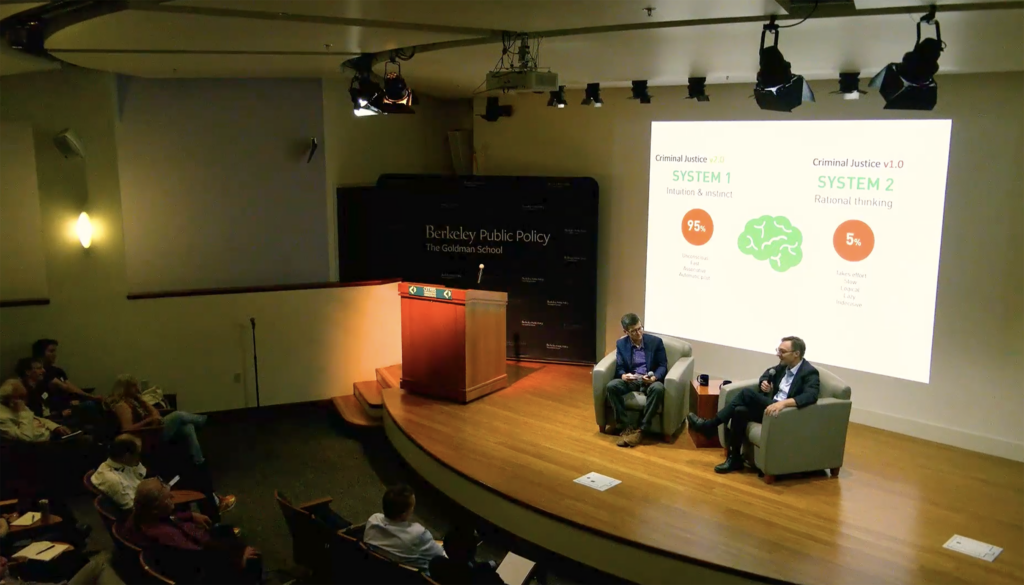
And so what is our brain doing instead? You can see about 5% of what our minds are doing is that. Most of what our minds are doing is stuff that we are not even aware of because it happens quickly, effortlessly, below the level of consciousness. So psychologists call the rational part of your brain system two. The automatic, instinctive, intuitive part of your brain they call system one. And what it basically is, is a series of automatic responses that your mind has developed, that deal effortlessly on your behalf with a bunch of usually low stakes routine things that you see in your daily life. You could not live without system one. How many doors have you opened today? Nobody here knows the answer to that. That is your system one at work for you right there.
But one of the key things that we teach in economics and public policy though is nothing in life is free. And so what you pay as a cost for system one handling so much of this on your behalf, it’s fast, effortless, but not always accurate. And I think the argument that I want to try and convince you of is that gun violence is much more a problem of system one than we’ve appreciated. So what does the Stroop Test illustrate? So here’s an automatic response that you’ve all developed as you walk around and you see text. The little voice in your head does not say there’s someone in a Cal Golden Bear sweatshirt. Should I read that? Your mind just automatically reads it, almost involuntarily reads it. So see word, read word, super useful to you, super adaptive in your daily life.
What the Stroop Test illustrates is that normally adaptive system one response can get you into trouble when it’s overgeneralized. That’s basically the key argument here. So what does that have to do with gun violence? We know that unfortunately in many, many under-resourced urban neighborhoods in the United States, all of the adults in the community, what criminologists call formal and informal sources of social control, from neighbors on the informal side, to cops and teachers and social workers and whatever is totally overwhelmed. And so let me just tell you a very quick story that really made a big impression on me on exactly how true that is.
So when we started the Crime Lab, I thought, I really want to be helpful to the city of Chicago on the gun violence problem, but I don’t know anything. And so I spent a huge amount of time in the courts, in public schools, and housing projects, and riding around with the cops as part of this as well. So I’m in a car with the commander of the Englewood District on the South side of Chicago a few years ago. So Englewood, it’s three miles due West of Hyde Park on the south side. Two mile by two mile neighborhood, super small, super low income, super violent. Consistently has one of the highest murder rates per capita in any neighborhood in Chicago. It’s a Friday night. I’m sitting next to the commander in the police car.
We’re driving down 63rd Street, one of the big East-West arteries in Englewood. It’s two lanes in both directions. And there’s a car in front of us that is swerving across all four lanes of the road, from furthest in our direction, to furthest in oncoming traffic and then back. I was like, “Holy smokes.” Commander jams on the brakes to put some distance between us and the other car. And I look at him and I say, “Commander, I think that guy’s drunk.” And he turns to me and he says, “I do too.” And I said, “Aren’t you going to do anything? You’re not just a cop. You’re the cop. You’re the Commander of the Englewood district. What’s going on here?” And he turned to me and he said, “Look, if I pulled over every drunk driver in Englewood on a Friday night, I wouldn’t have any time to deal with the real problem in this neighborhood, which is the shootings.”
And I can tell you from having spent a lot of time in police cars on summer Friday nights in Englewood, it is literally true that every 15 minutes it is a man with a gun call or a shots fired call. To be a police officer in Englewood on a summer Friday night, it is nonstop, 60, 70, 80, 90 miles an hour from one call to the next over surface streets, lights and sirens, getting to gun calls. So now you’re a 15-year-old kid or even younger growing up in Englewood. You’re walking to school and someone challenges you for your lunch money. You’ve learned, your system one has learned the adults in Englewood just do not have time for this or anything even remotely like this. So you learn, system one has learned that you’re on your own. And system one has learned that the adaptive response, the usually adaptive response to being challenged is to fight back.
And let me also point out that the severity of the fighting back need not be proportional to the provocation. Because the fight back here is not backward looking retribution for what you just did to me. The fight back here is forward-looking signaling to everybody in the neighborhood that I’m not an easy victim. Because I know if I hand over the lunch money today, they’re coming back from my phone the next day and my coat the day after that. And so that kind of, I get provoked, I fight back, might normally work really well for me, but that can be overgeneralized into situations where it’s not helpful, like if I’ve got a nine millimeter in my waistband. That’s the behavioral economics perspective on what’s going on with gun violence.
So another way to capture the core ideas — this is really the core idea at the heart of the book — another way to capture the core ideas, I was in the juvenile detention center a few years ago on the West side of Chicago. I should add for work, maybe. So we’re in the facility and I’m talking to a staff leader. And he’s saying to me, this is where the juvenile justice system in Cook County holds the kids that they think are at highest risk for violence involvement. And he says to me, he says, “20% of the kids in here are psychopaths. You let them out, they’re going to hurt other people. You just have to lock them up.” This is him saying this, not me. He said, “But the other 80%, I always say to them, if I could give you back just 10 minutes of your lives, none of you would be here.” I think that is yes, there are bad people out in the world.
Yes, for sure there are bad economic conditions as well. Yes, for sure guns don’t help any of this. But the argument that I want to try and convince you of is that a hugely out-sized share of the gun violence problem is normal people making a decision they regret very quickly in a very difficult 10 minute window. So how am I going to convince you of that? I want to show you some data to try and get you to think that that is right. And then I’ll tell you a little bit about what this implies for public policy. And then I’m happy to have a conversation with Steve and hear your comments and reactions.
Let me talk you through the very first study that we did at the Crime Lab when we started. So we partnered with this amazing Chicago nonprofit called Youth Guidance, as well as the Chicago Public Schools, to do a study of a program that Youth Guidance had developed called Becoming a Man. So we did it with middle school and high school male students in something like 12 to 15 schools across the South and West sides. These were lowest income, highest violence neighborhoods across the city. And the kids, they participate something like 15-ish hours of the course of the school year. They do this. During the school day, they get out of a class in order to go. That’s part of the attraction of participating. And the very first exercise is called the Fist, where they pair the kids up.
So let’s say Steve and I are a pair. They would give me a rubber ball and the BAM counselor then, it’s 12 kids in the room and one BAM counselor. And the BAM counselor will say, “OK, here’s the Fist exercise. Steve, get the ball out of Jens’s hands. You have 30 seconds. And the only rule is that there are no rules, go.” And then they call time after 30 seconds, they switch. They give Steve the ball and then. And then the BAM counselor calls us together again and debriefs. And the BAM counselor will then say to the kid in Steve’s situation, “So Steve, tell me what strategies you tried.” And the kid in Steve’s situation will normally say some version of, “I tried to pry his hand open. He’s stronger than he looks.
In my case, that would have to be tautologically true. I think I broke his pinky, but I still couldn’t get the rubber ball. Then I put him in a headlock. That didn’t work. I started to punch him in the stomach. I was about to bite his ear and then you called time.” And then the BAM counselor will turn to Steve, or the kid in Steve’s shoes and say, “Why didn’t you ask for the ball?” So Youth Guidance tells me that since we started to work with them back in 2008, they’ve served something like 10,000 kids in Chicago, and literally not more than a dozen ever ask for the ball. Most of the kids in this situation, in Steve’s situation, when they get asked that, say some version of, “If I would’ve asked Jens for the ball, he would’ve though I was a …” And you could imagine what the kid says in that case.
And then the kicker here is the BAM counselor turns to me, or the kid in my situation and says, “Jens, what would you have done if Steve had asked you for the ball?” And most of the kids in that situation say, “I would’ve gladly given him. It’s just a stupid rubber ball. It’s much better than having this guy break my pinky, insult me, put me in a headlock, punch me in the stomach,” and all this stuff. So what is BAM doing? What BAM is doing is it’s basically putting you in a situation that you encounter out in the world over and over again. It is triggering your automatic response that you’re not even aware of. It is showing you that that normally useful automatic response can get you into trouble when it’s overgeneralized, and it’s doing that by giving you feedback. And the other thing that I would just mention is these sorts of programs only work if the kids are actually into it, engaged, coming. And this is a program that is show, not tell.
Imagine the kids are coming down to the first meeting, they’re like, “This is just going to be so lame.” And then the very first thing that they’re doing is Steve is breaking my pinky, putting me in a headlock, punching me in the stomach. This is less lame than I had anticipated. Here’s maybe a couple other quick ways to think about what this program is doing. Unfortunately, none of us learn as well from the experience of other people as we should. We disproportionately learn from our own experiences. And so we’re learning too much from our own trial and error. So if you’re a middle-aged guy living in Hyde Park working at the University of Chicago, you make a mistake. You learn something from that trial and error, no big deal. It’s just an embarrassing story at a dinner party.
If you’re a 15-year-old kid growing up in Englewood, trial and error is a very, very costly way to learn. So another way to think about what programs like BAM are doing is it is giving kids more decision-making reps in simulated situations where the costs of getting feedback are much, much lower than normal. Here’s one different way to think about it. One of the most famous and widely replicated findings in criminology is something called the age crime curve. So imagine the X axis here going left-right is age, and the Y axis here is arrests to people at different age points. And what you consistently see in every country around the world at every time period, is arrests go up through adolescence and peak late teens, early 20s, and then start to gradually decline.
One way to think about what BAM is doing is in some sense, it is trying to be a maturation accelerant. We’re trying to get kids through that high risk period as quickly as possible by accelerating life experience, and learning by trial and error. That’s another way. So you guys are thinking, I know what you’re thinking. You’re sitting there and you’re thinking, “You are telling me you flew all the way from Chicago to tell me that one of the most important intractable public policy problems in the United States is about this. This is going to solve the problem.” So I get your skepticism. I get your skepticism.
And so what I want to do is I want to try and really convince you with data, because we didn’t just partner with the Chicago Public Schools and Youth Guidance to deliver the thing. We structured it like a randomized control trial in medicine. So we enrolled 2,700 kids. We had money for about 1,000, 1,300 BAM slots. Way more kids than that could benefit from BAM. So we randomized which of the 2,700 kids in these neighborhoods would get BAM, which would get business as usual in the Chicago public schools. And then we look at the Chicago Police Department arrest data, and what we see is nearly a 50% reduction in violent crime arrests, 33% reduction in weapons offenses. If gun violence is guns plus violence, they’re less violent. They’re less likely to be walking around with guns. That is a huge win.
So we take the results … So this is like a amazing story for those of you who believe in evidence-based policy. We go down to City Hall. Mayor Rahm Emanuel is the Mayor. We tell him about the results. He’s like, “This is great. I’m going to put some city money into scaling this.” And then we say, “We were as surprised as anyone by these results. Let’s make sure this is not …” So many of you are aware there’s a crisis of replicability in social science. Is our whole field just statistical flukes? We’re p-hacking our studies and nothing is really real. So we say to Mayor Emmanuel, “Let’s study the rollout of the city funded BAM slots to make sure this is a real thing. And you get almost exactly the same results.”
Now, whether this would work at much larger scale, I think is an open question, but notice this cannot happen if conventional wisdom really explains gun violence. What Becoming a Man is doing, it is not threatening kids with stiffer punishment. It is not waving a wand and ending poverty and segregation, and all of the other root causes in Chicago. As important as those would be to fix, all it is doing is getting kids to recognize that their system one can sometimes get them into trouble in high stakes situations. And you’re seeing huge behavioral responses. This tells you this can only be true if there is something to this behavioral economics perspective on the problem. This is proof of concept for this new kind of third perspective on what’s driving the problem.
Let me close with then just a very, very brief overview of what I think this implies for policy, which is a set of things that you have never heard anybody talk about in a presidential debate about this problem in the United States. So what have we been doing? The problem is what people do in these 10 minute windows. We have been trying to solve that problem by changing the incentive’s people face. If you think about the last time you were in a road rage or near road rage moment yourself, you will realize that is not you at your most deterrable. So here’s, I think, what we can do instead. One type of policy that we could do, is change what people are bringing into those 10 minute windows to reduce the chances that they initiate or that they escalate. And that is programs like Becoming a Man. And I think this is also an important part, I argue we can talk more about this during the Q&A. I think that this is an important part of what K-12 schooling does inadvertently.
I think that there’s a lot of room for the K-12 system to develop this kind of helping people understand their own minds much more deliberately, which I think would have huge public safety benefits. Because the public school system, $800 billion a year, 50 million kids, this should be our most important prevention tool that we have. And I think there’s a lot more we can get out of that. I think the other kind of policy direction that we could use is, no prevention effort is going to be perfect. And so a different type of thing that we can do is when these 10-minute windows happen, we can increase the chances that some external adult is there who can step in and deescalate this. When you think about what police do, I think this is a very important … I’ve come to believe, and I can talk more about why, I think an important and underappreciated role for what police do is violence interruption. Community violence intervention organization, some of you will be familiar with that.
I think most people in the public are like, “I have no idea what that is or why that would work because it doesn’t connect to either the bad people or the bad economic conditions perspective.” I think this frame on the problem helps you see why community violence intervention is a really, really important part of how we think about solving the problem. And the last thing that I’ll just mention along these lines is, when you look at survey data and ask city residents, “Which agencies do you think are an important part of creating public safety in the city?” They will say the cops, the mayor’s office, the public schools, the prosecutor, the Department of Family and Support Services, whatever. Here’s what doesn’t show up anywhere on that long list is the Planning department, the Parks department, Streets and Sanitation.
And yet, right? So 60 years ago, Jane Jacobs wrote a book that many of you will be familiar with called The Death and Life of Great American Cities. She was living on Hudson Street in the West Village in New York at the time. She’s looking around and has the same greater Grand Crossing South to our moment that I had in Chicago. She’s like, “How can it be that similarly poor neighborhoods in New York have dramatically different rates of crime and violence?” And she hypothesizes that the explanation is even among places with similar levels of neighborhood poverty, there are big differences in neighborhood vibrancy. The amount of people out in public, or as she called it eyes on the street. And since then, we have learned that that turns out to be not just relevant for gun violence, but shockingly important.
So some of my friends at the University of Pennsylvania did an amazing study a few years ago where they worked with the city of Philadelphia to randomly pick some of the vacant lots in the city. If you’ve lived in a city, you know what these are like. Tall grass, trash everywhere, empty tequila bottles, beer bottles, needles, heroin baggies, used condom, you name it. This is not an inviting thing to bring people out of their homes to hang out around. They randomly pick some of these vacant lots. They turn them into pocket parks. They collect survey data. You see people are way more likely to come out of their house and spend time in public on the block. And you see that shootings go down on that block. This is a randomized experiment so you can believe this is the causal effect of cleaning up the lot. Shootings go down in low income neighborhoods by 30%. 30%. That is insane.
So I am the Parks department in a city. I’ve got a long list of vacant lots in the city to remediate all over the city of Chicago. Here is a super insanely easy thing for a city to do, is prioritize cleaning up the vacant lots in the most violent neighborhoods. Get a double dividend in terms of moving the needle. You see exactly the same thing in terms of commercial activity in neighborhoods. You open a store, it generates more foot traffic, violent crime goes down. You’ve got a super slow backlog to permitting and whatever system for people to open new businesses. If you’re a mayor, here’s what you can do. You go to that department. Ideally, you would make that much more streamlined. At the very least, you would go, “Fast track the applications for new businesses in the most violent parts of the city, get a double dividend for public safety.”
So lots of things implied by this perspective that are super cheap, sidestep a lot of our biggest political fights, and the data suggests can be shockingly helpful on this super important problems. So to just end, I think the key pivot hat I want to suggest is this problem of gun violence, and I don’t just think it’s this problem of gun violence. I think lots and lots of other policy problems we will discover over time, we have been conceiving of as entirely system two problems. And what I want to argue is that when we’re thinking about big problems out in the world like gun violence, I think a much larger share of those implicate system one to a much greater degree than we appreciate. Thank you very much.
Steve Raphael: God, I have so many questions and I’m going to go off script. I wrote some questions down, but I’m sitting here. I started thinking. So Jens, the first thing I want to ask you is pertaining to the perspective in most criminal justice agencies that I think in some ways does not take into account any of the behavioral insights that you’re bringing thinking about violence. So if you’re a prosecutor or a cop, you’re operating under a model that you’re going to deter people from committing crime by either having a very serious punishment, or increasing the probability of being caught, or maybe making the likelihood of being caught more swift and certain. And I wonder if I realize that our response criminal justices is very balkanized and specific, and we endow too much responsibility in some ways with these agencies. But what would you advise, let’s say, a district attorney to do to change their practice? Or the police where perhaps they have more ability to incorporate this line of reasoning?
Jens Ludwig: Yeah. Let me start with the police. So I think that police, I’ve come to hypothesize that police professionals for the most part have no idea why policing reduces crime. And the reason that I believe … This is not a slight on the policing profession, but an empirical observation. I have lived in Chicago for, I think this is my 19th year living in Chicago. And I think in those 19 years, we’ve had something like 15 different police Commissioners. For those of you who study public management, maybe not ideal. I don’t know. I’m not an expert, but that’s a separate problem. And the interesting thing about this is every police commissioner does something totally different from the previous one.
Police Commissioner one comes in and says, “I’m going to have people just arrest people for everything.” And then the next police commissioner comes in and says, “That’s the dumbest thing in the world. You need to do just a ton of street stops and traffic stops.” And then the next one comes in and says, “That’s super stupid. We need to do community policing.” And then police commissioner four comes in with their own other whatever thing they’re going to focus to do, whatever they’re going to do. So I think that they can’t possibly … This can’t be like heart surgery where there’s a book that tells you exactly how to whatever. I assume there’s a book like that for heart surgery. I don’t know.
So I think the number one thing that this could do is help police understand that a really important part of what they’re doing, I think, is interruption. I’ll just very quickly tell you a story about the light bulb moment for me for why I think that’s what police are doing. So I’m in a police car on the south side of Chicago on one night, and there’s a call over the radio of brawl in the middle of the street. So lights, sirens, race over there, huge group of people fist fighting in the middle of the street. Cops get out of the car. They’re like, “Break it up.” They figure out what’s going on. Teenage girl on this side of the street is dating or was dating a boy on that side of the street. They break up. Someone in teenage girl’s family decides it would be an awesome idea to walk across the street into the boy’s house, and punch him in the face in front of his family.
And now it’s on. And so the cops, they break it up. They say, “OK, everybody back in your house. And if we’ve got to come back here again, all y’all going to jail.” And then they get in the car and they drive away. And so you can see … So I also want to just pivot here. You can see A, the hugely important role that only police can play. You have 30 people, a fist fight. I don’t know how many of you have seen a big brawley fist fight. It is so much worse than you imagine. This is going to sound so dumb. Violence is so much more violent than you appreciate. 20, 30 people fist fighting in the street is like a horror show. You have no idea. Only a bunch of Chicago cops are going to be able to interrupt that. That is acute violence interruption.
But then we get in the car and I say to the sergeant as we’re backing away, “Do you think that worked?” He’s like, “Oh, there’s going to be a shooting here for sure.” I was like, “Why are we going?” He was like, “Are you listening to the police radio? We’ve got man with the gun shots fired calls that we got to. What are you thinking?” And I want to use this to also highlight the other thing that I think police can do is appreciate that community violence interruption can be a huge assist to them, because you need the cops to deescalate the brawl, but then you need someone to come in after that and help the two families figure out how they’re going to live across the street from. You cannot have this be like the Hatfield’s and the McCoy’s, and think this is a sustainable equilibrium forever.
Someone’s got to come in and do that in the wake of what the cops do. And so I think those two things, don’t have your guys spend all their time making nonsense arrests, processing people in the station. Have them available to do prevention, and then appreciate that CVI can be a help, not a hindrance.
Steve Raphael: Well, a related question, and I think I know where this comes from. The San Francisco Juvenile Justice Center is implementing a CBT program for kids with violent offenses. And the delinquency court judge keeps asking for a gun violence program. And I say we have one, CBT. How do I explain to the judge and other stakeholders that CBT is a gun violence prevention program?
Jens Ludwig: Yeah. Whoever’s question that was, send me an email and I’ll send you our paper that shows that violent crime arrests go down and weapons offenses go down and respond. So if you’re not like in the … CBT is cognitive behavioral therapy. It’s a version of what Becoming a Man. I hate the T in CBT, because it implies that it’s for people where something is wrong. And I think really what’s going on is none of us know how our minds work, and it’s so enormously helpful to better understand that. So I think the data suggests this is super valuable for gun offenses. And the other thing that I would say is, I think this is a hugely underappreciated social good arbitrage opportunity to infuse CBT in these facilities.
The reason that I was in the juvenile detention center in Chicago several years ago, was we were working with the new administrator there. He took the place over in response to a federal lawsuit, took it over, appointed him. He didn’t have any money, but he wanted to make the place more developmentally helpful to the kids. So he saw the kids would go to school in the morning, and then watch TV all afternoon while the guard stood against the wall, watching the kids watching TV. And Earl Dunlap was the guy’s name. He was like, “Why don’t I train the guards to deliver BAM-like things to the kids? It’s not going to be the greatest thing in the world, but it’s free. And we see 20% reductions in re-arrest rates to the kids.”
Now, 20% is not 100%. So you’re like, “Maybe how impressed should I be? But let’s find five things that reduce violence by 20% each at a cost of zero per thing.” That’s pretty good. That’s pretty good. And the data in Chicago show 90% of the shooters, 80% of the shooting victims have prior arrest records. We had them in our care. We had the chance to do something. This is something that we can do at zero cost. Why are we not doing this?
Steve Raphael: There’s a great question about the example of the two neighborhoods that you offer. And this questioner’s asking, why is system one thinking so differently in one neighborhood? Or what is the explanation for the variation that you see given the matching on all observables?
Jens Ludwig: Yeah. So two of the things that I would point to in the two neighborhoods is so right now the poverty rate in South Shore and Greater Grand Crossing are almost identical. But in the 150 years, whatever, over which Chicago developed, South Shore had a longstanding built-in advantage of being along the best thing in Chicago in my view, which is Lake Michigan. And so the big commercial strip on the South side is located in South Shore. So the neighborhoods are equally poor, but there’s just much more neighborhood vibrancy, more eyes on the street in South Shore. I think that’s one important part of it. And the other big difference is, and my friend Sendhil Mullainathan wrote a paper a few years ago, a book with Eldar Shafir called Scarcity, where he argues that one of the consequences of being poor is it is a nonstop mental bandwidth tax.
And you can see in the data, there are lots of other things that are much more prevalent in Greater Grand Crossing that create much more of a bandwidth tax. There’s way more graffiti. COVID hit Greater Grand Crossing much harder. So there are way more people dealing with all of the after effects of that. So if you think, what is the effect of a greater mental bandwidth taxes? If system two is very mental bandwidth intensive, having a mental bandwidth tax leads you to be much more system one in your responses.
Steve Raphael: I’m going to ask you to interpret some findings from your lab in this context, which I don’t think anybody has done. So there are additional randomized control trials that show the effects of youth employment programs, that tend to show declines in arrests while kids are employed during the summer, but that they persist for a year. And that oftentimes they persist for violent arrests in particular, and large scale, reproduced both by your lab and then elsewhere. Is there a behavioral interpretation, especially of the latter effect, that the experience of being busy during the summer is impacting?
Jens Ludwig: It’s great. So this has been one of the big puzzles in the research literature is when you give adults more money, or you give adults a subsidized job or something like that, property offending goes down. So you’ve made somebody materially better off, which is important intrinsically in its own right. And their property offending goes down, but violent offending typically doesn’t decline. But it does when you give teenagers summer jobs. And so here’s my hypothesis about what’s going on, is a few years ago, two of our former Ph.D. students at University of Chicago, so Sarah Heller, who’s at Michigan now, and John Davis at Oregon, they reanalyzed the data on the youth summer jobs. And they followed kids up, and they found that there’s two subgroups of kids who participate in these programs. One group benefits way more economically. You give them a summer job, and then you look out over the next year and that summer job leads to much better economic outcomes after the summer job. There’s something about the summer job that then translates into bigger earnings gains afterwards. Those are not the kids for whom violent crime arrests decline the most.
And so the other group, there’s another group of kids that are not getting the big economic benefit that are really avoiding violence. And my hypothesis is that what the youth summer jobs must be doing is some sort of human capital development. This is a conjecture, but I think it is something like this, but we need more research to see if that turns out to be right.
Steve Raphael: All right. I’m going to link this to another question. So somebody’s asking about what about drinking, and maybe visceral stimulation when people might not be thinking rationally when they’re under the influence. And I wanted to ask you as well, so you’re talking here about youth, but I also know that your lab has been involved in interventions with older people who, and older, I mean in their mid-20s or pushing 30, who are at very, very high risk of either committing or being the victim of a violent crime. And do we think of interrupting type one thinking in a different way for people who are no longer juveniles? And is it as effective?
Jens Ludwig: Yeah. So maybe one background thing that I would just, just building on the question, Steve, is I mentioned the age crime curve. So one of the unhelpful things about the age crime curve is that it decays after late adolescence pretty slowly. So even though the peak arrest age is like late adolescence, there are just way more adults than there are teenagers. And so when you look at Chicago, for instance, the gun violence problem is overwhelmingly driven by like 18- to 34-year-olds. And so the good news is that we have found that exactly the same type of program as Becoming a Man can be remarkably helpful even for 18- to 34-year-old guys with unbelievably intensive criminal justice involvement, and huge exposure to trauma.
We did a program that combined a subsidized job to bring people in the door with a BAM-like sort of program. And we see something like a 60% reduction in shootings by the guys in the program. And you look at their criminal record, and it is remarkable because you would think that nothing would be able to … Something like 10 or 15% of the guys in the program had been shot before. I think the median number of previous arrests for participants was like 30. These are super traumatized, super criminal justice system involved people, even into their mid-30s. So I think part of the lesson here is it’s never too late. And then the second quick thing that I would just add to this is, the challenge here is that the safety net that is developed in the United States in the 30s under President Roosevelt, in the 60s under President Johnson, is really a safety net for older people and moms and kids.
And there’s an unemployment insurance and their EITC, whatever. So if you have some labor market involvement, there’s something there for you. But in Chicago, if you look at Black male 18 to 24 year olds, it’s something like 45% are not in school and not working. There is nothing in the federal safety net to help that population. The assumption has been that working age men would be working, so there’s nothing there. We can see clearly on the South side of Chicago, there’s some sort of structural problem, whatever that is, that is causing that assumption to break down. And cities like Chicago have to figure out what to do about that without the benefit of any federal help. That is a huge headwind for making progress on this problem, I think.
Steve Raphael: Well, to build on that and to combine a couple of questions. So you’ve mentioned that largely, at least for those interventions for the older folks, that they’re older men or young men, frankly, but they’re not adolescents. And we have some people asking, is BAM offered to girls and to women? And then another question asks, we know that gun violence varies greatly by race and even after adjusting for income. And it’s amazing when you saw the chart that Jens held up where you saw that spike in homicide around the pandemic. If you break that down by race and ethnicity and gender, it’s just all concentrated on basically Black men in a certain age range. Do you have any idea why that’s the case? And to some degree, obviously BAM is mostly involving Black and Latino kids because of where the program is being offered, but do you have any thoughts on trying to understand the racial differences in gun violence, victimization and perpetration?
Jens Ludwig: Yeah. Let me take that first and then remind me to respond about the gender thing, too. So I think maybe I’d give two different responses to the last question, which is there’s a University of Chicago sociologist called Frederick Thrasher, which he wrote a book in the 1920s called something like The Gang. You probably remember the name better than I do, Steve. So he went out and he cataloged all the gangs in Chicago in the 1920s. And it was something like 95% of gang members in the Chicago in the 1920s were either Italian, Irish or Polish. One of my favorite gangs from the 1920s, it’s a Polish gang. They controlled Milwaukee Avenue. Their name was Buckets of Blood. And so now whenever I take my daughter to her music lessons on Saturday, we drive by, there’s a bar called Buckets of Blood on Milwaukee Avenue right now. All the hipsters then find that funny or something like that.
So I think the lesson there, I think in modern society, the gun violence problem in cities like Chicago is overwhelmingly concentrated among the Black community and the Hispanic community. And I think there’s a temptation to look at this and think, “Oh, there’s something about a particular group of people.” And I think instead I would say there’s a particular group of people who are stuck in a particular type of circumstance right now. But the fact that you go back 100 years and you see it’s a totally different group of people living in those neighborhoods, from different countries with different cultures and whatever, whatever, tells you that it’s something more universal that you wouldn’t see just from the current context.
The one other example of that that I would just add is when you look at the leading causes of death to American adolescents, it’s homicide, especially in low income minority communities, to your point. But suicide is also one of the leading causes of death. I’ve got a friend who teaches at Stanford Law School, our mutual friend, John Donahue, and I spent a lot of time talking to him. And his kids tell him all of the horrible suicide stories in Palo Alto. They have one of the highest per capita teen suicide rates. The two other leading causes of death to teens in America are drunk driving deaths and drug overdoses. And I think of those as deaths of decision making. And the relative proportions, the mix of those across different places varies, but the huge burden of those deaths of decision making show up wherever there are adolescents.
So it’s like there’s something universal about our minds getting us into trouble in this particular way, because we don’t know what our minds are doing. And it just comes out in different ways. And then I’ll just pivot from there to the gender question. So Youth Guidance, when we finished working with them on becoming a man, then they would get this question a lot. What about girls? And so they started a program called Working on Womanhood. And I went down, I was in very far Southside High School in Roseland visiting the Working on Womanhood program when they were starting. And one of the counselors there had us meet with some of the high school girls in the program. And the counselor turns to the girls and said some diplomatic version of, “If you feel comfortable sharing, would you be willing to share with our visitors how many of you have been sexually abused before?” I don’t know exactly what terminology she … And literally every hand in the room goes up.
And to say the set of issues, the sort of traumas, the young men, their trauma is, “I was out with my buddy last week and I saw him get shot in the back of the head when he got kidnapped from, when we both got kidnapped after … This happened to some of our gangs.” So that’s the trauma that the young men are dealing with and the girls are dealing with a very different sort of trauma. And so when we look at the outcomes from the Working on Womanhood program, the big changes there are not externalizing behaviors like violent crime. The big changes are reductions in anxiety, depression, and PTSD.
Steve Raphael: All right. So we have a couple of questions that I think pertain maybe to system actors. And perhaps we can dovetail this with some of the thinking about changing system one versus system two behavior. First, can you talk a little bit about your work on the pretrial detention, and what it tells us about the ability of judges to actually identify who’s a risk of either flight or committing some sort of pre-trial misconduct? What have you learned from that?
Jens Ludwig: Great. So one of the amazing things about writing a book is you reflect back and you think, “Oh my, I am less scattered in hindsight than I thought, in what I was doing.” And so my friend Sendhil Mullainathan and I and some computer scientists wrote a paper a few years ago, showing that judges seem to massively mispredict. So when you get arrested in the U.S., you have to go in front of a judge within 24, 48 hours. The judge decides whether you go home while waiting trial or sitting in jail. And the judge is supposed to make that decision based entirely on a prediction of your risk of skipping court or rearrest. So it’s a prediction problem. And the data show that people are horrible at that. And that is basically just a different version of what is going on with the BAM kids.
So I’ll just give you a simple cartoon example is, there was a paper that came out a few years ago in economics that show that judges are vulnerable to something called the Gambler’s Fallacy. So your system one without you realizing it, thinks that whatever snippets of information it has are representative of the larger world. So if I am a judge and I have like four people that I think are low risk and I let go in a row, that fifth person, regardless of their characteristics, are at hugely elevated risk for being detained, because your system one gives you the feeling like I am due to have a high risk person. And these sorts of statistical tools can help de-bias the judges away from that.
And I think the only other, because we’ve got a bunch of policy people in the room, maybe the only other thing that I would add there is, even with Rahm Emanuel helping us … When Rahm Emmanuel was mayor, you could not go to a becoming a man fundraiser and swing a cat without hitting Rahm Emanuel. He was the biggest BAM booster in the history of BAM boosters. And yet we could never raise enough money to serve more than a few thousand kids at a time in Chicago. And yet when Sendhil and I, we publish our paper on the judge thing in the QJE [Quarterly Journal of Economics], we use New York City data. We show the judges are mispredicting. We get a call from the Mayor’s office that calls our bluff. They’re like, “If this is such a good idea, why don’t you build this for the city?” We’re like, “Oh.” So we are cornered and we had to do it.
So we did this for something like three to $500,000. We deployed this in 2019. We are just getting the evaluation data in now. And we can see that release goes way up in response to the tool, and crime if anything goes down. And so this to me, it’s like these sorts of algorithmic interventions, I think of them as super low cost, super scalable de-biasers of really important public policy decisions. And so I’m getting increasingly interested in thinking about from a scale perspective, how much further can we go in that direction?
Steve Raphael: I have one anecdote I’m going to tell that I think is relevant there. One time I had a conversation with the head of basically parole board decisions for people leaving from very long, indeterminate sentences. And the person told me that the board would go from institution to institution in the state. And regardless in low risk, high risk, they’d always release at least one person. And it would be interesting to see that a lot of these systems have gone to Zoom, where all of a sudden you have people in different institutions, how that’s changed. So there’s definitely a lot of irrationality and cognitive bias, which brings us to the next question.
So where do police and police violence fit into this question? And should we be thinking about policies that impact police training regarding slowing things down and trying to prevent unnecessary shootings?
Jens Ludwig: Yeah. Great question. So when our bam results came out, I’ve got a colleague at the University of Chicago named Oeindrila Dube. She’s married to a Chicago cop. And she looked at those results and said, “I can think of another group of people that is continually facing, forced to make very high stakes decisions under stressful situations, and I think maybe get it wrong a bunch of times.” And so she said, “Why don’t we do BAM for cops?” And so she basically developed BAM for cops and she structured that like a randomized control trial. She did it with something like 2,000 Chicago cops. And then it was a regular part of their training. And then they go off and they do their normal Chicago cop job. So the outcome there is not a lab exercise. It is looking at their administrative data on what they do the year after they get the training.
And what you can see is uses of force go way down. Officer injuries go way down. Low public safety value arrests go down. Just to give you a sense for what … I take my crime class at the University of Chicago to Bond Court every year. And I remember being in Bond Court. A judge set it up for us. I’m sitting next to the judge. It’s like a heroin possession case, and then a domestic violence case, and then someone arrested for smoking on the subway. I was like, smoking on the subway? I turned to the judge, I was like, “What is that?” And she said, “I think the judge says the cops would say she talked her way into jail.” Just to give you a sense for what I mean by low public safety value, those go down, and racial disparities in low public safety arrests go down.
So this is just to say, A, I for sure think that that is a big driver of a lot of the things that we don’t want in policing. And the good news is I think we can do something about it.
Steve Raphael: All right. Maybe one more question. We good? We could sit here all day. But I want to ask you maybe go outside of research from your lab, and think about other promising interventions that are behavioral, and that maybe make the collateral consequences of interaction with the criminal justice system less harmful. So for example, I’m thinking of Aurelie Ouss’s work on text reminders for people to show up for their trial dates, or anything like that where we’re leveraging some of the insights from behavioral sciences to just try to make things move more smoothly, and be less punitive and have better outcomes at lower costs.
Jens Ludwig: Let me just use your Aurelie Ouss example for a second because it’s such a canonic. I think the high level idea that I hope you do, even if you don’t care about criminal justice, you don’t care about gun violence, whatever. I think the high level idea here is assuming that everybody’s behavior is driven by system two rationality, leads you to make a ton of policy mistakes in terms of designing your solutions. So the example that, I’ll just flesh out the example that Steve alluded to. So you go before the judge pretrial, the judge releases you. And so they need you to come back to court so that the criminal justice system can function. Fair enough.
So the criminal justice system interprets people not coming to court through the lens of system two. These people are disobedient. They’re challenging the authority of the court. We need to show them who’s in charge. We need to incentivize them to come back. So if you skip court, we’re going to put a warrant out for your arrest. So you’ve got moms who are driving their kids to school. They’d skip court whenever ago. They run a red light, or a stop sign or whatever. They get pulled over. The cop sees they’ve got a warrant. It’s like the lady gets … And that doesn’t fix the problem. And so then the criminal justice system says, “We know what to do. Let’s increase warrant enforcement or increase warrant penalties when we can …” So you can see it’s when brute force fails, apply more brute force. In the Mark Kleiman, just more needed.
What Aurelie Ouss, our friend at the University of Pennsylvania, what she had the insight is that here’s another thing that. So sometimes people are disobedient. They’re like “F you” to the courts, and they’ll never take me, whatever. But here’s another thing that’s characteristic of people is we forget. It’s like I get arrested and then they give me a ticket that’s confusing to read, that says on June 13 at 3 p.m. in the afternoon, you’ve got a court hearing, whatever. You’re like, “OK, whatever. I put this in the glove box and then my kid in the back is so stressed out from being pulled up but whatever. She starts throwing up all over the court, and then I got her home and I forgot to go to the grocery store and I’ve got my whatever.” And I forget all about the fact that … You can imagine.
So the very simple intervention that they develop is two-fold. They make the ticket much easier to read. So the date that you have to go is not buried in four point font in the middle of whatever. It’s like 15-point font, show up at court on whatever. And then they send you text messages to remind you, just as a reminder, next Tuesday you’ve got to. And you see, given that the intervention is free, you see impressively big reductions in court skipping. And it’s just like another reminder that a lot of this behavior, that public policy is often all about behavior change. And to take that seriously, you really need to have some theory of mind that I think has been massively underdeveloped in the design of our policies. And I think we really got to expand our thinking about that.
Steve Raphael: Well, that’s a great place to end. So please join me in thanking Jens for a great time.
(Applause)
(Music: “No One Is Perfect” by HoliznaCC0)
Anne Brice (outro): You’ve been listening to Berkeley Talks, a UC Berkeley News podcast from Strategic Communications at Berkeley. Follow us wherever you listen to your podcasts. You can find all of our podcast episodes, with transcripts and photos, on UC Berkeley News at news.berkeley.edu/podcasts.
(Music fades out)



