
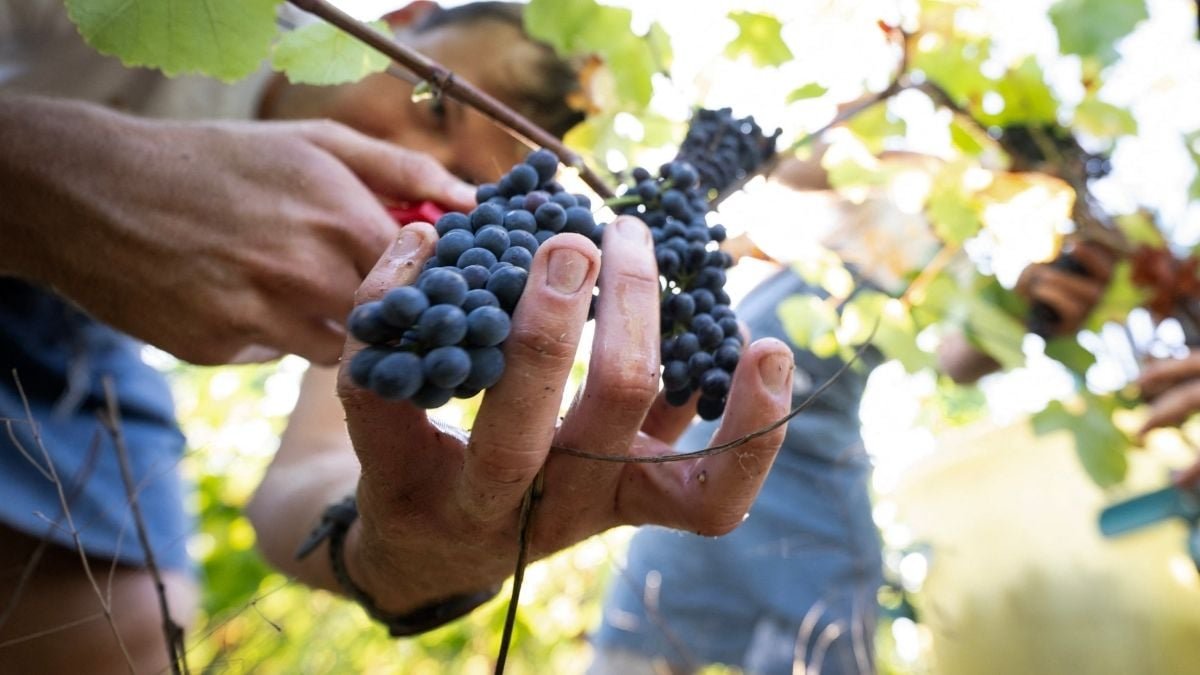
As Western Europe nears the end of its hottest summer on record, growers across the world’s most famous wine regions are starting their harvests early – provided their grapes weren’t already burnt in the heat of fires and drought.
All evidence suggests wine regions in Europe and across the world are going to continue to be hit with hotter, drier weather.
A recent study by viticulture experts from institutes across France, Germany, and Argentina assessed how well two of the most popular wine grape cultivars – Pinot noir and Chardonnay – might fare as drought becomes more prevalent as climate change progresses in the coming years.
As a crop, wine grapes (Vitis vinifera) are quite resilient to dry conditions. In the case of red wines, a moderately drier year can even improve the vintage (and the value of each bottle), despite reducing the yield.
This careful balance is easily tipped over by more extreme conditions, though. In drought, grape vines tend to produce much lower numbers of berries, in smaller sizes, and may even fail to ripen properly.
Scientists have suggested artificial selection or even gene editing could help create new wine varieties better suited to future climate conditions.
But wine growers in heritage regions like France, Italy, and Germany are loyal to their vines.
 frameborder=”0″ allow=”accelerometer; autoplay; clipboard-write; encrypted-media; gyroscope; picture-in-picture; web-share” referrerpolicy=”strict-origin-when-cross-origin” allowfullscreen>
“While many possibilities have been explored to adapt wine production to climate change, changing cultivars is indeed a risky choice for premium wine regions whose wine characteristics and reputations strongly rely on a single or a few varieties,” writes viticulturist Sébastien Nicolas, of Institut Universitaire de la Vigne et du Vin – Jules Guyot, with his colleagues in their recent paper.
“These levers are considered as options of last resort in cool or temperate climate winegrowing regions bound by strict regulations such as the Loire Valley, Bourgogne, or Champagne in France…
“This is because the combination of wine variety and place of origin strongly marks the wine sensory characteristics.”
It’s important, then, to know how warming scenarios might impact these legacy vines. The reality is, with the European summer being as hot and dry as it is, we could be seeing these effects as soon as next year.

To assess exactly how two popular wine varieties would fare in a climate two degrees warmer than pre-industrial levels, the researchers collected samples of Pinot noir and Chardonnay grapes from a total of 80 vineyards in 13 wine-producing regions of France, Italy, Germany, Portugal, and Argentina, across three vintages: 2019, 2020, and 2021.
They evaluated the status of water availability in the vineyards using carbon isotope analysis from the grapes’ juices – a method that has proven a reliable indicator of vine water status.
“Both varieties appeared to be able to withstand a wide range of water deficits, some of which may be associated with climatic conditions similar to a +2 °C warming scenario in Burgundy,” Nicolas and team write.
Chardonnay vines, across all regions, experienced the widest range of water deficits across the three years.
Interestingly, the driest regions were not the ones in which the vines were exposed to the highest water deficits, because those vineyards had embraced irrigation.
Depending on vineyard water status, the researchers saw some major changes to the metabolic fingerprints of the grapes, affecting the terroir – the special character of the wine that arises from its unique growing conditions.
“The ‘Chardonnay’ cultivar did not seem to reach a tipping point, and the response dynamics of the metabolites was linear, suggesting a potentially higher adaptability of this variety to its changing environment,” the authors report.
Related: Yep, Cheap Wine Really Does Taste Better if You Increase The Price Tag
In bad news for red wine lovers, Pinot noir did appear to have a tipping point. Its metabolites were consistent until the vines experienced the stress of severe water deficit, a point past which these molecules so important to the wine’s character began to fall apart.
These results suggest we may continue to see quality Chardonnays, even as droughts become more frequent. The best Pinot noirs, on the other hand, could very well be behind us.
The research was published in Food Chemistry: X.
This article was fact-checked by Fiona MacDonald and edited by Fiona MacDonald. While we pride ourselves on our process, we are only human. If you spot a mistake, please let us know.



