
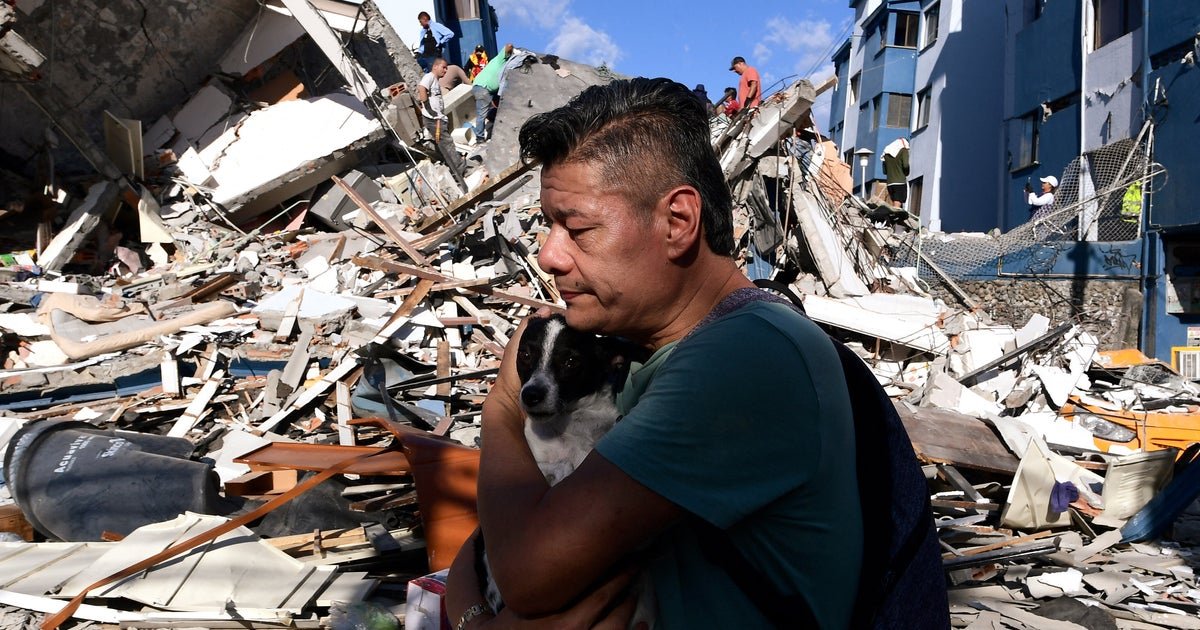
This summer has brought no shortage of earthquakes. Earlier this week, a 7.4-magnitude earthquake shook western Colombia, causing widespread damage and killing at least 169 people.
In June, four massive earthquakes struck different parts of the world ― Northern California, Venezuela and Japan ― within a span of eight hours.
The string of major earthquakes in recent months has left many wondering whether the quakes are connected and if the frequency of earthquakes we’ve been experiencing is out of the ordinary.
As unnerving as all the earthquake news has felt, geologists say there’s nothing atypical about the current earthquake patterns.
“It may feel like we’re having an unusually large number of earthquakes, but statistically, this has been a fairly normal year,” said Wendy Bohon, a geologist who studies earthquakes.
Globally, we typically see about 15 to 18 earthquakes between magnitude 7.0 and 7.9 each year, Bohon told HuffPost. So far this year, we’ve had 10, which puts us on the lower end of what we would expect by this point in the year.
“What is notable is that several recent earthquakes have been damaging or destructive,” she said. “Those are the events we hear about, see images of, and remember.”
JAIME SALDARRIAGA via Getty Images
“There are also well-documented cognitive effects, including recency bias and the ‘frequency illusion,’ that can make something seem more common once it has captured our attention,” Bohan added.
Recency bias happens when we ascribe more importance to recent events than to older, long-term data. Frequency illusion, also known as the Baader–Meinhof phenomenon, occurs when you notice a specific phenomenon more frequently after recently becoming aware of it.
Bohon says mental biases like these are why long-term statistics are so useful.
“Our perception may be that earthquake activity is increasing, but the data allow us to step back and ask whether that is actually happening,” she said. “Right now, we are not seeing evidence of an unusual global increase in large earthquakes.”
Improved monitoring and instant news and social media coverage may also make earthquake activity feel more frequent, said Lingsen Meng, a professor of geophysics at the University of California, Los Angeles.
“There’s no convincing evidence that earthquakes are becoming more frequent globally, though,” he said.

When earthquakes are related, it’s typically because of aftershocks — smaller earthquakes that occur in the same general area in the days to years following a larger event, or “mainshock.”
There are also cases of earthquake clusters caused by induced seismicity — earthquakes and tremors triggered by human activity that alters the stresses and strains in Earth’s crust, according to William D. Barnhart, an assistant coordinator in the USGS Earthquake Hazards Program.
The reality is, earthquakes are happening all the time; most of us just don’t notice because they’re out in the middle of the ocean or in remote areas, rather than the densely populated areas that have been hit recently.
“There is a magnitude 7 on Earth about once every three to four weeks, but the vast majority of these are unfelt or do not cause damage,” Barnhart said.
We still need to prepare for “The Big One.”
All this said, U.S. scientists agree that we’re due for “The Big One.” In California, that would likely be a massive earthquake along the San Andreas Fault.
Though it’s difficult to predict when that will happen, the most recent research shows that tectonic stress along the southern portion of the fault has reached its highest level in 1,000 years, raising concerns about a potential magnitude 7.8 or greater rupture.
“The next magnitude 7 or higher earthquake might very well happen in California ― on the San Andreas or the Hayward or the San Jacinto or on any of the many faults that rupture right across or close by major population areas,” said Ahmed Elbanna, a professor of earth sciences and civil and environmental engineering at the University of Southern California.
“In the U.S., we watch these events around the globe and think we are different and we will fare better,” he said. “It’s true that we have made strides in seismic design and construction practices, but we have lots of vulnerabilities, many still lingering from before the 1994 magnitude 6.8 Northridge earthquake.”
Looking at the damage and loss of life that we have seen in Venezuela, Japan, and Colombia, Elbanna said he’s concerned about the impact of a similarly catastrophic event at home.

David McNew via Getty Images
Historically, earthquakes are hard to predict because deep underground conditions are hidden, tectonic movements are miniscule, and fault rocks react differently to stress and heat. But there’s another hindrance to monitoring now: Trump-era budget cuts to scientific research.
As CNN reported last year, a network of roughly 800 seismographs across the Western United States serves as a critical line of defense. These ground-motion sensors detect early shifts beneath the Earth’s surface, helping scientists monitor seismic activity and assess the threat of major earthquakes.
Teams of USGS scientists typically head out each summer to repair broken instruments, but that work has become more difficult as the Trump administration has sharply cut the workforces of federal science agencies.
“The impacts will not be seen immediately but will become increasingly severe,” Michael Wysession, a professor of earth and planetary sciences at Washington University in St. Louis, told HuffPost.
“It’s a marathon, not a sprint, with monitoring Earth processes, and we’re now trying to run on one leg,” he said.
For people living in earthquake-prone areas, the recent string of earthquakes and scientists’ concerns about budget cuts are a reminder that natural hazards are a fact of life ― and that preparedness matters, Bohan said.
“Have an emergency plan, keep emergency supplies available, and know the recommended protective action where you live,” she said.



