
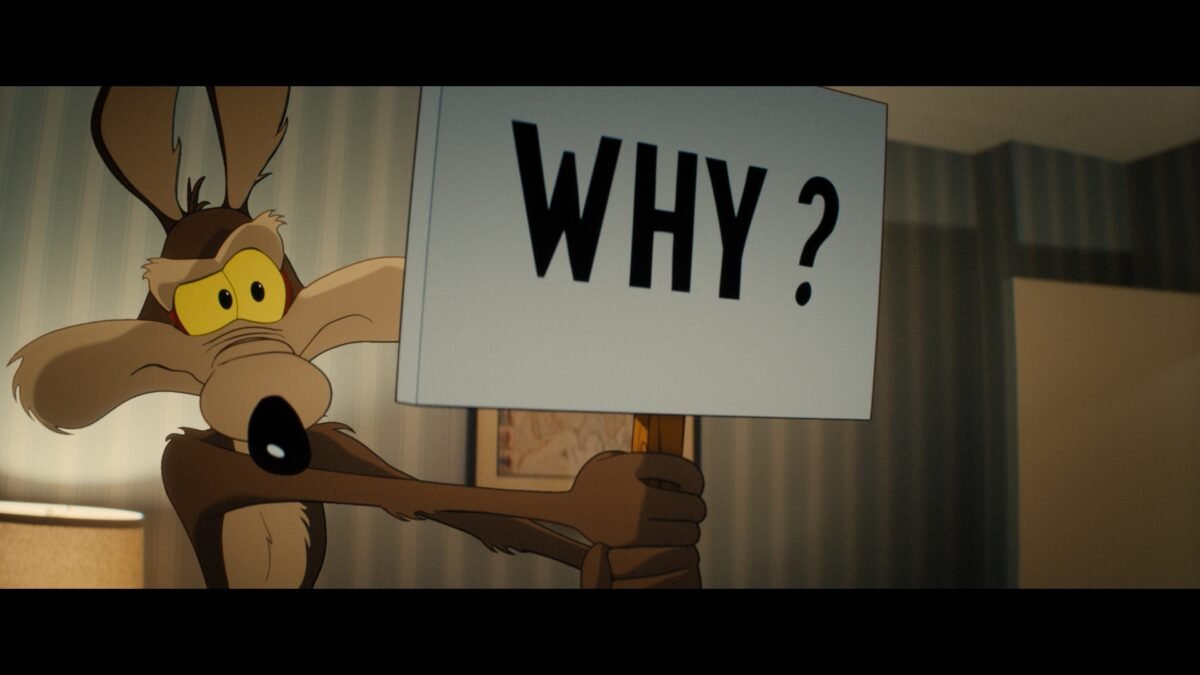
The fate of Coyote vs. Acme feels like something right out of Coyote vs. Acme: The film is about a corporation making shrewd business decisions without regard for feelings, and in 2023, Warner Bros. Discovery decided to shelve it in order to get a tax writeoff, breaking the hearts of director Dave Green, star Will Forte, and many more who worked on the film. (Green notes that three people who worked on the film were so invested in it that they got a Wile E. Coyote tattoos.)
The blowback to the shelving was fast and passionate. Many of Green’s filmmaker friends objected, as did fans, who took to the internet to demand that they get to see the film.
Warner Bros. eventually relented, agreeing to let the filmmakers shop the film, and it was soon picked up by Ketchup Entertainment, which will release it August 28th.
Coyote vs. Acme is based on a 1990 New Yorker article by Ian Frazier, written as a legal complaint in which frustrated plaintiff Wile E. Coyote details the many ways Acme products have backfired on him in his pursuit of a fellow Looney Tunes character, the Road Runner.
The film, written by Samy Burch (May December) from a story by Burch, Jeremy Slater and DC Studios co-chief James Gunn, brings the lawsuit to life. Forte plays Albuquerque attorney Will Forte (imagine Saul Goodman with morals and no ambition), who, with new hire Paige (Lana Condor) takes on Acme attorney Buddy Crane (John Cena) and his blowhard boss. Looney Tunes favorites pop up in imaginative ways, like the toons in one of the film’s influences, Who Framed Roger Rabbit.
We talked with Forte and Green about their delayed trip to theaters, the power of being nice, and their gratitude to Warners for finally doing the right thing.
Dave Green and Will Forte on the Emotional Roller Coaster of Coyote vs. Acme
MovieMaker: This film starts off with a joke at Warner Bros. expense that’s also in the trailer. Was that joke part of the film before the whole tax write-off stuff started?
Dave Green: Yeah, definitely. We got everyone at Warners’ permission to do that joke. I mean, Warners has a big history of kind of messing around and being playful with their logo. … I’m sure there’s a huge team of lawyers that had to look at it.
Will Forte: We didn’t realize how close to the phrase “art imitates life” we were at that moment.
MovieMaker: How disappointed were you — after they were cool about the little joke, and you’d made this movie poking fun at big corporations — that Warner Bros. then did something so very corporate, by taking the tax writeoff on your completed film?
Will Forte: Disappointed is just one of the many emotions, and they were all at 100. It was like everything peaked out. All the bad ones peaked out. There were no real good ones.
After I got to see it, there was pride in it, but that just kind of added to the frustration bucket. So it was like all the good ones made the bad ones even stronger. So yeah: really disheartened, disappointed, frustrated, angry — really angry for a while — and then just kind of confused, and I just tried to forget about it.
Dave Green: And I would say that Will’s anger was a nice medicine for me. He and so many of my friends, and then all these people online, really offered support in the community, speaking up for the movie. So it never felt like we were alone in this process.
Will Forte: We were trying to figure out a way to get them to still show the movie. One of the things that I had brought up was like, “What if we told them, why don’t we show the movie, like put it on YouTube, and you can donate all the money to charity? And then you can get maybe even more than whatever you’re making for your tax write-off in charitable contribution write-offs.” I was trying to push that for a while, but there was somebody that said that was not a viable alternative.
Dave Green:There was a long period of time where I would have been absolutely thrilled to have the movie available to watch on an airline. … So we’re completely thrilled and overjoyed that we’re in this moment where people can bring their families to watch it on the big screen.

MovieMaker: How hard is it to make a movie that works for kids and adults alike?
Dave Green:When I was a kid, I remember the feeling of adults talking down to me, and it feeling like the worst thing in the world. And I remember all the movies that I truly loved as a kid — from Raiders to Beetlejuice to Tim Burton’s Batman to Ghostbusters — were family movies, but they never pandered to kids, and they never talked down to kids. And I would say that that’s always my goal: to not pander.
And I think that’s also something that Looney Tunes has been really great at doing over the years. Looney Tunes was a lot of kids’ entry point to opera. Or you’d learn about what Casablanca is through Bugs Bunny being Humphrey Bogart.
Will Forte: When I first read it, I loved the script, but the one question mark was, this is either going to be a movie that appeals to absolutely no one — because it’s too adult for kids and too kids for adults — or it’s just going to appeal to everybody. And Dave did such an amazing job. While we were making it, it felt like, OK, we’re making the really good version of this movie.
And then when Dave went and did all the animation and everything in post, he just brought it to life in a way that made it even better than this already wonderful script. I’m so excited to bring my kids to it.
And the great thing that I always hear John Cena say is you don’t need to know Looney Tunes at all to enjoy this movie.
MovieMaker: You get a lot of emotion out of characters who don’t use any words. Is there an overall philosophy behind doing that, getting us to feel a strong connection with these animated characters who can’t talk?
Dave Green: Thank you so much. I’ve always been really interested in inanimate objects and movies and cartoons that explore the inner lives of characters that you might think are dormant, or don’t think or have an interior soul. Toy Story is one of my favorite movies ever, and that’s about an object that you look at and wouldn’t think has a soul.
So I love that challenge, and Samy Birch, the screenwriter, did too, of telling this story about Wile E. Coyote, who’s not a verbal character, but feels feelings very deeply… He’s really a silent film actor, if you think about it.
I learned a lot working with the storyboard artists and all the illustrators who really helped in pre-production to concept what Wile E. wanted from scene to scene.
It’s so much fun to also put a character like that next to an actor like Will, who’s so emotionally tapped into a scene and can really connect with objects and people and characters who aren’t there, but also make everything feel spontaneous and fresh.

Will Forte: You did such a great job — you really had me feeling for Wile E. at the end. I had no idea that you would bring me to tears through this.
Dave Green: Thank you, but that’s all you, honestly. Like if you’re not selling the plausibility that Wile E. is actually standing there, and bouncing off of you, then there is no movie.
Will Forte: Well, then I’ll throw it back at this entire crew. Because, wow. Every part of it, it’s just so beautiful.
Dave Green: We had a puppeteer named Dave Barclay who’s a true master, and worked with Jim Henson for years and years, and was a puppeteer for Jabba the Hutt. He had a life-sized puppet of Wile E., and so he would show Will the blocking in the first couple takes, and Will would rehearse scenes with that Wile E.
We’d do the first couple takes with the puppet, and then we’d strike the puppet, and Will would just track his eye line to where he remembered Wile E. to be.
MovieMaker: Will, you’re probably aware that you have a reputation for being very nice. The Lonely Island guys said in a recent episode of their podcast that you’re the person who will talk to someone’s grandmother for 15 minutes. Do you think that reputation is deserved? And also, does it kind of give your characters freedom to misbehave? Can you get away with more on screen, because audiences think of you as an actor being so nice?
Will Forte: First of all, that’s very nice of you to say. I mean, I always attempt to treat people with respect at work, and there’s nothing like going to work and just being around a bunch of nice people. Usually I just kind of give what I get and it seems like, on most sets, I’ve just been surrounded by amazing people. And Dave Green is one of the nicest people you will ever meet.
One of the things that is kind of fascinating to me is portraying characters who are flawed and maybe even damaged, and seeing how far you can push it and still have people be on your side. Obviously, MacGruber is that kind of character. And the character I play in Last Man on Earth, Phil/Tandy, same thing. We pushed it, and I feel like we maybe went a little too far, and then we pulled it back a little bit, and tried to find the right mix. That’s always the funnest, most fascinating thing.
Certainly, I have my moments where I’m a pain in the a–, and one of those moments comes from when you shelve my movie.
But I want to also come back to that and just say that for all the bad emotions, it also was the thing that led to this really positive, incredible emotion — how we’re ending it with the movie being saved by Ketchup. I had given up hope. So the elation that I felt was Spinal Tapped up to 11.
And I have to be thankful that Warner Brothers was willing to sell the movie to them.
Dave Green: Absolutely.
Will Forte: In a way, it might even be that this is the journey that this movie was supposed to take, and all the craziness that happened might raise our profile a little bit, and make people more aware that it’s out there.
Dave Green: Will’s intrinsic kindness makes it possible for you to fall in love with a lawyer who is a little bit lazy and who isn’t completely motivated, and it makes you want the best for him. I wouldn’t want to watch the movie about a lawyer who is fast-talking and skeezy and not lovable who’s paired with this coyote. I think the fact that we love Will for his kindness from the jump makes a world of difference.
Will Forte: By the way, when they say that I would talk to grandmas for 15 minutes? Grandmas are where it’s at. They have the most information. So, like, if you’re not talking to grandmas, you’re missing out.
Coyote vs. Acme arrives in theaters on August 28, from Ketchup Entertainment.



