
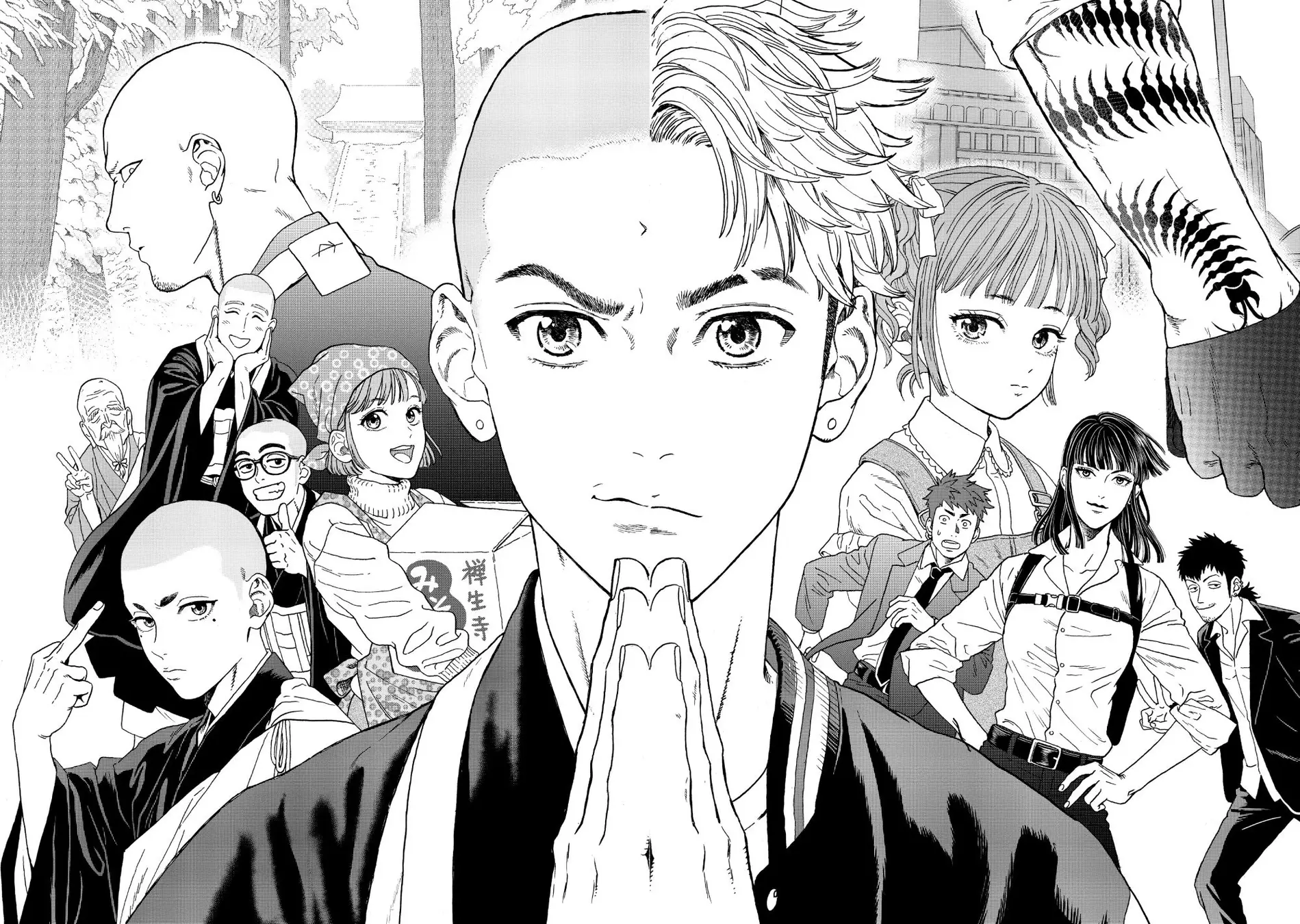
Gen Momoji is a fairly new mangaka, making their debut in 2018 with the historical seinen series “Heilang”. After years of hiatus, they return with a manga that blends action, drama, and comedy set in a Zen Buddhist temple with “Let’s Go, Nirvana!”.
Buy This Title
by clicking on the image below
The story follows Kazunobu Haramoto, a low-level yakuza member with dreams of rising through the ranks. However, when he accidentally witnesses the purge of his entire group, Kazunobu becomes the next target of a mysterious assassin. With the police unable to offer protection, he is forced to take an extreme step. He has to go into hiding in a Zen Buddhist temple. Using a new identity as a monk named Isshin, the gangster now has to follow an extremely strict routine on the path to enlightenment.
Despite the seemingly wild premise, this manga sheds light on the flaws in the Japanese justice system. Kazunobu is in danger at any moment, and has no choice but to hide due to the lack of a proper witness protection program. His decision to stay at a temple exposes another problem as well. Several times, the characters explicitly state that religious institutions are usually exempt from police investigations. In the story, it’s conveyed through Seinin, a senior monk who uses physical violence towards newcomers. His superior attitude serves as a reminder that whatever happens inside is above the law.
The manga’s skewed portrayal of Zen Buddhist monks still provides insights into the religion at play, even to those who might be unfamiliar. Kazunobu begins as completely clueless as well. Readers then get to learn about life at the temple alongside him, by showing various practices, rituals, and even values. This journey is also takes inspiration from gang manga, relying on heartfelt moments as the monks build bonds with one another. Furthermore, these arcs that focus on their friendship or sometimes, shared suffering, act as catalysts for important character growth.
Apart from the storytelling, Momoji’s art is another highlight. A lot of detail goes into drawing the historical Zenshoji temple. Readers get an immersive look into the inner workings of the historic building. The same can be said about the action and comedy scenes. The way expressions are drawn provides moments of light humour.
Furthermore, this second work also showcases Momoji’s skills in character design. Most are bald and wear traditional monk attire, making everyone look alike except for those who aren’t part of the temple. However, each of them has distinct physical features, even in a group that is supposed to be the most similar. For example, the appearances of the four new monks show their diverse backgrounds. As a gangster, Kazunobu has a small scar on his forehead. Meanwhile, Raian is taller than the rest, reflecting his foreign background.
Overall, “Let’s Go, Nirvana!” is a story about unexpectedly finding oneself in a dire situation. Told through a yakuza’s struggle to survive with a secret identity in a temple, it’s a captivating character-driven drama that pulls readers into the world of Zen Buddhism.



