
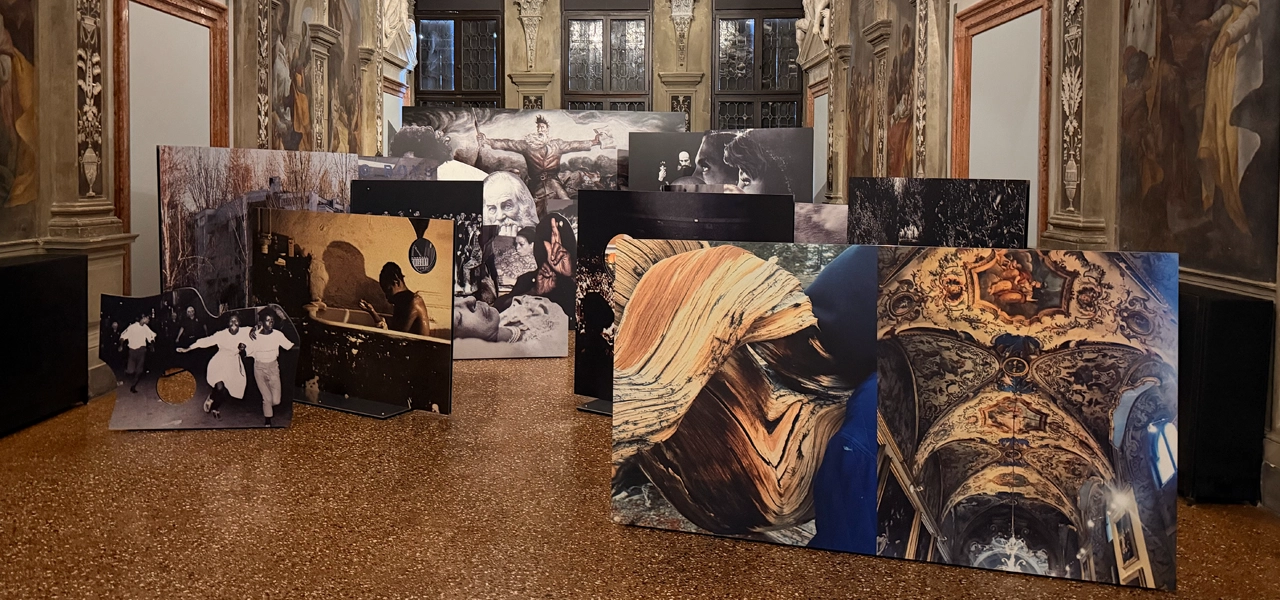
Helter Skelter begins with a culture that has seen itself reproduced too many times to trust its own reflection. Cowboys, celebrities, pornography, violence, pulp fiction, music, news footage, social media and advertising circulate through the work of Arthur Jafa and Richard Prince, carrying the residue of every previous use. At Fondazione Prada’s Ca’ Corner della Regina in Venice, curator Nancy Spector brings these two artists together for the first sustained examination of their affinities.
Jafa and Prince both take rather than invent. They work with images that already belong to public circulation, rerouting them through photography, video, painting, sculpture and installation. Marcel Duchamp provides an obvious precedent, and Spector openly places the readymade behind both practices. Yet appropriation quickly proves too broad a category to explain what happens here. Taking an image can operate as provocation, critique, desire, recovery, exploitation or reclamation. The identity of the person taking it changes everything.

Prince has spent decades testing the cultural fantasies that America manufactures for itself. His images frequently approach masculinity, sexuality, celebrity and rebellion through material already corrupted by commerce. He rarely resolves his own attraction to what he borrows. That uncertainty gives his work its persistence. The viewer remains caught between recognition and suspicion, aware that critique and fascination can occupy the same image.
Jafa brings a far more historically charged relationship to circulation. His work examines how Black life has entered visual culture through cinema, music, journalism, entertainment and repeated scenes of violence. He understands that visibility carries consequences. An image can record, exploit, memorialize and injure at once. Through selection and sequencing, he forces familiar material to retain the pressure of the histories that produced it.
Placed together, Prince and Jafa sharpen one another through incompatibility. Prince’s ambiguity becomes more exposed beside Jafa’s attention to racial history. Jafa’s handling of found imagery becomes even more specific when viewed beside Prince’s fascination with white American masculinity and its fantasies. Their methods overlap while their stakes remain distinctly unequal. That tension gives the exhibition its intelligence.
More than fifty works occupy the ground and first floors of Ca’ Corner della Regina, with thematic associations replacing a chronological division between the artists. Their works repeatedly enter one another’s orbit. Images converse through repetition, vulgarity, humor, aggression and desire. The curatorial structure encourages comparison while resisting any comfortable equivalence between their practices.
The title carries its own history of misuse. “Helter Skelter” began with a British amusement ride, entered popular language as a term for chaos, became a Beatles song in 1968, and was subsequently hijacked by Charles Manson for his racist fantasy of an apocalyptic war. The Museum of Contemporary Art in Los Angeles later used the phrase for its 1992 exhibition Helter Skelter, which excluded Black visual artists.
Reusing the title now turns the phrase into another appropriated object. Its accumulated meanings mirror the exhibition’s central concern: culture recycles language and images without preserving their original context. Every reuse leaves something behind and introduces another layer of contamination.
That history also prevents the exhibition from treating American darkness as seductive decoration. Jafa’s presence makes race impossible to reduce to atmosphere. Prince’s work keeps desire and complicity equally difficult to dismiss. Together they expose how easily violence, rebellion and transgression become consumer imagery in the United States.
The collaborative zine developed through images exchanged between Jafa and Prince extends this argument. Authorship becomes circulation again: one artist sends, another receives, and meaning changes with each transfer.
Helter Skelter refuses reconciliation. Jafa and Prince share an appetite for images that already carry trouble, yet they approach their material from radically different historical and cultural coordinates. Spector allows those differences to remain visible.
By the end, America appears as an archive that has lost control of itself. Its images circulate endlessly, carrying fantasies of freedom beside histories of racial violence, sexual desire beside commercial manipulation, humor beside cruelty. Jafa and Prince enter that archive as scavengers, selecting what they need and sending it back into circulation altered.
The unsettling question is what, after all that circulation, an image still remembers.



