
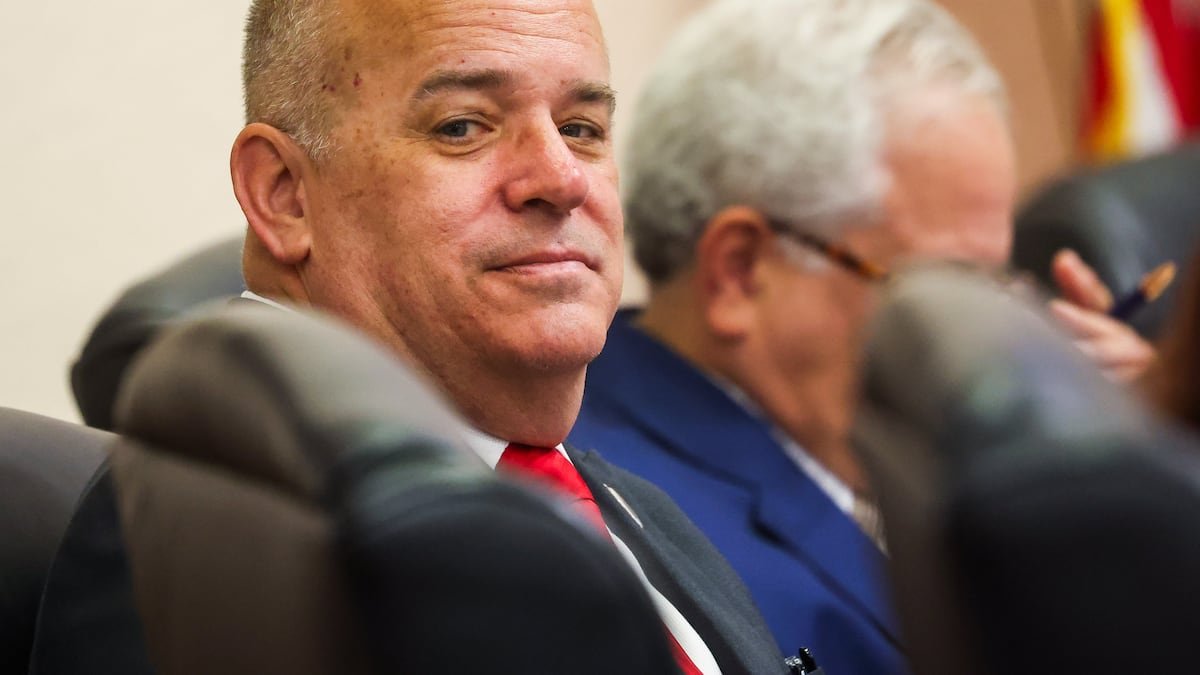
Days before city and county officials are expected to vote on a Tampa Bay Rays stadium deal, two Hillsborough County Commissioners who previously voted in favor cast doubt on the project.
Commissioners Chris Boles and Christine Miller questioned the city’s portion of the $2.3 billion deal, the structure of which has shifted since city and county officials approved a draft agreement in May.
Boles went as far as to say he will vote no on the deal, which could come before commissioners next week. “As it stands today, absolutely,” he said when asked by the Tampa Bay Times Thursday if he would vote against moving forward.
Their skepticism adds a layer of uncertainty to a stadium conversation that, in recent weeks, has centered on the city as council members debate terms and delay votes.
Boles raised questions about the terms in the weeks after approving the nonbinding agreement three months ago.
In June, he told the Times that Gov. Ron DeSantis’ proposed property tax amendment — which voters will decide in November — had “dramatically changed” the landscape in which the deal was being negotiated.
In an email to County Attorney Julia Mandell and County Administrator Bonnie Wise that month, Boles raised a series of questions about the amendment. The answers, he said, would “significantly influence whether I feel sufficient common ground exists to justify continued advancement of the proposal.”
But his objections extend beyond the possible property tax cuts.
On Thursday, Boles took issue with what he said is a lack of guaranteed revenue for the county and worried that the baseball team had not vowed to include sufficient assurances on its proposed mixed-use development surrounding the stadium.
Boles also expressed frustration with the team’s swift timeline for negotiations.
“How often do things turn out great when you rush?” he said, adding that he voted in favor of the draft agreement because he was open to continuing a conversation with the Rays and because the team faced a deadline to secure state funding.
Now, he said, he doesn’t understand the need to hurry.
“What’s the rush? They don’t want to share what the rush is,” Boles said of the Rays.
Miller, too, said she has questions about how negotiations have unfolded.
In an email to the Times Thursday afternoon, she challenged the city’s slice of the agreement. She called it the “Carlson deal” in reference to council member Bill Carlson, who in recent weeks has embraced the project and proposed a range of changes.
The draft agreement approved in May outlined a $180 million city contribution toward the cost of the stadium. The first $100 million would have come from Tampa’s Community Redevelopment Agency, with the other $80 million from the Community Investment Tax, Hillsborough’s half-cent sales tax that pays for roads, public buildings and upgrades to existing stadiums.
But in an interview with the Times on Thursday, Mayor Jane Castor shared updates on a new structure that would involve an $80 million city loan. The Rays would likely also take out a $100 million loan.
Both would be paid off with property tax revenues generated from the Rays’ proposed mixed-use development of restaurants, residences and retail surrounding the stadium.
It’s that development that Miller is worried about. The City Council, she said, late last month blocked a proposed land use amendment that would have changed how the stadium site can be developed. The update would have allowed for high-density commercial and residential development on the site at the Dale Mabry campus of Hillsborough College.
“I can’t in good conscience send another dime to this project until somebody shows me in writing that the city will approve the economic development piece,” Miller wrote. It is unclear if future city approval on the land use change would be enough to sway Miller’s vote.
In a phone call to the Times, Miller’s legislative aide, Casaundra Marion, said she believes the city could be asked to pay interest on the combined $180 million in loans. Miller wrote in her statement that the city could be on the hook for up to $380 million.
“The residents of the City of Tampa are our constituents as well,” Miller wrote. “I feel an obligation to protect them.”
Like Boles, Miller said she approved the nonbinding agreement in May to continue a conversation with the Rays. Ahead of that vote, she said, “Champa Bay was not built overnight. It was built because leaders were willing to step back, look at a bigger picture and invest their future for this community.”
On Thursday, she was displeased with the direction the conversation had taken.
“Right now, the details seem to change every time it suits one man’s run for mayor,” Miller wrote in reference to Carlson, who is running for the office in 2027.
He promptly replied on X.
“Too bad political fighting is more important than bringing the community together,” Carlson wrote. “It’s hard enough to build community consensus without the dirty politics.”



