
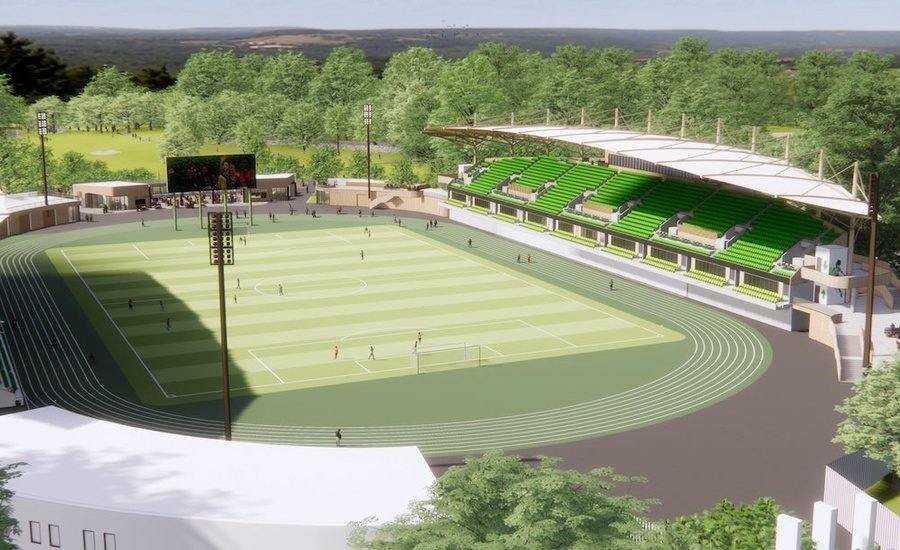
Massachusetts’ highest court ruled in favor of Boston Mayor Michelle Wu’s $325-million plan to transform a deteriorating stadium into a professional women’s soccer venue.
The lawsuit struck down by the Supreme Judicial Court on Aug. 19 sought to block a public-private renovation plan for the 11,000-seat stadium for Boston Legacy Football Club, the women’s soccer team, as well as for Boston public school athletes and community use. The stadium site is in Franklin Park—the centerpiece of Boston’s Emerald Necklace parks designed by landscape architect Frederick Law Olmsted.
While project demolition is complete, abatement and subsurface utility foundation work were ongoing in February, including upgraded power, water and telecommunications infrastructure set to finish this fall. Bond Building Construction Inc., the construction manager-at-risk for the city’s half of the project, has completed the below-grade utility relocation phase, Carolyn Campot, a Bond spokeswoman, told ENR in an email.
A spokesperson for Bond said it could not provide a construction update at this time.
With Boston taking center stage during the World Cup soccer matches, “we’ve seen the power of sport, the power of soccer,” said Wu at an Aug. 20 press conference in Franklin Park. “We are now poised to have the country’s best student athletic facility be the platform for us to keep that momentum going.”
Wu told the Boston Globe that the project is on budget and meeting planned construction milestones.
Court Ruling
While the groups that brought the suit argued that the project violates state law dictating public park land use, the court unanimously ruled that based on state legal decisions more than 75 years ago, the public charitable trust—the George Robert White Fund—does not limit the stadium parcel to park use. In 1950, the legislature designated it as “a school building and yard” to be repaired and maintained through the city’s school committee appropriations, it notes.
The ruling also ends a nearly three-year suit brought by the Emerald Necklace Conservancy, an environmental nonprofit, and city residents who live near the historic Franklin Park fought to halt the contentious project. They argue taxpayers should not have to foot the bill for a for-profit pro-soccer stadium and instead should build a more affordable public high school stadium that meets the needs of BPS students and their families.
In a statement, Jennifer Epstein, Boston Legacy FC controlling owner, called the ruling “a tremendous victory for Boston Public Schools students, the Franklin Park community, and the future of professional women’s soccer in Boston. The Court’s decision clears the way for completing the White Stadium renovation and delivering a world-class facility that will serve our community for generations and sets a national standard for youth athletics and professional women’s soccer.”
Opponents of the project criticized ballooning costs for the city’s portion of the project from an originally estimated $50 million to $91 million to $325 million pitched a $30 million alternative design, which includes a new track, field, student athletic training facilities and public amenities.
“We’re disappointed by this outcome, which means that a new professional for-profit sports stadium and entertainment complex in Franklin Park will not be subject to the high level of scrutiny, formal review of alternatives, and required approvals that our state’s constitutional public recreation land protection laws require.” Emerald Necklace Conservancy President Karen Mauney Brodek says in statement,
After decades of neglect, the stadium’s grandstand was crumbling, and locker rooms had no heat or running water. “Students were playing on a pitted field that was causing injury,” Wu recalls. “Our Boston kids deserve the very best and as a city, we can never apologize for fighting to give it to them.”
Students will have state-of-the-art indoor/outdoor athletic facilities, including a professional-grade grass field, a collegiate-level eight-lane track, and fully equipped strength and conditioning facilities, new locker rooms and study and community spaces, she says.
“We’ll have year-round youth sports programming and community events,” Wu adds. “Thanks to this one-of-a-kind partnership with Boston Legacy, our BPS students will access these world-class amenities in a publicly owned, publicly scheduled and controlled stadium at less than half the cost.”
Boston Legacy FC privately secured $190 million for renovations. Wu says Boston will also benefit from $252 million in privately funded community benefits over the next 15 years, “the largest community and public benefits deal in our city’s history,” she says.
Minority Ownership
Contracts awarded to local and minority-owned businesses working on the project total $54.2 million with an additional $11.8 million in contracts expected in future months. “Our primary focus must be ensuring local minatory and women-owned businesses have a fair shot,” says Miniard Culpepper, a Boston City Councilor whose district covers the stadium. Culpepper has also worked to secure funding for a pilot program focused on minority and women-owned business enterprise.
Crews began demolishing portions of the stadium in January 2025 in hopes of finishing the project in time for the National Women’s Soccer League 2026 season.
“Even with the legal proceedings, construction crews have been working on the stadium site six days a week,” Wu says.
Source: www.enr.com



